Magical Instruments and Vestments
In ceremonial magic four principle implements are employed: the Wand, the Cup, the Sword and the Pantacle. These implements are represented by the four suits of the Tarot, and what you have already learnt concerning the symbolism of those suits should prepare you to understand the further developments set forth in this lesson.
Eliphas Levi gives the following description of the magic wand, a description full of blinds, but one which contains many clues to the real significance of this implement:
“The magic rod, which must not be confused with the simple divining rod, nor with the fork of the necromancers, nor with the trident of Paracelsus, the true and absolute magic rod, must be a single and perfectly straight beam of the almond or hazel tree, but by a single blow with the magic pruning-knife, or golden sickle, before the sun rises, and at the moment when the tree is about to blossom. It must be longitudinally perforated without splitting or breaking it, and a needle of magnetized iron, occupying its whole length, must be introduced; then a polyhedral prism triangularly out (that is, a tetrahedron), must be fitted to one of its ends, and to the other a similar figure of black resin. In the middle of the rod must be placed two rings, one of red copper, the other of zinc; the rod must be gilt on the side of the resin, and silvered on the side of the prism up to the central rings, and it must be wrapped in silk to the extremities exclusively. On the copper ring must be engraved these characters ירושלים הקדשה = (596 + 414 = 1010), and on the zinc one המלך שלמה (=95 + 375 = 470). The consecration of the rod should last seven days, beginning at the new moon, and should be made by an initiate possessing the great Arcanum, and himself having a consecrated rod. This is the transmission of the magical priesthood, which has never ceased since the misty origin of the transcendent science. The rod and other instruments, but the rod above all, must be carefully hidden, and under no pretext should the magus permit it to be seen or touched by the profane; otherwise it will lose all its virtue. The manner of transmitting the rod is one of the secrets of science which it is never permitted to reveal. The length of the magic rod should not exceed that of the operator’s arm; the magician should never use it except when alone, and should not even handle it unnecessarily. Many ancient magi made it only the length of the forearm, and concealed it beneath their long mantles, showing the simple divining rod only in public, or some allegorical scepter made of ivory or ebony, according to the nature of their operations. The magic rod is the Verendum of the magis, he should not so much as refer to it in any clear and precise was; no one should boast of having it, and the secret of its consecration should be transmitted on condition of absolute confidence and discretion alone.” The Mysteries of Magic, p. 206 (Parentheses are ours.)

Even a cursory reading of this description ought to be sufficient to show that it is not intended to be taken literally. But the clues to the real meaning are abundant.
In the first place, the material of the wand is to be the wood either of the almond or hazel, and both these trees are symbolic of the power of Kether. The almond about to blossom refers to Kether itself. The hazel is especially attributed to the Moon, and so to the path of the letter Gimel, which proceeds from Kether. The rod must be a single, straight beam. It must be cut with a single blow. Note the emphasis on the idea of singleness or concentration.
In Hebrew the almond is שקד (=404), and the name refers to the earliness of its flowers and fruit. The derivation is from a verb spelt with the same letters, which means 1) to hasten away; 2) to be zealous, to be eager for or intent upon something; to attend carefully. These ideas, as you can see, are directly connected with Kether, because Kether is the first, or earliest of the Sephiroth, and because it therefore represents the first awakening of the Life-Power into activity at the dawn of the Cosmic Day.
By Gematria, שקד corresponds to קדש, sacred, (which is a transposition of the letters) and to דת, a law, edict or commandment. These words represent the outgoing affirmative quality of the primal Will of Kether. The last is particularly interesting because it combines the letters of Venus (D) and Saturn (Tv) and so indicates that the Law is an expression of the creative imagination (D) in activities leading to concrete, specialized results.
The alternative wood, hazel, is named לוז (=43), and this was the name of the place where Jacob is said to have had the dream of angels ascending and descending a ladder. לוז is also a verb whose primitive meaning is “to turn away, to deviate.” Later connotations include the idea of forwardness and perversity; and these have a bearing upon later meaning of the path of the letter Gimel. For that path is the path of the Moon, and it is the symbol of the departure of the energy from Kether on its way down to Tiphareth. This departure, descent, or involution is, as we have tried to make clear throughout these lessons, the cause of all limitations and “evils” on which account the feminine principle represented by the moon has always been designated in the books of the wise as the cause of the “Fall”.
Corresponding to לוז by Gematria are גדול, which means “great” in a wide variety of applications—great in mass or size (weighty, important); great in vehemence (violent); in dignity (authority); in eminence (distinguished). To a Qabalist, therefore, LVZ would suggest intense power and value, so that it is symbolically representative of the potency ascribed to the magic rod. Another word which corresponds to לוז by Gematria is חלה, Challah, which is interpreted by Qabalists as representing the Shekinah, or divine agency through which God rules the world. This Shekinah (which Qabalistic Rabbis call the cohabiting glory) is in every respect the same as what the Hindus call Shakti, the feminine power which is the Mulaprakriti and working principle in all things. חלה, as corresponding to this power and to לוז, represents the intermediary power between the Primal Will and its manifestations. That power, on the Tree of Life, is represented by the UNITING INTELLIGENCE of the 13th path, and to this path both the almond שקד and the hazel לוז are attributed. The magic rod, therefore, is to be made of a single beam of this UNITING INTELLIGENCE, that is to say, is to be fashioned from a single ray, or one particular specialized expression of the power which descends from Kether through the 13th path.
Notice, too, that all these words referring to hazel wood are represented by the number 43. They therefore direct our thought to something which combines growth and augmentation (3) with order and regulation (4). And the words which correspond to שקד, or 404 are designated by a number which shows the essential order (4) of the Limitless Light (0) expressing itself in the regulation of all things (4). These ideas, of course, are directly related to the notion of magic power expressed by the rod.
The prototype of the magical rod is described in the Bible as being of almond wood (Numbers 17). This was the rod of Aaron, the first High Priest of Israel, whose name means “enlightened or lofty”.
The needle of magnetized iron represents the Mars-force, or Rajasic energy of desire which must animate the volition of the magus.
The two prisms refer to the fire-power symbolized by the tetrahedron. One is of crystal, representing the transmission of light. The other, of black resin, represents the absorption of light.
The rings in the middle of the rod are of copper and zinc. The red copper ring refers to Venus, and the zinc refers to Jupiter. The gilt at one end of the rod is a symbol of the sun. The silver at the other end is a symbol of the moon.
The Hebrew letters on the copper ring may be translated “Jerusalem the Holy”. Note that their numeral value is a double 10. The letters on the ring of zinc may be translated “(The) King Solomon”, or “(The) King of Peace”. This name has the value of 470, which corresponds by Gematria to DVR DVRIM, a cycle of cycles, or eternity, so that we have here the essence of the idea which Levi expresses elsewhere when he says that a magician should work as if he had all eternity in which to complete his operation. The total value of these Hebrew letters is 1480, and this is the numeration of שבע שבתות, which is literally “Seven Sabbaths”. Seven periods of seven days are forty-nine days, and this number 49, which is the square of seven, and so related to the powers of Venus, is one with which we meet constantly in works devoted to practical occultism. Note that its reduct is 13, and its least number 4. The same results come from the reduction of 1480, so that the Qabalistic treatment of the letters on the wand bring us at last to the consideration of Unity and Love (both represented by 13) and finally to the idea of Order, symbolized by 4.
Hence, no sooner has Levi mentioned these letters, than he tells us the consecration of the wand should take seven days. He follows this by a reference to the moon as being important in connection with the consecration, and we have seen that the hazel and almond both refer to the path of the Moon. This, too, is the 13th path, and the reduction of the total value of the Hebrew letters on the wand gives the number 13.
Furthermore, the very word “rod” in Hebrew is מט =49. Consider, too, what its letters mean. There is M, corresponding to the Hanged Man in the Tarot, and Th, the symbol of Fohat and of its direction, as represented by Strength in the same book of symbolic wisdom.
It is said that “the length of the rod should not exceed that of the operator’s arm,” to indicate that the extent of the aspiration, or one-pointed purpose which it symbolizes should not be out of his reach. It is called the Verendum, a Latin word synonymous with lingam or phallus, but having special reference to secrecy or privacy, because the immediate source of the power of any magician is actually the nerve-force ordinarily expressed through the organs of reproduction.
We have been at some pains to indicate the clues to the real meaning of Levi’s description of the magic wand, because it is an excellent example of the way in which a writer well versed in symbolism can convey occult instruction for the initiated in terms which make apparent sense to the uninitiated.
What he is talking about is the magician’s central, dominant purpose—the one particular tendency of the Life Power which he has set himself to realize. And he gives priceless practical instruction when he says that it must be kept carefully hidden, so that the profane may never touch or see it.
For the true rod of miracles in the ONE AIM which you have set yourself to realize in life. Keep it concealed. Do not talk about it. Do not handle it unnecessarily, even when alone, says Levi. This means that the ONE AIM must be kept sacred, that it must not be the subject of too much thought, above all, never of light or doubtful thought. The times when you dwell upon it should be times set apart for the very best that is in you.
This emphasis on secrecy is not to be lightly passed by. None may become a magician who cannot keep his own counsel. Your true, innermost purpose must come to you as an intimation from the highest Self, from that indivisible principle of unity, seated in Kether, which is names IChIDH, Jechidah. That Self is the “initiate possessing the Great Arcanum,” and that Self already possesses a consecrated rod.
From that self alone may you learn the one high purpose for which you have entered into incarnation, and it is what happens when you receive this inner teaching that Levi means when he says, “The manner of transmitting the rod is one of the secrets of science which it is never permitted to reveal.”
Now, in ordinary ceremonial, no such elaborate preparations are required. One magician of our acquaintance uses a common black wand with ivory tips, such as may be bought at the shops which deal in supplies for stage conjurors. This form of wand is excellent from the point-of-view of symbolism. The ivory tips are symbols of the elephant-god of India, Ganesha, the god of wisdom. The black body of the wand represents the hidden force of the magical will, and the secrecy which the magician must maintain concerning his one aim. The contrast of colors, black and white, serves the same symbolic purpose as the more elaborate symbolism of the wand described by Levi. For white is the synthesis of all colors, and black is the absorption of every hue. Consequently every aspect of color-vibration is included in this combination of black and white, which, moreover represents the combination of Will (Kether) and Understanding (Binah) since Kether is white and Binah is black. For each magician, the wand must represent all these ideas, plus the special aim or purpose which he has come to realize as a result of listening to the Voice of his innermost Self.
Every time the wand is used in ceremonial, it must be employed to make some gesture or other indication of the power descending through the path of Gimel from Kether. Hence it must invariably remind the magus of the eternal self-direction of the Life-Power toward the production of beautiful results, inasmuch as the path of Gimel ends in Tiphareth. Hence, in making rituals, one must be careful that the wand is used in the right places, and to represent the correct ideas, for otherwise the ceremonial will be more or less confused, and the auto-suggestive value will be lessened.
The prototype of the magic cup is the silver cup used by Joseph for divination. It is primarily a symbol of receptivity, in contrast to the wand, which, as representing the lingam, corresponds to the letter YOD, the archetypal world, and to the powers of Kether and Chokmah. The cup represents the second letter of IHVH, and this letter is assigned to Binah.
It should be made of crystal (which costs too much for ordinary students) or of glass. The preferable material is black glass, but when this cannot be procured, an ordinary glass goblet may be painted black, inside and out, and then varnished with some water-resisting substance. We recommend having this done by somebody who understands all about paints and their application to glass.
The reason the cup should be black is that it is intended to symbolize Binah, the sphere of Saturn. This is one reason, rather. Another is that black is the best color for a magic mirror or divining crystal, and the cup is sometimes used for this purpose.
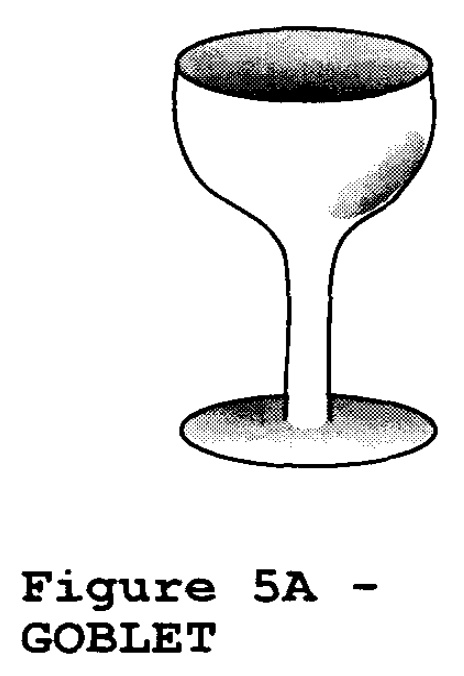
A goblet of the shape shown here, which is not very unusual, will serve perfectly, after it has been painted black, and the whole cost will be well within the means of the average student.
It is used to contain the water of purification used in ceremonial work, and, as said before, for the kind of divination commonly known as crystal-gazing.
Around its base, in Hebrew letters, should be written the words בינה, אלהים and אימא.
Because the cup corresponds to Binah, it is the particular symbol of intuition, and its use in ceremonials has always to take this into account.
It contains the water of purification, and this water is the symbol of the Astral Fluid, or universal substance. Thus, in a sense, the cup represents the Great Sea of undifferentiated substance whence all forms are generated. And as a cup gives a temporary form to the water which is poured into it (so that if the water be frozen it takes the shape of the cup) this implement of the magician typifies the formative power of Understanding, with which we make our personal contact through intuition.
The cup is a symbol of receptivity, and as such represents the descending current from Kether which traverses the 12th path of the letter Beth. Into the cup of Binah, moreover, are poured the currents of the Life-Force from Chokmah, through the path of Daleth, the 14th path. Hence the water in the cup represents the mingling of the Primal Will with the Life-Force, but that mingling, we must remember, is also a mixture of the qualities of Mercury and Venus. For the 12th path which leads from Kether to Binah is tinged with the quality of Mercury, and is symbolized in the Tarot by the Magician. Thus it represents the volition and attention of the self-consciousness. And the life-force חיה, Chaiah which comes to Binah through the path of Daleth, is tinged with the Venusian quality represented by the Empress, who is subconsciousness as the generatrix of mental images.
Our magical cup then holds the impulses of the Primal Will, expressed as self-conscious attention to the facts of self-experience, and as intelligent classification of those facts, mingled with the life-force proceeding from Universal Wisdom, and expressed as mental imagery proceeding from the principles of that Wisdom.
This combination is what is symbolized by the water in the cup, and all the lustrations and other applications of that water refer to the paths proceeding from Binah. The first of these is the 17th path of Zain, and the other is the 18th path of Cheth. The 17th path is completed in Tiphareth. The 18th is completed in Geburah. The 17th, because it corresponds to Gemini, ruled by Mercury, carries and elaborates an influence which has its origin in the 12th path. The 18th, because it corresponds to the sign Cancer, ruled by the Moon and the exaltation of Jupiter, is a path in which the powers of the subconsciousness, represented by the path of Daleth, predominate. In ceremonial uses of the water in the cup, to produce the most satisfactory results, every emblematic employment of the fluid must express ideas connected with one of other or these two paths.
The magical sword is thus described by Levi:
“The sword is less occult, and must be made in the following manner: - It must be of pure steel with a copper handle made in the form of a cross with three pommels, as it is represented in the Enchiridion of Leo III, or else with two crescents for guard. On the middle knot of the guard, which should be covered with a gold plate, the sign of the Macrocosm must be engraved on one side, and that of the Microcosm on the other. On the Pommel must be inscribed the Hebrew monogram of Michael, as it is seen in Agrippa; the characters באילים יהוה מי במכה (93+26+50+67 = 236) must be engraved on one side, and on the other the monogram of Constantine’s labarum with the following words, Vince in hoc, Deo duce, comite ferro. The consecration of the sword must take place on Sunday, in the hours of sunlight, under the invocation of Michael. The sword must be thrust into a fire of laurel and cypress wood; it must then be dried and polished with ashes of the sacred fire, moistened with the blood of the mole or serpent, these words being said: - Sis mihi gladius Michaelis, in virtute Elohim Sabaoth fugiant a te spiritus tenebrarum et reptilia terrae; it must then be perfumed with the perfumes of the Sun, and wrapped up in silk with branches of vervain1, which must be burned on the seventh day.”

The key to the understanding of this symbolic description is to be found in the fact that the sword is to be consecrated on Sunday, in the hours of sunlight, under the invocation of Michael. For Sunday, sunlight, and the Angel Michael all refer to the sixth Sephira, Tiphareth, to which Qabalists particularly assign the V or IHVH, and of this letter V, in this connection, the sword is the symbol.
Its steel blade represents Mars and the Sephirah Geburah. Its copper handle represents the Sephira which is the complement of Mars, namely, Netzach, sphere of Venus. The middle knot of the guard, with its gold plate, is the sixth Sephira, because gold is the metal corresponding to the sun. The sign of the Macrocosm is the six-pointed star or Hexagram, and the sign of the Microcosm is the five-pointed star, or Pentagram. They are combined in the sword, because this implement represents the personal (microcosmic) expression of universal (macrocosmic) powers. The Hebrew characters (which are printed with many typographical errors, here corrected, in Levi’s book) may be freely rendered “In the powers of IHVH how shall there be defeat?” The Latin motto means, “I conquer in this, with God my guide, my sword my companion.”
If you will study the diagram of the Tree of Life, you will see that from Kether to Tiphareth inclusive there are six Sephiroth. These are represented by the Hexagram, or seal of the Macrocosm. From Tiphareth to Malkuth inclusive there are five Sephiroth. These are represented by the pentagram, or seal of the Microcosm.
The successive numbers of the Hebrew words are also significant:
באילים = 93 = בני אל, Beni El, the sons of God; לבונה, frankincense, symbol of aspiration; מגן, a shield, used in Hebrew as emblem of God the Protector, and especially connected with the Hexagram, called מגן דוד, Mogun David or Shield of David; נחלה, possession, property, destiny, fate; and TzBA, a host, and army (of which the plural, צבאות, Tzabaoth, is used in the divine names assigned to Netzach and Hod).
יהוה = 26, and the other words given under that number are to be found in the Qabalistic dictionary. It emphasizes the powers of the Self-Existent One.
מי = 50, and this refers to the Gates of Understanding, to the squares of the Pythagorean Triangle, and to the various words having the same number given in the Qabalistic dictionary.
במכה = 67 = a number also given in the dictionary, which is particularly referred to בינה, Understanding and זין, sword, the name of the seventh letter.
236, the sum of all these names, is the number of the Rabbinical word קומץ, which Knorr von Rosenroth translates as Pagillus in his Kabbala Denudata. This word signifies the hand as a weapon, (as may be seen from the English word pugilist, derived from it). Rosenroth says it is YOD (the Hand), or Chokmah (because I of IHVH is assigned thereto), which may be resolved into five fingers, i.e., Binah, since to Binah is referred H (=5) and the fifty Gates. It therefore denotes the powers collected and hidden in the supernals prior to manifestation, whose extension (the opening of the fist) is effected in Binah.
This curious and characteristic bit of Qabalistic symbology is a clue to the Hebrew motto on the sword. The powers of the sword are primarily the powers of Chokmah, of the Father. And, as we have learned that Chokmah is the sphere of the zodiac, here is a hint that all the powers which are symbolized by the magical sword are really the vibrations of the cosmic light manifested through the zodiac. Of like import is the sign of the Hexagram on the pommel. What is meant is that all the activities of personality are really specializations of cosmic forces.
The Latin motto implies the same idea. Vince in hoc signes or ‘I conquer in this sign’ refers to the cruciform shape of the sword, which designates the letter Tau, the vibration of Saturn, and the crystallizing, specializing power of human activity. This, indeed, is the secret of our magical victories. We win them because in our theurgy, or god-working, we consciously wield and direct, not our own puny personal forces, but the infinite powers of the One Life.
We do so as conscious instruments of the Life-Power, and this is what is meant by Deo duce, ‘with God for my guide.’ Finally, the magical sword is our companion, our agency, our aid, and this is signified by “Comite ferro.”
Now, the V in יהוה refers to the Sephiroth from Chesed to Yesod inclusive, and thus symbolizes the powers of the personal consciousness. Chesed is the sphere of MEMORY, Geburah is the fiery Mars-force which we feel as WILL; Tiphareth is IMAGINATION; Netzach is DESIRE; Hod is INTELLECT; Yesod is the AUTOMATIC CONSCIOUSNESS, or the cell-consciousness of the animal organism. These powers, and the connecting activities, represented by the paths joining these Sephiroth, are what is represented by the magical sword. Careful study of the diagrams in Lesson 10 of Section A will help you to understand it better.
Nor should we forget that the magical sword, as corresponding to V of יהוה does, in a measure, represent the particular powers associated with Vau as a letter. To Vau the Sepher Yetzirah assigns the power of HEARING, so that it is the letter which particularly represents the subtle principle of Sound, or Akasha. To wield the magical sword is to make use of the potencies of sound-vibration – and this is the basic power in all production of forms.
Finally, we come to the Pantacle, represented in the Tarot by the suit of Coins, and so corresponding to the final Heh of IHVH, to the world named Assiah, to the element of Earth, and to Malkuth among the Sephiroth.
Tradition says it is a disk, made of beeswax, and engraved with the sigils and names relating to the particular magical operation to be performed. Thus, if the work be a work of light and wealth, under the patronage of the Sun, the pantacle will have the sigil of Michael, angel of the sun, will bear the magic square of 6 x 6, and the magical names belonging to the Tiphareth. It will be encased in a bag of orange silk, and the names upon it will be filled in with orange paint or with gold. For works of divination and mysteries, under the patronage of the Moon, the names and sigils will be those belonging to Yesod, sphere of the Moon, the magic square will be one of 9 x 9, and the writing will be in silver or blue. So for all the other works. Each is under the presidency of one of the planets, and the pantacle used must bear the magic square, sigils, and names corresponding to the Sephira which is the sphere of that planet, written in the corresponding color; and when not in use will be wrapped in a bag of the same color.
On the reverse side of the pantacle, written in the color which is complementary to that in which the sigils, names, etc. are written, should be a brief statement of the specific result which the operation is intended to accomplish. Thus, if the work be an undertaking which is under the presidency of the Sun, whose names and sigils are written in orange, the statement of the work to be done will be written in blue, the color complementary to orange. These names and sigils are first engraved on the surface of the wax with a stylus, and then filled in with the proper colors.
The material, beeswax, is particularly susceptible to impression by certain of the finer vibrations of the astral light. Its plasticity represents the amenability of the external world to control by mental imagery. As a product of the work of bees, it is of course a symbol of the results of industry, but there is a deeper meaning than this obvious one, which will be easier to grasp if we know the mythological significance of the bee.
Concerning this, the Neo-Platonist, Porphyry, writes:
“The Ancients, moreover, used to call the priestesses of Mother Earth Bees, in that they were initiates of the Terrence Goddess, and the Maid herself Bee-like. They also called the Moon the Bee, as Lady of Generation; and especially because (with the Magians) the Moon in exaltation is the Bull, and Bees are Ox-born—that is, souls coming into birth are Ox-born – and the ‘God who steals the Bull’ (Mithra) occultly signifies generation.”

The Moon, whose sphere is in Yesod, the Foundation or basis, is the subconscious plane of mind, and beeswax, as the product of the Bee or Moon, thus represents the sphere of the elements, Malkuth, which proceeds from the ninth Sephira. In other words, the use of beeswax for the pantacle is a symbolic reminder of the fact that the appearances of the external world are really differentiations or projections of subconsciousness in terms of time, space, name and form. The things which make up our environment are emanations of the subconsciousness. Their very substance is the subconsciousness. And he who is master of his mental imagery is able to make his environment what he will by reason of his power to express patterns upon this universal subconscious plane of being through the channel thereto provided by his personal subconscious mind.
In addition to the four implements, ceremonial work requires incense, fire, and for some rituals, consecrated oil. The incense is of various sorts. Each kind has its particular correspondence to one of the planets.
For works of the Sun, the principle ingredients are clibanum (frankincense) and cinnamon. For works of the Moon, camphor and aloes. For works of Mars, pepper, dragon’s blood, and like hot, pungent odors. For works of Mercury, mastic, white sandal, mace and storax. For works of Jupiter, cedar and saffron. For works of Venus, rose, red sandal, and the leaves of myrtle. For works of Saturn myrrh (and in evil magic) assafetida and sulphur.
The base of the oil is pure olive oil (representing the order and measurement of the sphere of Jupiter). With it are combined liquid storax, (for Mercury), camphor (for the Moon) and benzoin (for Venus). Since this course of lessons is concerned principally with the theory of ceremonial, the exact proportions of the elements used in the incense and oil are not here given.
The ashes of the incense are mixed with salt, and are mingled with the water of purification. Rituals of magic include formulae for the consecration of the ash and salt, and for the consecration of the water into which they are cast. The ash represents the material element in aspiration, which is symbolized by the incense. The salt is a symbol of preservation. These are mingled and cast into the water to represent the nucleus of the Tmasic quality around which are crystallized the material results of the magical work.
The magical fire may be a small red lamp, such as is used on altars in the Roman church, containing a large wax candle. It is used for lighting the charcoal on which the incense is cast. From it, also, are lit all the fires or lights which may be required in certain ceremonials; and it serves, too, for the ceremonial purification of the blade of the magic sword, before it is used in making the signs of the Pentagram or Hexagram. This fire represents the cosmic fire, as the ash and salt represent earth, the incense (in process of combustion) air, and the oil one aspect of the watery element.
We have left the description of the magical vestments to the last, not because it is unimportant, but because in this elementary study of the subject, it would be futile to enter into detailed descriptions.
Some writers are of the opinion that the vestments should include an outer robe and an inner robe, a girdle in the form of a serpent, an apron similar to those worn by Free Masons, and a crown. Others substitute a hood or cap for the crown. Others say that the two robes and a silken girdle are sufficient.
The inner robe should be of woolen stuff, and its color black. Thus by color it represents the primal Night which to uninitiated eyes appears to be night but which every seer who has experienced superconsciousness declares to be a radiance surpassing any light we see on earth. It is darkness to our eyes and intellects, but it is also the Primordial Glory, wherein all lesser lights are swallowed up. Thus the black inner robe is often called “The Robe of Glory”. It symbolizes AIN SVP AVR, the Limitless Light.
The outer robe may be of a color appropriate to the specific work—orange for works of the Sun, Blue for operations under the dominance of the Moon, Scarlet for works of Mars, Yellow for those of Mercury, Violet for those under the influence of Jupiter, Green for those of Venus, and deep Indigo for the works of Saturn. When these colored outer robes are used, the silken girdle should be of the complementary color. (Color complements are those which are opposite each other in the color-chart.)
But we may simplify matters by using only a white robe, inasmuch as white is the balance or equilibrium of all colors. With this will be worn a girdle of yellow silk, symbolizing the restrictive power of the intellectual selfconsciousness, under the rulership of Mercury.
The black inner robe may be cut like the outer one, or hereafter described, or it may be a cassock such as is worn by priests. Its cut is unimportant, because it is the symbol of the formless Light.
The outer robe, which is called the Robe of Concealment because it is either of a specific color, or else of white linen or silk representing all colors, (we say because on account of the derivation of the word “color,” from the Latin celare, to conceal), is cut so as to represent one form of the Tau-cross, thus:
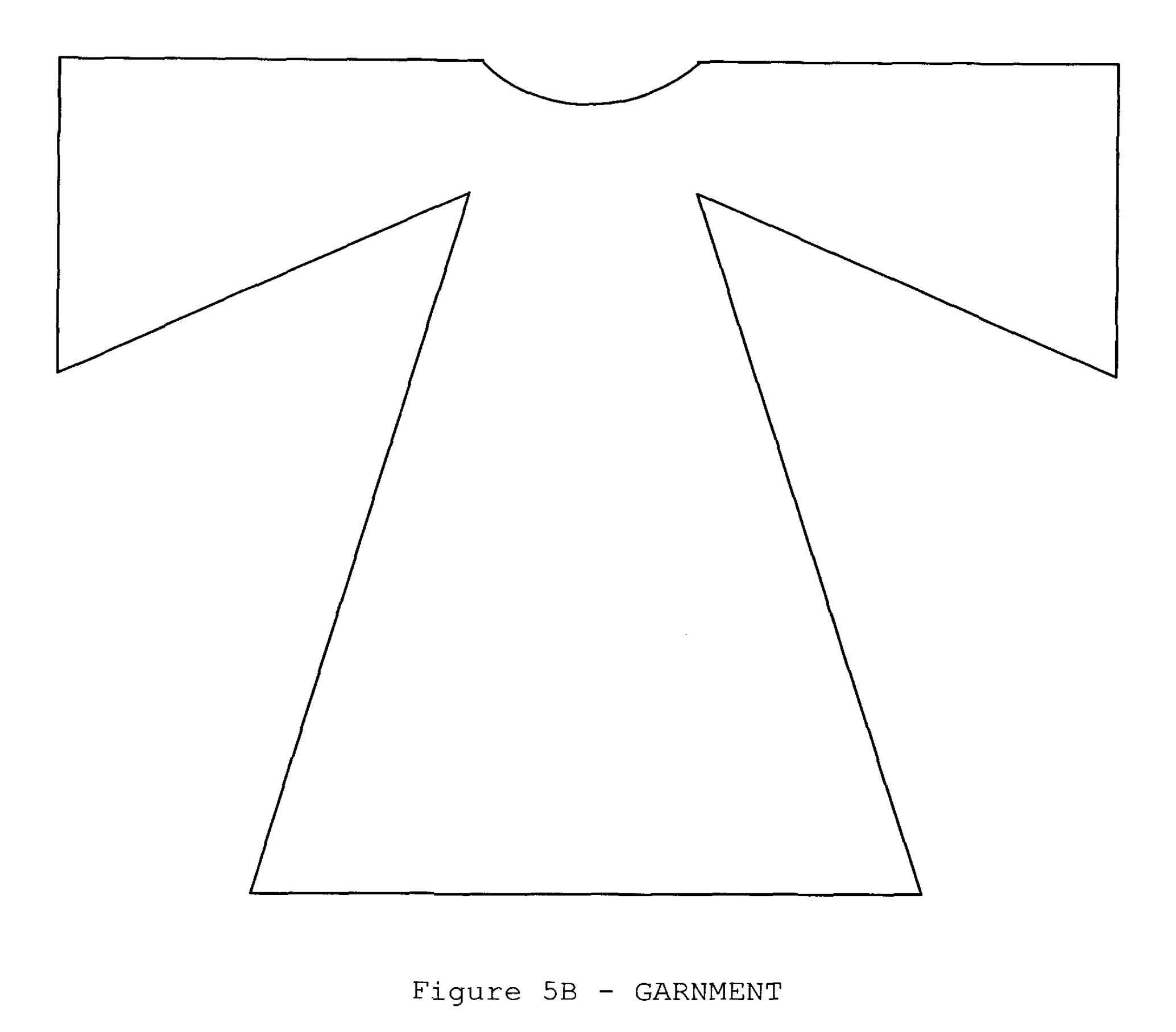
The shape of this garment refers to the letter Tau, and to the 32rd path on the Tree of Life. The name of that path, Administrative or Assisting Intelligence, describes the magical consciousness, because a magician is one who by his knowledge of the hidden laws of the Life-Power’s self-expression, takes a conscious active part in the administration of those laws. Tau also refers to Saturn, and so represents the force of crystallization which is at work in all practical applications of occult law.
Embroidered upon the breast of the outer robe, or hung by a white cord from his neck, the magician also wears a lamen, or symbolical summary of his understanding of the cosmos. Some use a simple crucifix—which is a perfect symbol if only it be understood, but worse than useless if it be worn without a real knowledge of its meaning. Others wear some variation of the Rose and Cross. Yet others find it best to devise their own lamen, and many enclose it in a vesica piscis. Such a lamen is pictured in a little book on magic which is meat for those who can digest it, entitled, Book Four, Part 2. We prefer the lamens which are the result of the magician’s own ingenuity. The simpler they are, as a rule, the better.
Here ends our first instruction on the implements and vestments of the magus.
Footnotes
-
Ed note: also called Verbena. ↩