Fire
Alchemy is a philosophy of fire, a science of fire, and an art which consists mainly in the direction of fire. By Qabalah and Tarot we may unlock the secret meaning of alchemical writings and symbols, but we cannot use the keys until we have examined the locks. We shall begin this lesson, therefore, with quotations from the alchemists concerning the element of fire.
Paracelsus says: “First and chiefly, the principal subject of this Art is fire, which always exists in one and the same property and mode of operation, nor can it receive its life from anything else. It possesses, therefore, a state and power, common to all fires which lie hid in secret, of vivifying. The fire in the furnace may be compared to the sun. It heats the furnace and the vessels, just as the sun heats the vast universe. For as nothing can be produced in the world without the sun, so also in this Art nothing can be produced without this simple fire. No operation can be completed without it. It is the Great Arcanum of Art, embracing all things which are comprised therein; neither can it be comprehended in anything else. It abides by itself, and needs nothing; but all others which stand in need of this can get fruition of it and have life from it. Know, then, that the ultimate and also the primal matter of everything is fire. This is, as it were, the key that unlocks the chest. It is this which makes manifest whatever is hidden in anything.
“By the element of fire all that is imperfect is destroyed and taken away, as for instance, the five metals, Mercury, Jupiter, Mars, Venus, and Saturn. On the other hand, the perfect metals, Sol and Luna, are not consumed in that same fire. They remain in the fire and at the same time, out of the other imperfect ones which are destroyed, they assume their own body and become visible to the eyes. For fire tests everything, and when the impure matter is separated the three pure substances are displayed. Fire separates that which is constant or fixed from that which is fugitive or volatile. Fire is the father or active principle of separation. Whatsoever pertains to separation belongs to the science of Alchemy. It teaches how to extract, coagulate, and separate every substance in its peculiar vessel. Fire contains within itself the whole of Alchemy by its native power to tinge, graduate, and fix, which is, as it were, born with it and impressed upon it.”
Nundinus writes: “The fire which includes all our chemical processes is threefold: the fiery element of the air, of water, and of earth. This is all our magistery requires.” Bondinus declares: “Our Stone is fire, and has been generated in fire, without, however, being consumed by fire.” According to Medales, “The fire of the sages may be extracted from all things, and is called the Quintessence. It is of earth, water, air, and fire.”
Basil Valentine hides the secret in plain sight, thus: “Our fire is a common fire, and our furnace is a common furnace. The fire of a spirit-lamp is useless for our purpose, nor is there any profit in horse-dung, nor in the other kinds of heat in the providing of which so much expense is incurred. Neither do we want many kinds of furnaces. Only our threefold furnace affords facilities for properly regulating the heat of the fire. Our furnace is cheap, our fire is cheap, and our material is cheap. He who has the material will also find a furnace in which to prepare it, just as he who has flour will not be at a loss for an oven in which it may be baked.”
Thomas Vaughan writes: “Fire, notwithstanding the diversities of it in this sublunary kitchen of the elements, is but one thing from one root. The effects of it are various, according to the distance and nature of the subject wherein it resides, for that makes it vital or violent. It sleeps in most things – as in flints, where it is silent and invisible. It is a kind of perdue, lies close like a spider in the cabinet of his web, to surprise all that comes within his lines. He never appears without his prey in his foot; where he finds aught that’s combustible, there he discovers himself, for – if we speak properly — he is not generated but manifested. There is nothing in the world generated without fire. This fire is at the root and about the root – I mean about the centre – of all things, both visible and invisible. It is in water, earth and air; it is in minerals, herbs, and beasts; it is in men, stars, and angels; but originally it is in God Himself, for He is the fountain of heat and fire, and from Him it is derived to the rest of the creatures in a certain stream or sunshine. Now, the magicians afford us but two notions whereby we may know their fire: it is, as they describe it, moist and invisible. Hence have they called it the horse’s belly and horse-dung; but this is only by way of analogy, for there is in horse-dung a moist heat but no fire that is visible. Now then, let us compare the common Vulcan with this philosophical Vesta, that we may see wherein they are different. First of all then, the philosopher’s fire is moist, and truly so is that of the kitchen too. We see that flames contract and extend themselves, now they are short, now they are long, which cannot be without moisture to maintain the flux and continuity of their parts. But the common fire is excessively hot, but moist in a far inferior degree, and therefore destructive, for it preys on the moisture of other things. On the contrary, the warmth and moisture of the magical agent are equal; the one temperates and satisfies the other: it is a humid, tepid fire, or, as we commonly express ourselves, blood-warm. This is their first and greatest difference in relation to our desired effect; we will now consider their second. The kitchen fire, as we all know, is visible; but the philosopher’s fire is invisible and therefore no kitchen fire. This Almadir expressly tells us in these words: ‘Our work,’ saith he, ‘can be performed by nothing but by the invisible beams of our fire.’ And again, ‘Our fire is a corrosive fire, which brings a cloud about our glass or vessel, in which cloud the beams of our fire are hidden.’ To be short, the philosophers call this agent their bath, because it is moist, as baths are; but in very truth is no kind of bath, neither of the sea nor of dew, but a most subtle fire and purely natural, but the excitation of it is artificial.” (Condensed from Lumen de Lumine).
Boehme says: ‘When life and movement appears, which previously existed not, a principle is present. Fire is a principle with its property, and light is also a principle with its property, for it is generated from fire, and yet is not the fire’s property. It has also its own life in itself, but fire is cause thereof. All sense, and whatever is to come to anything, must have fire. There springs nothing out of the earth without the essence of fire. It is a cause of all the three principles, and of all that can be named.”
Many alchemical works quote from the Chaldean Oracles, a collection of Neo-Platonic fragments often attributed to Zoroaster, who probably had nothing to do with their composition. Their substance is practically the same as the teaching of Porphyry, in whose writings, there is the following:
“There is above the Celestial Lights an Incorruptible Flame always sparkling; the spring of life, the formation of all beings, the original of all things. This Flame produceth all things, and nothing perisheth but what it consumeth. It maketh itself known by itself. This Fire cannot be contained in any place; it is without body and without matter. It encompasseth the heavens.
“The heart should not fear to approach this adorable Fire, or to be touched by it; it will never be consumed by this sweet Fire, whose mild and tranquil heat maketh the binding, the harmony, and the duration of the world. Nothing subsisteth but by this Fire, which is God Himself. All is full of God, and God is in all.”

This universal fire of the alchemists is the same as the Agni or Tejas of Hindu Philosophy. Hindu Scriptures declare that Agni is the supreme deity, and attribute to him the powers of all the other gods of the pantheon. They represent him as a young ram, carrying a notched banner, inscribed with a swastika. This is precisely what is shown on the medals used by the Roman Church to represent Christ as the Lamb of God, or Agnus Dei. The only difference is that instead of the swastika, the banner bears a cross of equal arms. (See illustration, Agnus Dei, in Webster’s New International Dictionary).
In our interpretation of the Rosicrucian pamphlets, Fama Fraternitatis and Confessio Fraternitatis, we have shown how this peculiar symbolism of the young ram, or lamb, is employed to indicate the true nature of the Founder of the Rosicrucian Order, “Our Brother and Father, C. R.” He represents the spiritual source of the higher consciousness attained in the alchemical Great Work, or by the practice of Yoga. He is what the Book of Tokens calls, “The circle of eternal flame, self-fed,” and he is also a representation of the true alchemical fire.
Thus the quotation from Paracelsus tells us that the secret fire of the alchemists is the very life of the alchemical Art itself, and goes on to say that this hidden fire possesses the power of vivifying. The furnace he mentions is the athanor, which we have explained as being the human organism, itself produced from the ‘Essence of Fire,’ (ATh HNVR, Ath Ha-Nour). Observe, too, that he calls it a “simple” fire, meaning thereby that it is one without a second, a fire unmixed with anything whatsoever. The rest of the first paragraph from his writings is almost a paraphrase of the quotation from Porphyry. It plainly indicates that the secret fire is by no means to be confused with that which is manifest in ordinary combustion.
His remarks about the effect of fire on metals are to be understood as referring to the secret metals, or centers in the nervous system. Note that Sol and Luna, or Gold and Silver, are not destroyed by the secret fire. In the alchemical operation, the powers of all the other centers are transmuted into the powers of the “Sun” and “Moon.” But here let it be remembered that the other centers are not destroyed. Their essential activities are raised, or sublimated, so that they all contribute to the perfect manifestation of the alchemical Gold, or spiritual illumination.
Nundinus and Medales identify the secret fire of alchemy with the Stone and with the Quintessence. The Stone, ABN, Ehben, is by Qabalah the same as the Sun, or Gold, ChMH, Khammaw. The Quintessence is the same as the Akasha of the Hindus and the Aether of the Greeks.
Basil Valentine, as I have said, hides the secret in plain sight, by the use of the adjective “common.” Uninstructed readers would suppose from this that he meant ordinary fire. The real thought is this: The philosophical fire is a fire common to all things, a fire shared by all. So also is the alchemical furnace a common possession. Everybody has the fire and the furnace, and those who waste their time and substance in looking outside themselves for these things betray their ignorance of the alchemical doctrine. The furnace is threefold, according to the esoteric division of the human personality into Body or alchemical Salt, Soul or alchemical Sulphur, and Spirit or alchemical Mercury.
Thomas Vaughan develops Valentine’s doctrine that the fire is a common fire in several examples. He is careful to say, “He is not generated but manifested.” This, of course, is common knowledge today. We do not generate any of the forces that modern invention utilizes in so many wonderful ways. We simply provide suitable conditions for the manifestation of those forces. Vaughan, furthermore, is confirmed by present-day science when he declares that the secret fire “is in water, earth and air; in minerals, herbs and beasts; in men, stars and angels.” Recently some of the most important figures in the scientific world have also shown a disposition to agree also that this fire is, as Vaughan says “originally in God Himself.” It will be no new thing to readers familiar with other publications of the School of Ageless Wisdom to think of this magical agent as an influx of power which may properly be called “a certain stream or sunshine.” Without any metaphor whatever, the alchemical fire is the essence of the radiant energy of the sun, and this also is the substance of all things whatsoever.
It is moist, or like water, because it flows in streams, forms itself into whirlpools, collects like water in suitable reservoirs, has currents which may be charged almost as definitely as those of the sea, and forms itself into waves. At the same time, in itself it is invisible. We see its effects, but the energy itself remains hidden from us.
Vaughan’s second quotation from Almadir deserves comment, the fire is said to be corrosive because it does actually “eat away by degrees.” The glass or vessel is the auric egg. The cloud is the Physical body, which, according to certain esoteric doctrines is formed inside the auric egg by the action of the vital fire. This body is the veil which hides the beams of the secret fire.
The Hebrew word for fire is ASh, Ash. The same letters, with different vowel points, form the word ASh, Ish, signifying entity. They are also the letters which spell the Aramaic noun ASh, Osh, a foundation. To the first letter, Aleph, the Ox, Qabalists attribute Ruach, the Life-Breath, and this undifferentiated Life-Breath they call “Fiery or Scintillating Intelligence.” The second letter is Shin, the Tooth, which is itself the letter of Fire, and the sign of tho “Perpetual Intelligence.” Furthermore, in Qabalah Shin is called the “Holy Letter” because its number, 300, is also the number of the words RVCh ALHIM, Ruach Elohim, Life-Breath of the Creative Powers. Thus the two Hebrew letters which represent their noun for fire and both symbol for a fiery power, and symbols also of the Life-breath. They are likewise the first and last of the three “mother letters.”
The alchemist’s fire actually is Ruach, the all-pervading Life-Breath. Its primary manifestation is shown in Tarot as the Fool, which represents the Life-Breath as about to descend into the abyss of manifestation. This is true even in those ancient versions of this Key, which show a man about to fall into the open mouth of a crocodile. For the crocodile represents the lower nature, typified in our version of the Key by the depth which opens at the feet of the Fool. The fire of the alchemist, when it has entered into the abyss of manifestation, passes through all the transformations typified by the numbered Keys of Tarot following the Zero card, until it completes the circle of its activities in the resurrection typified by Key 20, attributed to the letter Shin.
The scene pictured in Key 20 is the anastasis, or ‘rising again,’ usually called ‘resurrection’ in the New Testament. Here we should be careful to remember that this is an esoteric term, especially in the four Gospels. There is reason to believe that it was misunderstood almost from the beginning of the public teaching of the Gnostic doctrine veiled in the exoteric letter of Christianity. In that doctrine the “dead” are those who are caught in the world’s illusion, “dead in trespasses and sins.” This point is made very clear by Ouspensky in his recent book, A New Model of the Universe. He says:
‘In St. John’s Gospel the idea of ‘new birth’ is introduced in explanation of the principles of esotericism.
Except a man be born again, he cannot see the kingdom of God. (John 3. 3).
‘Then follows the idea of resurrection, resuscitation. Life without the idea of esotericism is regarded as death.
For as the Father raiseth up the dead, and quickeneth them; even so the Son quickeneth whom he will (John 5. 21)
Verily, verily, I say unto you, The hour is coming, and now is, when the dead shall hear the voice of the Son of God: and they that hear shall live… Marvel not at this: for the hour is coming, in the which all that are in the graves shall hear his voice (John 5. 25, 28).
Verily, verily, I say unto you, If a man shall keep my saying, he shall never see death (John 8. 51).
These last passages are certainly interpreted wrongly in existing pseudo-Christian teachings.
“Those that are in the graves” does not mean dead people who are buried in the earth, but, on the contrary, those who are living in the ordinary sense, but dead from the point of view of esotericism.
“The comparison of people with sepulchres or graves is met with several times in St. Matthew and St. Luke:
Woe unto you, scribes and Pharisees, hypocrites! for ye are like unto whited sepulchres, which indeed appear beautiful outward, but are within full of dead mens’ bones, and of all uncleanness (Matt. 23. 27).
Woe unto you, scribes and Pharisees, hypocrites! for ye are as graves which appear not, and the men that walk over them are not aware of them (Luke 11. 44).
‘The same idea is developed further in Revelations. Esotericism gives life. In the esoteric circle there is no death.” (page 181, New Model of the Universe).

Now, the word anastasis, according to the Greek values of letters, is equivalent in number to the word techne, art, craft, skill, whence we derive our English word technic. The ‘rising again’ is NOT a natural process. Thus Vaughan says that the magical agent is “a subtle fire and purely natural, but the excitation of it is artificial.’ The same idea recurs again and again in esoteric writing. We are told that there is a force tremendously powerful, but man must direct it. Eliphas Levi goes so far as to say it is the burning body of the Holy Ghost. Yet he says also that it is the devil of exoteric dogmatism, and the blind force which souls must conquer, if they would be freed from the chains of earth.
In other words, the alchemical fire must be first of all known, and then controlled. It will not, as many have imagined, change the present human race into supermen by any process of natural evolution. We may look forward to a day when the earth is governed and inhabited by none but Masters of Wisdom, but when that day comes, it will be because men and women have themselves taken in hand the direction of the alchemical fire. Not without reason is this work called The Great Art.
The Aramaic word for fire is NVR, Noor. This is the word which we have already noticed in connection with ATh H-NVR, Ath Ha-Noor, athanor. It also appears in the word MNVRH, Menorah, a candlestick, which is the same by numeration (301) as ASh, Ash, fire. NVR by its letters gives further indications as to the nature of the secret fire.
The first letter is Nun, to which the sign Scorpio, governing the organs of sex, is attributed in Qabalah. The second letter is Vau, to which is attributed the sign complementary and opposite to Scorpio, the sign Taurus, ruling the throat. The third letter is Resh, to which the Sun is attributed.
Now, in Scorpio Mars is the ruling planet, and Uranus (the Fool in Tarot) is exalted in that sign. In Taurus, Venus is the ruling planet, and the Moon is exalted, these two being represented in Tarot by the Empress and the High Priestess respectively. The Sun, symbolized by Key 19, is the ruler of the heart and spinal cord, through the heart center and the sign Leo, and is exalted in the sign Aries, ruled by Mars, governing the head and brain.
Thus in the one word NVR a Qabalist would find references to the Sun, Moon, Venus and Mars, and to the bodily areas of the brain, throat and ears, heart and spinal cord, and organs of sex. The corresponding Tarot Keys are 19 (Sun center), 2 (Moon center), 3 (throat center), 16 (Mars center), 4 (head and brain), 5 (throat and ears), 8 (heart and spinal cord), 13 (sex organs).
These are valuable clues. For in the actual Hermetic practice, the centers and areas just named are of primary importance. The secret fire of the philosophers is, as Valentine asserts, a common fire, present everywhere, and available to all men. It is also the essential vital principle in all forms of manifestation whatsoever. At the same time, it has certain special types of manifestation which are the ones the alchemist employs in the technical operations of the Great Art. These are the forms of the secret fire which are at work in the parts of the human body indicated by our analysis of the word NVR.
Hence alchemy must remain today, as it has in the past, more or less a secret doctrine. A full, detailed explanation of certain facts about the secret fire cannot be made, even if one desired to make it, without incurring severe penalties. Greater freedom in the explanation and discussion of the facts of sex is possible than heretofore, but there still exist legal restrictions to plain speaking, and every effort to change these restrictions is met with vigorous opposition from the organized, influential powers to whose interest it is to maintain popular ignorance.
Let it be said once more, however, that the alchemical process is not concerned with any sort of jugglery with the sex-function. Our inability to discuss the matter freely arises from the fact that neither the physiology nor psychology of that function may be accurately described or defined in any work intended, as this is, for general circulation.
As to the practice, even though there were no restrictions such as we have just mentioned, only the most general indications can be given. Consider only the centers and organs involved. They are the most delicate, and the most important in the human organism. It is extremely dangerous to try any tricks with them. Even under the personal guidance of a competent instructor, who knows every detail of the alchemical process, there is some degree of danger. Without such guidance a rash experimenter runs very real and very terrible risks.
For the secret fire is indeed a corrosive flame, and when it is intensified by the practical operations of the Great Art, it is more than strong enough to destroy like lightning, unless proper precautions be taken.
In Tarot, fire is represented primarily by the letter Shin and Key 20. This Key gives the most direct intimations concerning the nature and use of the secret fire. Three other Keys are also connected with fire, because they represent the three fiery signs of the zodiac, Aries, Leo, and Sagittarius. The corresponding Keys are 4, The Emperor; 8, Strength; and 14, Temperance.
Key 20, Judgment, illustrates the threefold manifestation of the One Fire, mentioned in the quotation from Nundinus, by the symbolism of the three figures rising from the coffins of stone. These figures may be interpreted as representing the same idea as that which is typified by the three sides of the right-angled triangle, discussed in Lesson 3. The man is Osiris, the Father. The woman is Isis, the mother. Between them is Horus, the child, who is the Son, “one with the Father.”
The angel overhead, who is, by the implications of the scene and of the title of the Key, the archangel Gabriel. But according to the Qabalah, Gabriel is the angel of water. Here there seems to be a contradiction, until we remember the alchemists’ own explicit declaration that they “burn with water,” and call to mind also the several hints given by authors quoted in this lesson, to the effect that there is a fluidic quality about their secret fire.
The icy peaks or glaciers in the background of the 20th Key, and the expanse of water supporting the coffins, are symbols of this fluidic fire. The coffins themselves are made of stone, and they float upon the sea, to intimate that the solid forms of the mineral kingdom are really supported by the universal fluidic energy, The human figures have been enclosed in the coffins, but are now emerging. Here is the idea that the potencies of human consciousness are present even in mineral forms. To this the passage of Scripture refers which declares that God is able out of stones to raise up children unto Abraham.
The letter Shin, corresponding to this Key and to fire, is, as has been explained, related by its number to the words Ruach Elohim, Life-Breath of the Creative Powers. 300 is the extension of 24 (the sum of the numbers from 0 to 24 inclusive). Thus 300 represents the full development of the idea symbolized in Revelations by the twenty-four thrones of the Elders. 24 itself is the number of the Hebrew word GVIH, geviyah, meaning ‘substance,’ or ‘body.’ Thus here is a hint that the secret fire is simply the extended manifestation of that same reality which gives body to all things, or is the substance of everything. Hence in the diagram of the Egyptian triangle of Lesson 3, you will notice that the first space in the line attributed to Isis is that assigned to the element of fire. Similarly, in Qabalah, the first letter of the Tetragrammaton, IHVH, is said to stand for the same element. This letter is I or Yod, and Qabalists declare that among the Ten Sephiroth, Yod belongs to ChKMH, Chokmah, Wisdom, the second aspect of the Life-power. This again connects with the idea of fire, because Chokmah is said to be the “Root of Fire.” Chokmah, again, is the seat of ChIH, Chaiah, the Life-force, and is also the Sphere of Masloth, “the highways of the stars.”
Complicated as these Qabalisms may appear to some readers of these pages, they are clues to the alchemical mystery. In this connection we must remember the words of Paracelsus, in the second chapter of his book, The Tincture of the Philosophers:
‘Now, if you do not understand the use of the Qabalists and the old astronomers, you are not born by God for the Spagyric Art, or chosen by Nature for the work of Vulcan, or created to open your mouth concerning alchemical arts.”

“Spagyric Art” is a name for alchemy, derived from two Greek roots, one meaning “to separate,” the other, “to assemble.” Thus the whole art has been summed up in two Latin words, Solve, to dissolve, and Coagula, to thicken; and it is said to consist in the volatilization of the fixed and the fixation of the volatile.
The process of assimilation, for example, is a phase of the alchemical process. It begins by the destruction of the solid forms of food, and their gradual volatilization (by mechanical and chemical activities in the alimentary canal and stomach), up to the point where the “Virgin’s Milk” is taken up by the lacteals in the small intestine. From that point fixation begins, as the energy assimilated is built into the structure of the body. This on the Physical plane.
On the Mental plane, analysis of experience leads to the discovery of the forces, laws, and principles behind what affects our senses. This analysis is performed with the help of Mercury, or self-consciousness, and the Magician in Tarot is a picture of the process. It is followed by the synthesis of the principles, laws, and forces discovered by analysis. New combinations are made through the operation of creative imagination, as symbolized by the Empress. Thus man is enabled to introduce into the operations of nature new manifestations of her own laws, which she cannot produce except through human agency.
Knowledge of the “use,” that is, of the methods, of the Qabalah and of the old astronomy, or astrology, is indispensable to would-be alchemists, because long ago the fundamental laws of mental and physical analysis and synthesis were found out by the Inner School, and embodied in the symbolisms of astrology and Hebrew Wisdom.
The Qabalah is fundamentally a mathematical system, and its root ideas are developed through number and geometry. All the intricacies of Qabalistic geometry are derived from the following simple problem, with which Euclid began his famous works. It is the method for constructing an equilateral triangle, as follows:
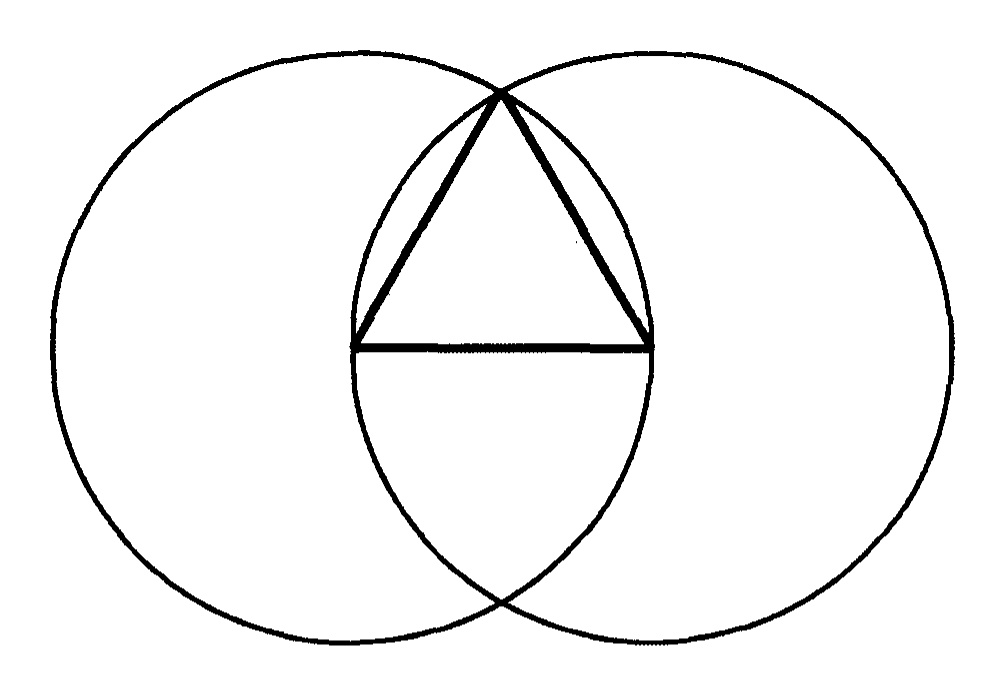
Describe a circle. With unaltered compasses describe a second circle, using any point on the circumference of the first circle as the center of the second. The space enclosed by the intersecting lines of the two circles is called a Vesica Piscis. It is a key to many secrets of architecture, Free Masonry, and Qabalah. Connect the upper point of the Vesica with the centers of the two circles by straight lines, and the centers of the two circles by another straight line. The three straight lines will form the equilateral triangle which is the alchemical symbol for the element of fire.
The two circles forming the Vesica Piscis are an ancient symbol of the threefold nature of Reality, because the two arcs of the Vesica are each two-sixths of a circle, and each of the circles outside the Vesica has, besides that part of it which is included in the Vesica, a remaining arc of two-sixths. The triangle also definitely indicates the number 3. So does the numeral value of the letter Shin, 300, because 300 may be Qabalistically reduced to 3. The form of the letter ש is also immediately suggestive of the number 3. So also, as you have seen, is the symbolism of the 20th Tarot Key. The number 3 is also hidden in the number of this Key, 20, because the sum of the numbers from 1 to 20 is 210, and the digits of 210 add to 3.
Key 4, The Emperor, illustrates the activity of the alchemical fire in the head of man, in the faculty of vision, and in the power of reason. Through the connection of this Key with the letter Heh, the symbolism is all related to the sign Aries.
Now, Aries is typified as a young ram, or lamb, called TLH, Taleh, in Hebrew. This word is numbered 44, and is equivalent to DM, Dam, Blood, to ChVL, Khool, Sand, and to LHT, Lahat, Flame and Magic. The connection between Aries and the Hindu fire-god Agni is obvious. And in another lesson of this series we have considered the correspondences between blood, sand, and flame. Just now, what I would emphasize is the idea of rulership, or control, intimated by the title of Key 4. The alchemical fire is the fire of reason. It is the fiery energy that is at work in the brain. It is the force which takes form in physical and mental vision. It is the power whereby order is established throughout the manifested universe. This power, when we recognize it, and permit it to work without interference through us, is a magic power. In itself it is the power of composing, framing, or constituting worlds. Thus when it finds expression through a properly prepared human brain it enables the possessor of that brain to see things as they really are, and bring about so perfect a personal manifestation of reason that all details of that person’s life are rightly ordered.
Key 8, Strength, is connected with the sign Leo, through its attribution to the letter Teth. Some of the profound alchemical significance of this Key has been touched upon elsewhere in this course. This Key also has links of connection with the central mystery of Free Masonry, which has to do with the raising of the dead body of Hiram Abiff, by means of the “strong grip of the lion’s paw.” In the Masonic legend, we are told that the body was at an advanced stage of putrefaction, which is a direct reference to the alchemical doctrine that the materials of the Great Work must be utterly decomposed before they can be raised, or sublimated. In this connection, remember that ChVRM ABIV, the Hebrew spelling of Hiram Abiff, is the number 273, and this is the number also of ABN MASV HBVNIM, Ehben Masu Ha-Bonim, The STONE which the Builders rejected. Careful consideration of these three words may also lead some of my Masonic readers to discover a clue to the true significance of the “substitute” for the Lost Word, for the syllables of the substitute are concealed in these three words.
It is also interesting to note that the Temple which was nearing completion when Hiram Abiff was killed was situated on Mount Moriah. The bearing of this on our present study is that the words HMVRIH HR, Ha-Moriyah Har, Mount Moriah, add up to 471, which is the spelling of the word ASh, Ash, fire, ‘in plenitude,’ thus: ALP-ShIN. The implication of this Qabalism is that the “Temple” is built upon a foundation of fire. This is further borne out by the fact that MVRIH, Moriah, means “seen of Jah,” or “hill of vision,” so that it is directly connected with the power of vision already noticed in connection with Key 4. And to confirm this, the Hebrew for ‘temples,’ HIKLVTh, Haikaluth, is also the number 471.
Here is another point. The Aramaic word NVR, Nour, written in its plenitude, is NVN-VV-RISh, and totals 628. 628 is 4 x 157, and 471, the value of ALP-ShIN, or ASh in plenitude, is 3 x 157. Thus there is a relation between the numbers representing these two words. 157 is the number of the words in the phrase DMDVMI ChMH, The setting of the sun, and of the words ZQN, zaqan, the Beard, MVPLA, mowpeleh, Occult, miraculous, hidden (applied to Kether, the Crown, in Qabalah), and NQBH, neqebah, Female. The ‘beard’ is regarded by many Qabalists as being a euphemism for the masculine aspect of the creative power, and the word Neqebah, Female, is directly derived from a root meaning “that which is pierced.” Thus these two words correspond more or less to the ideas represented by the Hindu lingam and yoni. The idea suggested is that the secret fire is both male and female, and this is exactly what is taught by the Hindus when they say that the secret fire used in Yoga is both solar and lunar, active and passive, male and female.
Key 14, Temperance, corresponds to the letter Samekh, which has the value 60. This is the value of the word BChN, bachan, to try or test, applied especially to metals, and implying that the trial is by fire. Here students of our writings on Qabalah will remember that the path of intelligence attributed to the letter Samekh is called “Intelligence of Probation or Trial.” Again, the number 60 is the number of the word KLI, keliy, a vessel, something prepared, apparatus. It refers to the secret vessels of alchemy, and these are symbolized in Key 14 by the vase which the angel holds, and from which water is poured upon the head of a lion. In older exoteric versions of this Key there are two vases, one in each hand of the angel, who pours a triple stream from cup to Cup, without spilling a drop. This is also excellent symbolism, if not quite so specific as that of the esoteric Tarot which is the basis of the design issued by us.
The zodiacal sign Sagittarius, corresponding to Key 14, is called QShTh, qesheth, meaning primarily ‘bow,’ and often used to designate the rainbow, but also signifying “bowman” or “archer.” This word has a particular significance in Qabalah, because it is composed of the letters assigned to the three paths connecting Malkuth, the Kingdom, with the higher Sephiroth on the Tree of Life.
The number of QShTh, qesheth, is 800, and this is the value of the letter Peh when it comes at the end of a word. Peh is the letter of Mars, and is connected with the Mars center in the body. This is the center which innervates the reproductive organs, and corresponds to the Svadistthana Chakra of the yogis. This center is said to be the seat of the Apas Tattva in the yoga doctrine, and since this is the Tattva of Water, we have here once more the apparent confusion of fire and water which we noticed in connection with the angel Gabriel. And it is to be noticed that in the 14th Key water is a prominent symbol. So, also, in Key 16 of Tarot, which represents the Mars-force, there are storm-clouds, so that the implication is that the fiery force there shown destroying the tower is somehow connected with water.
Again, the number 800 is the number of ShRSh, shoresh, a root, indicating that whatever occult significance there may be in the word QShTh, qesheth, may be expected to lead us to a better understanding of that which is the root, or fundamental, of all the forms of growth and development.
Years of familiarity with this material have undoubtedly made it easier for me to trace the connections between these Qabalistic clues to the occult doctrine of the secret fire. Just as an Apache tracker can discern marks on a trail which would be of no significance to the eyes of the average passer-by, so does one who has devoted years to making himself acquainted with the symbolic language of the Qabalah see plain indications when another will see nothing at all.
Nevertheless, I believe that when the clues are brought together, as they are in these lessons, any person who is really in earnest in his desire to penetrate the veil of symbolism behind which the secrets of the Hermetic Art are hidden will be able, if he thinks through what is given here, to discover the truth of the matter.
It must always be remembered, however, that the most important secrets of Hermetic Science cannot be put into ordinary language. We would tell them, if telling were possible, but there are no words in any human language which can communicate this knowledge. There are words, and other forms of symbolic expression such as Tarot, which, if meditated upon, will bring the student’s mind to the point where he can know for himself. Then all the words and symbols will take on a new meaning for him. He will understand that there is truly a magical language, and that it does serve, like all language, to aid communication between those who understand it.
The study of Tarot and Qabalah are preparations for this understanding. The mental effort expended in such study has its inevitable physical results. It does actually modify the structure of the brain. It makes one more and more receptive. Thus I have felt it necessary to include a considerable number of Qabalisms in this lesson, to the end that earnest students may be given the necessary materials for the exercise of mental functions which no other kind of thinking can call into play.
In recent years much nonsense has been Written about the verbal “juggling” of the technical Qabalah. As I. Muraskin says, in his introduction to Harry Waton’s valuable work, The Philosophy of the Kabbalah, ‘Far from being arbitrary word juggling, the technical Kabbalah constitutes a well ordered mathematical system, in no wise inferior to our own system of symbolic logic.” Furthermore, even juggling requires and develops dexterity, so that if nothing further were to be brought about by the use of this technique of permutation, transposition, and numerical valuation of the letters in Hebrew words, it would be worth doing for the sake of the mental flexibility and agility which it certainly does result in.
What really happens, however, is an unusual training of the power of association. The numeral correspondences between words are merely signals, so to say, which arrest our attention. On the surface, the words have no obvious relation to each other; but when we notice that they have the same number, we begin to look for the connecting links between them. And it is in the pursuit of these chains of association that we unfold the hidden knowledge.
For example, AChD, achad, Unity and AHBH, ahebah, Love, both correspond to the number 13, and this is a fairly obvious relation that almost anyone can see. But what is meant by the fact that AIB, ayab, Hate, is also numbered 13? Hate repels, and love attracts. Surely these are exact opposites. But are they? What more surely attaches our minds to another than to hate him? Is there any force more binding than thorough aversion? Recent developments in analytical psychology have shown conclusively that hate and love are but opposite sides of the same shield. Thus this one example of technical Qabalah is also an example of the transcendental logic which Ouspensky expresses thus: Everything is both A and Not-A at one and the same time. (Tertium Organum).
Paracelsus understood the Hermetic Science and was a great adept in the Hermetic Art. If, then, you are disposed to chafe a little at the Qabalisms in this lesson, remember his words, quoted in an earlier lesson. The only way you can “understand the use of the Qabalists” is by considering examples of their method. At first you may be like a child who is learning to read. You may be so occupied with your attempts to pronounce single words that the story told by them will make no impression upon you. Persist, and the time will come when the story will be all that you notice, because practice has made easy the reading of the symbols in which it is told.
Summing up this lesson, then, the main points are as follows:
-
The fire of the alchemists is closely related to their First Matter, for it is, as Paracelsus tells us, “the principal subject of this Art.”
¶ -
It is not the ordinary fire of combustion, but a hidden, occult force which is characterized by its power of vivifying.
-
Some call it a “common” fire, meaning that it is common to all things.
-
It is identical with the STONE.
-
It is one thing, from one root.
-
In many respects it resembles a fluid, and is often disguised by alchemical writers under the name “Water.”
-
It is silent and invisible.
-
It is not generated but manifested.
-
It is purely natural, but the excitation of it is artificial.
-
This fire, according to Boehme, is the root of light, which is generated from it.
-
It is the cause of the three principles, and of all that can be named.
-
It is God Himself.
-
It is the power which forms the physical body of man.
-
It is identical with Ruach, the Life-Breath.
-
It is the power which raises the “dead” (in the esoteric sense), as shown in Key 20 of Tarot.
-
The means whereby this result is accomplished is the Great Work of alchemy.
-
In the human body, where it becomes the subject of the alchemical operation, this fire is particularly connected with the nerve centers and organs of reproduction. It is also active in certain other centers.
-
This fire is represented by the first letter of the Tetra-grammaton, IHVH, consequently it is identical with the life-force in the human organism, because the first letter of IHVH is also attributed to Chokmah, the second aspect of Reality, and to Chokmah the Qabalah assigns ChIH, Chaiah, the Life-force.
-
This life-force is identical with the radiant energy which emanates from suns, and which is the motive power of all the heavenly bodies.
A careful consideration of these points, and equally careful rereading of this lesson should serve to plant deep in your sub-consciousness the seed-thoughts of the alchemical doctrine of fire. Give these seed-ideas time to germinate. Nobody learns alchemy altogether from books. The written word is but the means to awaken the subconscious process of deduction. This lesson provides you with the essence of what the sages have written concerning their fire. Your inner consciousness will develop their doctrine into the ripe fruit of understanding and realization.
In the next lesson we shall consider the alchemical doctrine concerning the element of water.