The Three Principles
As you learned in the first lesson, there is a close parallel between the yoga doctrine concerning the three gunas, or qualities, and the alchemical teaching concerning the three principles. In that lesson you were told that the Sattvaguna corresponds to the alchemical Mercury, the Rajasguna to alchemical Sulphur, and the Tamasguna to alchemical Salt. We shall now proceed to a further exposition of the nature of these three principles or qualities.
Sattva means literally, “illumination material,” or the essence of enlightenment. In his translation of the Bhagavad-Gita, Charles Johnston calls it Substance, and renders the sixth verse of the fourteenth chapter as follows: “Substance, luminous through its stainlessness, and free from sorrow, binds by the bond of pleasure and the bond of knowledge.” He translates the eleventh verse of the same chapter thus: “When light shines in at all the doors in this dwelling, when wisdom shines, then let him know that Substance has prevailed.” Again: “The fruit of works well done is stainless, belonging to Substance… From Substance is born wisdom… Those who dwell in Substance go upward.”
Johnston’s translation of Sattva as “Substance” is valuable to us because he is a thorough Sanskritist, and we may be sure that he did not decide on his English rendering without weighing the matter carefully. Thus it becomes evident that Sattva is very like what we have been considering in the two preceding lessons under the designation of First Matter, which, you will remember, is called Mercury by Kelly, Philalethes, Albertus Magnus, Raymond Lully, and many other alchemists. In other words, there is no difference between the First Matter and the first of the three principles.
Whether we call the first principle Sattva or Mercury, we are to think of it as a luminous substance. Thus we can understand why the alchemical treatise Aesch Mezareph, The Book of Purifying Fire, attributes the principle Mercury to Kether, the Crown, the highest of the ten aspects of the Life-power composing the Tree of Life.
On the diagram of the Tree of Life, the Crown is represented as a sphere of brilliant white at the top of the diagram. It is called the Crown because it is the supreme or ruling principle; but it has other names which clearly indicate its identity with Sattva, or “illumination material.” Among them are: AVR MVPLA, aur mopeleh, Hidden Light; AVR FShVT, aur pawshut, Simplest Light; and AVR PNIMI, aur penimi, Inner Light.
Qabalists declare that Limitless Light, Ain Suph Aur, condenses itself in Kether, and sets up a whirling motion which is the beginning of manifestation. Thus the initial activity of the Life-power is represented as the selection of a point at which to begin, so that Kether is termed NQVDH RAShVNH, nequdah rashunah, the Primordial Point, and this point is said to be the root of all manifestation. Like the First Matter, it is also called the “Existence of Existences,” and the “Concealed of the Concealed.”
What we wish to emphasize just here is that these Qabalistic doctrines are by no means mere philosophical abstractions. Hebrew Wisdom, like yoga and alchemy, is founded upon human experience, and that experience is the direct perception of a self-luminous substance as the root of all things, the self-sustaining existence (or better, subsistence) which enters into all forms whatsoever. Furthermore, it is perceived as essentially identical with the energy which produces the physical manifestations of light.
It is to the purest state of this subsistent light that Hindus give the name Sattva, and alchemists the name Mercury. Arthur Avalon says: “The first is Sattvaguna, the function of which, relative to the other gunas, is to reveal consciousness. The greater the presence or the power of Sattvaguna, the greater the approach to the condition of Pure Consciousness… The truly Sattvik man is a divine man, his temperament being called in the Tantras Divyabhava. Through Sattvaguna passage is made to Sat, which is Chit or Pure Consciousness, by the Siddhayogi, who is identified with Pure Spirit.’ (The Serpent Power, p. 53). It is also said by Hindu authorities that Prakriti or Shakti (First Matter) in its aspect of Perfect Unity is the divine perception which is pure Sattva and attribute of Ishvara, the Supreme Self.
Ishvara is defined by Vivekananda as: “The Supreme Ruler; the highest possible conception, through reason, of the Absolute, which is beyond all thought.” This conception is precisely what is behind the Qabalistic term IChIDH, Jechidah, the Indivisible, which also designates the Supreme Ruler, or ONE IDENTITY, attributed to Kether.
The Sattvaguna also predominates in what Hindus call Buddhi, the principle of determination, concerning which it is written that Buddhi, the basis of all cognition, sensation, and resolve, is the charioteer; Manas, the deliberative faculty of the mind, the reins; and the senses, the horses. That is to say, Buddhi is the driver of the chariot in the seventh Key of Tarot, and in this sense Buddhi is indistinguishable from Ishvara or Jechidah, the true Self. What we must keep continually before us, in this connection, is the fact that this One Self is itself identical with the Limitless Light concentrated in the Small Point of original manifestation. In other words, the Self is a point of manifestation for a dynamic energy, a point through which the energy is continually passing. It is the tendency of our minds to think of the Self, or I AM, as being something static or fixed, but Ageless Wisdom declares the opposite. It may help us to recall the geometrical definition of a point – “simple location, without length, breadth, or thickness.” In other words, nothing whatever that has shape, size, or form.
This conception is beyond our mental grasp. Thus we are told that the residuum after all grasping is at an end is the true Self. True knowledge causes even this Self to vanish. It is swallowed up in the infinity of the Limitless Light, the radiant energy which is termed by Qabalists Ain Suph Aur, and by Hindus, Mulaprakriti, the root-matter.
We have just said that Sattva, or alchemical Mercury, is the attribute of Ishvara or Jechidah. Here it is interesting to note that the numeral value of IChIDH, Jechidah, is 37, which we have seen to be the number of degrees in the angle which determines the relation of the hypotenuse of a Pythagorean triangle to its base. (See lesson 3). In other words, the number 37 signifies the power which maintains the relation of the evolving forms of the Life-power to Isis, or Mother Nature. That same power is Jechidah, the Self.
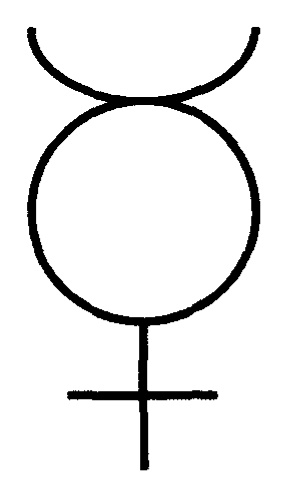
With this in mind, let us analyze the geometrical properties of the Mercury symbol shown in the margin. We find: 1. a semicircle, corresponding to the number 11; 2. a circle, corresponding to the number 22; 3. a cross composed of two lines, each representing the number 2, so that the cross stands for 4. (In occult geometry any circle is 22, because of the approximate Pi-proportion which makes a circle 3 1/7 times its diameter. Thus the smallest whole number which can represent a diameter is 7, corresponding to a circumference of 22. The valuation of the semicircle as 11 is derived in the same way. Readers of these pages are probably also familiar with the Pythagorean dictum that any line is the geometrical equivalent of the number 2. If, then, we add together the numbers corresponding to the parts of the Mercury symbol, the total is 37.
After all this, it should be evident that the name “Mercury” was deliberately chosen for the first principle because of its mythological associations. Mercury, or Hermes, was the messenger of the gods. It was his office to reveal the divine will, just as it is the office of the Sattvaguna to reveal consciousness. Mercury invented all the arts and sciences, and so corresponds to the determinative faculty, Buddhi. In particular he revealed the arts of astrology, magic, and alchemy, and every one of these, rightly understood, has for its object the maintenance of the true relation of evolving form to the fundamental characteristics of Mother Isis, or Nature. In the forms of life below man, this determinative power is exercised upon the vehicles of life without their conscious co-operation. In man there is conscious awareness of what is going on, which leads to his voluntary co-operation in the process which results finally in the perfect unification of his consciousness with that of the Originating Principle, as shown in the diagram in Lesson 3.
In that diagram, the first of the three divisions of the line corresponding to Osiris is attributed to Mercury, because the first differentiation of the One Life-power is this same principle of pure knowing, Sattva or Mercury.
This principle is that aspect of the Life-power which has been termed super-consciousness throughout the lessons issued by the School of Ageless Wisdom. Super-consciousness is the plane of life-activity above the level of human self-conscious knowing; but when we call it a plane we must again be careful not to fall into the error of supposing it to be static. It is a field of intense activity, a sphere of vibratory movement, a region of energy beyond the limits of our ordinary awareness.
That energy is the true Mercury of the sages. It is the power which flows down from above into the uplifted wand of the Magician in Key 1 of Tarot. A power invisible and intangible, but a real power, nevertheless. A power which becomes manifest on the physical plane as light, the Great Magical Agent described by Eliphas Levi. A power hidden behind the manifold veils of name and form. A power perfectly simple and indivisible in itself, but seemingly subdivided into an intricate criss-cross of complex manifestations. A power which is correctly described as Inner Light, which may become actually visible to the awakened inner sensorium of the alchemist as he progresses toward the completion of the Great Work.
Rajas, the second of the three qualities, is rendered “Force” by Johnston. In his translation of the fourteenth chapter of the Bhagavad-Gita we read: “Force, of the essence of desire, engendering thirst and attachment, binds the lord of the body by the bond of works… Desire of possessions, activity, the undertaking of works, restlessness, longing, these are born when Force prevails… The fruit of Force is pain… In the midst stand those who dwell in Force.” Arthur Avalon writes:
“The function of Rajasguna is to make active – that is, it works on Tamas to suppress Sattva, or on Sattva to suppress Tamas.”

Compare this with the words of Jacob Boehme: “The wise heathen have in some measure understood this ground, for they say, that in Sulphur, Mercury, and Sal, all things in this world consist; wherein they have not looked upon the matter only, but upon the spirit: for the ground of it consisteth not in gross salt, quicksilver, and brimstone, they mean not so, but they mean the spirit of such properties; in that, everything indeed consisteth, whatsoever liveth and groweth and hath being in this world, whether it be spiritual or material.
“For they understand by Salt the sharp magnetical desire of nature; and by Mercury, they mean the motion and separation of nature, by which everything is marked with its own image and shape; and by Sulphur they mean the sensible, desiring, and growing life.’ (Clavis, 82.)
The Rajasguna is active in that manifestation of the Life-power which the Hindus call Ahangkara, the “I-maker.” Ahangkara is the realization of oneself as a person. It is the self-consciousness of worldly experience, in which one thinks of oneself as a particular person who stands in relation with the objects of his experience. It is the power that Johnston, in his translation of the Gita, calls “self-reference.”
According to alchemical doctrine, the office of the principle named Sulphur is to swallow and transmute Mercury. This idea is presented under many curious veils of symbolism, but one need not enter into an elaborate examination of these. The meaning should be clear in the light of what has just been written. The alchemical Sulphur is the active principle of self-consciousness, and the office of this is to bring down the super-conscious energy (Mercury) so that it may be assimilated.
In Tarot, therefore, the invisible force which is drawn down from above by the Magician is Mercury, and Sulphur is represented by his red robe, typifying action. Super-conscious energy is the true food of self-consciousness which differentiates the Mercury so received into various forms of self-conscious activity. Thus the Hindus tell us that in the operation of Ahangkara (self-consciousness), Buddhi, in which the Sattva quality (Mercury) prevails, is the principle.
In the Book of Purifying Fire the alchemical Sulphur is attributed to the second aspect of the Life-power named Chokmah or Wisdom. Chokmah is understood as signifying practical as well as theoretical wisdom. It is not merely the distilled essence of experience. It is power to do, power to make active, and thus exactly corresponds to the nature of Sulphur and the Rajasguna.
In human personality, Chokmah is declared to be the seat of the vital force. This vital force is the “spiritual seed of Sulphur,” mentioned by Ripley and other alchemists.
They also declare that this seed is their secret fire. This corresponds to the Qabalistic doctrine that Chokmah is the “Root of Fire.” It agrees also with the statement of the alchemist El-Habib, who says that in the tincture Sulphur is the part of fire.
The noun “tincture,” in its alchemical sense, means “mixture of colors.” It is a fairly obvious figure of speech for human personality. The tincture is contained in the philosophical egg. This is the human aura seen by those who have awakened the inner sensorium, as an ovoid, transparent body in which there is a continual play of colors. This philosophical egg, containing Mercury, Sulphur and Salt, is the “vessel of glass” in which the matter of the work is brought to perfection.
Raymond Lully says that the true philosophical Sulphur is not to be sensibly distinguished from the true Mercury. The same writer also insists that the living Sulphur has no connection whatsoever with the ordinary substance bearing the same name. Again, in various alchemical writings, one reads that the Sulphur of Sol is the Soul of Gold, that the Sulphur of the Moon is the Soul of Silver, and so with the other metals. Spenser gives us a key to this in the lines:
“For of the soule the bodie forme doth take;

For soule is forme and doth the bodie make.”
That is to say, Sulphur is the power of formation, inherent in the life-force. Here, again, we have confirmation from the Qabalah, for Chokmah, to which Sulphur is attributed, is said also to be KChMH, Kachmah, the power of formation. The Universal Sulphur is therefore said to be the light from which all particular sulphurs proceed. Thus Boehme says: “All life and motion, with understanding, reason, and senses, both in animals and vegetables, consist originally in Sulphur, viz. in nature’s desire… Man, and every life also, as to the kingdom of this world, was created and generated out of the outward Sulphur; man out of the inward Sulphur, and the outward creature only out of the outward… ‘Whatever grows, lives, and moves in this world, consists in Sulphur, and Mercury is the life in Sulphur, and the Salt is the corporeal being of Mercury’s hunger.’ (Condensed, from Signatura Rerum.)
The alchemical Sulphur, then, is to be regarded as the middle principle. Thus its symbol is assigned to the second of the three divisions of the Osiris line in the Pythagorean triangle. Mercury is the Spirit, and Sulphur is the Soul, in all forms of the Life-power’s manifestation. Hence Mercury corresponds to what the Greaks term Pneuma, and Sulphur is what they designate as Psyche. As the yogis declare, this principle stands in the midst, as the quality which may act upon Sattva to suppress Tamas or upon Tamas to suppress Sattva. It may operate in either direction.
In the natural man it feeds upon Tamas, upon the bodily sensations, which are below it in the scale of consciousness. It is then drawn into the conflicts of sensation which are called the brimstone fires of hell.
In the spiritual, or “pneumatic” man who has entered upon the performance of the Great Work, this principle opens itself to the descending power of the Sattva quality, or Mercury, which is its proper food. This leads to the regeneration which is the object of the Great Work. Hence Boehme says that Sulphur is the womb where into we must enter, if we would be new born.
Sulphur, active in the desiring and growing life of self-consciousness, works either for the gratification of the senses, or for man’s release from this bondage. Sulphur is that in us which drives us to undertake works that shall lead us to higher levels. It is the transforming power, represented by the Tarot Magician in his red robe.
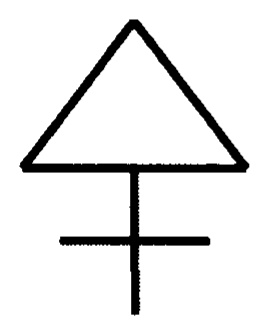
The Tarot Keys make this clear. If you are familiar with them, you will remember that Key 4, the Emperor, is explained as representing the same essential power as the Magician. The Emperor is the Magician, after the Magician’s mating with the High Priestess has transformed her into the Empress. In all the older Tarot packs, as in the B.O.T.A. version, the composition of the picture of the Emperor is based upon the symbol of Sulphur shown in the margin – a triangle surmounting a cross. The same figure is also the basis of the design of Key 7, the Chariot, except that a square, forming the body of the chariot, encloses the cross.
There are two ways to analyze the Sulphur symbol. One is to consider each of its five lines as representing the number 2. Then the whole symbol corresponds to the number 10. The other is to think of the symbol as a triangle (3) surmounting a cross (4). Then the number represented by the symbol will be 7. Every student of these pages who is familiar with the esoteric meaning of numbers will see that there is a close correspondence between 10 and 7. In Tarot, 7 and 10 are the third and fourth terms of the series of Keys which begins with 1, the Magician, and includes 1, 4, 7, 10, 13, 16, and 19. Every card in this series has some reference to alchemical Sulphur.
Key 1 is Sulphur as the transforming power. Key 4 shows it as the martial, regulative power of the Constituting Intelligence. Key 10 represents it as the whirling motion which makes all things active, the fly-wheel, one might say, of nature’s mechanism. Key 13 represents it as the power of growth associated with the meanings of the letter Nun, and presents it symbolically as the power which produces the outward phenomena of death and change. Key 16 shows it as the lightning-flash, destroying the structures of error. Key 19 is a symbol of the regeneration effected by the Great Work, a symbol of the making of philosophical Gold, or Sol; and in connection with this Key of Tarot we may remember that Bernard of Trevisan says: “Gold (Sol) is nothing but quicksilver congealed by its Sulphur.”
The Hebrew noun for Sulphur is GPRITh, gofreeth. Observe that the letters composing it are G, referred to the Moon, P, referred to Mars, R, referred to the Sun, I, referred to the operation of Mercury in Virgo, and Th, referred to Saturn. The Moon center is the pituitary body. The Mars center is that which governs the reproductive functions. The Sun center is that which is directly connected with the action of the heart, with the function of the spleen, and with the admission of solar energy into the sphere of personality. The operation of Mercury in Virgo has been explained in connection with the First Matter. The Saturn center is that in which the Kundalini force, or secret fire, is coiled, and is that also which controls excretion and the orgasm which occurs at the climax of the sex function.
Modern knowledge of the functions of the glands makes it evident that the parts of the body represented by the letters of GPRITh are actually those which are fundamental in all the activities of personality. It is by the forces operating through these centers that all human work is done. We do not go so far as to say that the word was intentionally spelt this way in order to preserve ancient knowledge of these centers and their functions, although we do know that modern “discoveries” in this field are but the uncovering of what has been known before. All that we assert is, that whether by chance or intention, the letters of GPRITh do actually correspond to parts of the human organism which are actively concerned in alchemical work. In this connection the student should remember that the uplifted wand in the Magician’s hand is a phallic symbol, which has been explained in our works on Tarot as typifying the sublimation and modification of the forces ordinarily employed in physical reproduction.
Self-consciousness (Sulphur), on account of its identification with the desire-nature, is inseparable from those basic activities of the human organism which have to do with the perpetuation of the species. It is an open secret now-a-days that the alchemical process is one which utilizes the nerve-force which energizes the organs of reproduction, and diverts its activity to effect chemical and structural changes in the alchemist’s own body. The Kundalini force, or serpent power, coiled in the Saturn center at the base of the spine, is the electric fire which fuses the brain-sand in the pineal gland into the crystal which is the true Philosophers’ Stone. Subtle modifications of the blood-stream by the internal secretions of the gonads, under the rulership of the Mars center, and of the pituitary body, or Moon center, are a necessary part of the Great Work. So is the charging of the blood-stream with certain elements derived from food in the region of the body corresponding to the operations of Mercury in Virgo. Indispensable to the success of the operation, also, is the function of the Sun center near the heart. All these activities are under the control of Sulphur, or the Rajasguna, when it works on Sattva (Mercury) to suppress the operation of Tamas (Salt).
Johnston translates Tamas as “Darkness.” In his version of the fourteenth chapter of the Gita we read: “Darkness, born of unwisdom is known to be the deluder of all who are embodied; it binds through heedlessness, indolence and sleep… Darkness, enwrapping wisdom, causes attachment through sloth… Obscurity, inactivity, sloth, delusion, these are born when Darkness prevails… The fruit of Darkness is unwisdom… Those who dwell in Darkness go downward, under the sway of the lowest powers.”
Hence Boehme, who calls this principle Sal, or Salt, declares it to be the intense magnetical desire of nature, which draws the life-force down into itself. Nature here should be understood as being represented by the base-line of the Pythagorean triangle, into which the stream of cosmic energy represented by the vertical line corresponding to Osiris descends, to be involved in the forms of the four elements, represented by the four divisions of the Isis line.
Boehme says also: “Whatever grows, lives, and moves in this world, consists in Sulphur, and Mercury is the life in Sulphur, and the Salt is the corporeal being of Mercury’s hunger, though the body is manifold. The outward world’s desire is in Sulphur, Mercury, and Sal; for such an essence it is in itself, viz. a hunger after itself, and is also its own satisfying; for the Sul desires Phur, and Phur desires Mercury, and both those desire Sal; for Sal is their son, which they hatch in their desire, and afterwards becomes their habitation, and also food. Each desire desires only the essentiality of Salt according to its property; for Salt is diverse; one part is sharpness of cold, and one part sharpness of heat; also one part brimstone; and one part salniter from Mercury.’
Boehme, it will be noted, divides Sulphur into a twofold nature. He represents its union with that which is above it (Mercury: Sattva) by the syllable Sul, which he calls the “oil of nature, wherein the life burns, and everything grows.” Its union with that which is below it (Salt: Tamas) he represents by the syllable Phur as being the “desire of the free lubet.” This word lubet is used by Law, in his translation of Boehme, for the original German lust. It is practically the same as the libido of analytical psychology.
Boehme also clearly indicates his knowledge that the lowest of the three principles partakes of the qualities of those above it, when he says that Salt is one part brimstone (Sulphur) and one part salniter from Mercury. Observe, too, that he recognizes a pair of opposites in Salt: sharpness, or intensity, of heat, and sharpness of cold, viz. extremes of expansion (heat) and contraction (cold).
Ordinary salt retards the chemical processes which cause decay. On account of this it is used to preserve meat. This is what is regarded as the main characteristic of alchemical Salt. It is due to the quality of inertia attributed to Tamas in Hindu philosophy. This quality is definitely associated with the idea of body.
Thus Paracelsus writes: ‘Hermes truly said that all the seven metals were made and compounded of three substances, and in like manner also tinctures (understand bodies—P.C.) and the Philosophers’ Stone. These three substances he names Spirit, Soul, and Body… Now, in order that these three distinct substances may be rightly understood, namely, spirit, soul, and body, it should be known that they signify nothing else than the three principles, Mercury, Sulphur, and Salt, from which all the seven metals are generated. For Mercury is the spirit, Sulphur is the soul, and Salt is the body. The metal between the spirit and the body, concerning which Hermes speaks, is the soul, which indeed is Sulphur. It unites these two contraries, the body and the spirit, and changes them into one essence.”
Paracelsus also declares that; the properties of Salt are compaction, congelation, and unification. And he writes: “Know that Salt is a balsam, and conserves Mercury so that its properties shall not putrefy or decay.”
In the book Aesch Mezareph the principle Salt is attributed to the third aspect of the Life-power, Binah, or Understanding. On the Tree of Life Binah is represented as a black circle, the color corresponding to the idea of Salt or Tamas as the principle of Darkness. Binah is the Great Mother, or dark womb of manifestation. Binah is also called the Great Sea, which is characterized by its saltness. This aspect of the Life-power is clearly indicated to be the source of all embodiment, throughout the Qabalistic philosophy.
Binah is the diversifying power, which produces the appearance of multiplication of bodies throughout the universe. Its real action is to veil consciousness, and thus produce world-experience. Thus it corresponds exactly to what Hindus call Shakti (Power) in its aspect of Maya. Thus Arthur Avalon writes:
“Maya Shakti is that which seemingly makes the whole (Purna) into the not-whole (Apurna), the infinite into the finite, the formless into forms, and the like. It is a power which thus cuts down, veils and negates. Negates what? Perfect consciousness.’ (The Serpent Power, page 29.)

He also says: ‘The general action of Shakti is to veil consciousness… In fact, like the materia prima of the Thomistic philosophy, it is a finitising principle. To all seeming, it finitises and makes form in the infinite formless Consciousness. So do all the gunas. But one does it less and another more. The function of Tamasguna is to suppress and veil consciousness… The lower descent is made in the scale of nature the more Tamasguna prevails, as in so-called ‘brute substance,’ which has been supposed to be altogether inert.”
Now this is precisely the import of the essential Qabalistic teaching about Binah, the lowest, or outermost, of the “Three Supernals” among the Sephiroth. Binah is the same as the Thomistic finitizing prima materia. Throughout the Qabalah the Great Mother is described in language such as Hindus invariably apply to Shakti as Maya. Even the English translation of the word Binah – “Understanding” – means by derivation exactly the same as “Substance,” literally, “that which stands under.”
This is true even though Binah is said to be the seat of the higher soul, Neshamah, through which one receives the interior teaching by the operation of intuition. The point is that even the highest instruction is yet a veil for the Absolute Reality. Whether it come from without or from within, teaching is but a preliminary to true illumination. As Eliphas Levis says, revelation is really a reveiling. Hence the power of the Tamasguna may be discerned even at these high levels, since there can be no instruction without form, no communication without the dualism of speaker and hearer, and thus no intuition without some tinge of Avidya, or unwisdom.
The Hindu point-of-view, which often regards the appearances of finite existence as unmitigated evils, is reflected in the view that the Tamasguna is also evil. This is an erroneous opinion, however, because all the older sages are agreed that some mixture of the Tamasguna is present even in the highest aspects of divinity, so long as there is any manifestation whatever.
The relative evil from which both yoga and alchemy seek to deliver us is the undue predominance of Salt or Tamas. In the Western schools of Ageless Wisdom this is emphasized. Thus, although Salt is used in the story of Lot’s wife to represent the crystallizing and limiting consequences of that mistaken mental attitude which always harks back to precedent and to the conditions of past experience, we find that Jesus compares his pupils to the same principle, on account of its preservative quality.
In the Qabalah, too, the usefulness of Salt is emphasized. The Hebrew word for it is MLCh, melakh, which is referred originally to the sea itself, from a verbal form, spelt with the same letters, meaning to flow, to dissolve, to vanish away. In Aramaic, the same combination of letters is used for a verb meaning “to subsist.” The idea is that subsistence, or manifestation, is really an eternal flux, even as the Greek philosopher, Heraclitus, asserted.
But MLCh has the value 78, and this is three times 26, or IHVH, “That which was, is, and will be.” Thus MLCh is a numerical formula of the threefold manifestation of reality. Readers of these pages who are familiar with the conceptions of the constitution of matter which have been developed during the last thirty years under the influence of such thinkers as Planck, Einstein, Heisenberg, Dirac, and others, will see that here we approach the ideas which have been forced upon physicists by their mathematical analysis of the results of strictly scientific laboratory research.
By Gematria, or correspondence of words to the same number, the noun MLCh is equivalent to ChNK, Enoch, the name of the patriarch who “walked with God.” This proper name means “initiation.” Another word equivalent to MLCh is LChM, lechem, food or bread. (Here note that the birth-place of Jesus, whose name signifies, “Reality liberates,” is in Bethlehem, BITh-LChM, “the house of food.” This corresponds to what has been said already about the importance of the Virgo area of the human body, in which the assimilation of food is carried out. And it may also give some light on the real significance of the dogma of Jesus’ virgin birth). Finally, MLCh, by Gematria, is equivalent to MZLA, mezla, a Qabalistic term designating the descending power flowing from Kether, the Crown. The literal meaning of mezla is “to drip, to flow down in drops.” Mezla, for Qabalists, is the same as Shakti for yogis. As Shakti produces the seeming multiplicity of appearances, so mezla produces all the manifold aspects of being which are summarized in the ten circles of the Tree of Life, representing the ten aspects of the One Identity, and the twenty-two connecting paths, representing the forces of consciousness attributed to the Hebrew letters.
The number 78, moreover, is the sum of the numbers from 1 to 12, and may therefore be taken to relate to the 12 lines which bound a cube. Ordinary salt crystallizes into perfect cubes, and representations of the cube are shown in Tarot Keys 2, 4, and 7. In the Basic Tarot Course they have been explained as representing the physical plane, or world of embodiment, and as being also representations of the word IHVH, Jehovah, inasmuch as the numbers which designate the limitations of a cube (6 faces, 8 points, and 12 lines), add up to 26, the number of IHVH.
This numeral symbolism may seem rather complicated to some who are taking this course. But it should be considered very carefully. In the performance of the Great Work, as in ordinary chemistry, numeral formulas have an important part. The science of sacred numeration (as distinguished from its divinatory counterfeits) will, we hope, be more adequately dealt with in future publications of the School of Ageless Wisdom. At present we need only say that the better you understand the numeral correlations given here and there through our work, the more evident will become the real inner significance of much of this instruction. In the present instance, the various considerations that have been developed from the number 78, as applying to Salt, all point to the idea that this lowest of the three principles is really just as truly an aspect of Reality as either of the others.
The truth is that the ONE REALITY HAS THE POWER OF FINITIZING ITSELF through the operation of the Tamasguna or Salt. That this principle does produce inertia and darkness, that it is the principle of embodiment which veils consciousness, is undoubtedly true. Thus, if we add the digits of 78, we get 15, and this is the number of the Tarot Key named THE DEVIL. That Key represents the exoteric ideas which are held in respect to the Tamasguna, and these exoteric ideas sometimes affect men of considerable enlightenment. Thus Mohini Chatterji, in his commentary on the Gita, explicitly identifies Tamas with “badness;” and even Swami Vivekananda permits himself to speak of ‘getting rid’ of this quality.
The real esoteric doctrine is that Tamas is just as useful as any of the other principles. Its preponderance, to the point of extinguishing the operation of Sattva in our lives, is what we seek to overcome. By right use of Sulphur the alchemist effects an equilibration between Mercury and Salt. Note, an equilibration. It would be just as unfortunate to have the balance tipped too far on the side of Mercury, or Sattva, even though it has been said that the divine man is “Sattvik.”
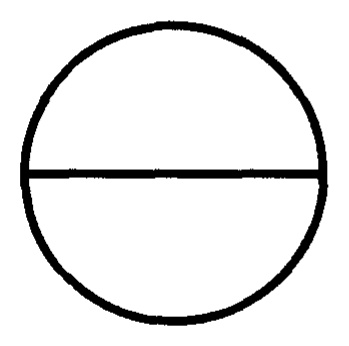
The fundamental idea in the Great Work is the maintenance of equilibrium, and that idea is suggested by the symmetrical symbol representing Salt. This shows clearly the balance between that which is above and that which is below. If the line be valued as 2, then the symbol stands for the number 24, and for the words: GVIH, substance, a body; ZIZ, abundance; and KD, a pot, a large earthenware vessel. The significance of these words in relation to Salt is plain. But if the line be taken as a diameter (7), then the figure stands for the number 29, corresponding to the words: HDK, to break down, to overturn; and KZB, to spin, to bind together. These, because alchemical Salt has both these properties of destruction and correlation.
The preliminary processes of the Great Work consist in the union of Sulphur with Mercury (Rajas with Sattva) to overcome the inertia, darkness, and heaviness of Salt (Tamas).
Little by little, through the influx of power from the super-conscious level (Mercury), effected by control of thought and action at the self-conscious level (Sulphur), the preponderance of fixed, habitual subconscious impulses (Salt) over self-conscious determinations (Sulphur) is overcome. Eventually the subconscious level of the Life-power’s activity is purged and purified. Its fixed conditions are volatilized (that is, its complexes are dissolved), and new and beneficent fixations ensue under the influx of the super-conscious powers.
Mastery of sub-consciousness (Salt) is not brought about by dissolving all complexes and keeping them dissolved. On the contrary, we must have complexes. A complex is simply a group of mental forces clustered around a nucleus. What we are to get rid of is the wrong kind of complexes.
The first steps in yoga and alchemy have to do with their dissolution. In yoga: 1. Yama, non-killing, truthfulness, non-stealing, continence, non-receiving of gifts; 2. Niyama, cleanliness, contentment, self-control, study, devotion; 3. Asana, posture and muscular control; 4. Pranayama, control of nerve-currents through regulation of breath; 5. Pratyahara, observation of the workings of the mind, similar to the catharsis of analytical psychology. In alchemy: 1. Calcination, the purgation of the “Stone,” by a gentle heat which expels the volatile matters; 2. Dissolution, the breaking up of complexes, through works similar to Niyama; 3. Separation, akin to the first stages of Pratyahara wherein the flow of ideas is observed; 4. Conjunction, a second stage of Pratyahara, in which the philosophical Man and Woman are united. A hint of this is given in the symbolism of the sixth Key of Tarot, THE LOVERS; but the final stage of this work of Conjunction is represented by the Hermit (whose letter, YOD, signifies Coition or Copulation). 5. Putrefaction, closely related to Pranayama, which, by changing the nerve-currents in the body, affects also the subtle states of sub-consciousness, and dissolves still further the complexes which retard free life-expression.
We do not mean to say that the stages of yoga, as commonly given, are precisely the same as the alchemical processes – the same in order, that is. All that is intended here is to show that both forms of the one art deal with purification, equilibration, and transformation, and that purification comes first. That which is purified is really the Tamasguna, or Salt, the subconscious level of the Life-power’s self-expression.
Summing up then, we may say:
-
That Mercury, or Sattvaguna, is the super-conscious level of life, corresponding to the highest of the three Supernals on the Tree of Life, Kether, the Crown. In another kind of symbolic expression, the Mercury of the sages is represented by the Tarot FOOL.
¶ -
That Sulphur, or Rajasguna, is the self-conscious level, corresponding to Chokmah, the seat of the life-force. In the Tarot Keys this aspect of consciousness is represented primarily by the MAGICIAN, but all the Keys in the sequence including 1, 4, 7, 10, 13, 16, and 19 are symbols of alchemical Sulphur. As Boehme indicates by dividing the word into its two syllables, Sul and Phur, this principle works both ways. In combination with that which is below it, it works to veil consciousness by inertia, and lowers the level of personal consciousness. In combination with that which is above it, it works to unveil consciousness by illumination, and thus raises the level of personal awareness. Sulphur is therefore the actual transforming power.
-
That Salt, or Tamasguna, is the subconscious level, corresponding to Binah, the Great Sea of Substance, on the Tree of Life. In the Tarot Keys this principle is primarily represented by the HIGH PRIESTESS. In a certain recondite sense, however, Salt is represented also by the following pairs of Keys: 2 and 3; 5 and 6; 8 and 9; 11 and 12; 14 and 15; 17 and 18; 20 and 21. For all these Keys represent the working of forces which are chiefly sub-conscious, or below the threshold of self-conscious awareness.
From these considerations, it will be apparent that the burden of the Great Work falls on Sulphur. Thus we read this summation of the whole operation in The Book of Lambspring: ‘Cook the Sulphur well with Sulphur.” So also Ripley tells us that the spiritual seed of Sulphur is the secret ‘Fire’ burning in the Athanor, the unique chemical instrument, or alchemical furnace, whose name itself means “Essence of Fire.”
When the self-conscious level of personality is rightly understood and utilized, it acts, even as shown in Key 1 of Tarot, as a mediator and transformer. Then the Sulphur assimilates, or swallows, the Mercury of the sages. In consequence of this, the Salt is purified, after having passed through the stages mentioned above. In plain language, subconscious states of mind are modified, and the power of sub-consciousness to build physical structure and control the functions of the body is turned in the right direction.
This, you will see, is quite another interpretation of alchemy from those given by Mrs. Atwood and Ethan Allen Hitchcock. The former thought of alchemy as a sort of hypnotism, performed by the alchemist upon a patient other than himself, whereby clairvoyant lucidity may be produced. Hitchcock supposed that alchemy was merely a system of morals veiled in symbols, Neither was right, but neither was wholly wrong. Alchemy, like yoga, does include certain practices akin to hypnosis; but this part of alchemical technique is applied by the alchemist to himself, and throughout his use of it, he retains self-conscious control of the process. The result is certainly the attainment of those qualities of character discussed by Hitchcock – rather part of the result is the expression of those qualities in their highest and best terms. This, however, is made possible by a transformation which is more than an ordinary “moral awakening.” This is a bodily transformation, which makes of the alchemist virtually a member of a new species, beyond man, as man is beyond the lower animals, and possessed of powers which go far beyond those of the average human being, including extraordinary control of the molecular and atomic structure of “matter,” so-called.
Finally, remember that in alchemy, equilibrium is the basis of the work. All three principles are required. None is to be utterly abandoned, as those believe who tell us we must get rid of body (Salt) and dissipate completely the cohesive virtue of Tamas. Our alchemical Mercury must be perfectly balanced with our alchemical Salt, so that the latter is an adequate and useful embodiment of the former. In other words, the power of sub-consciousness must be so adapted by the work of self-consciousness (Sulphur) that sub-consciousness will give itself to the building and maintenance of suitable vehicles for the expression, here on earth, of super-conscious powers.
The right performance of this work requires a thorough knowledge of the properties of what alchemists call “elements,” and yogis, “tattvas.” We shall begin our instruction on this in the next lesson, which will be devoted to THE ELEMENT OF FIRE.