Platonic Solids
Because the purpose of the Magic of L.V.X. is primarily to develop in the magician a vivid realization of his place in the cosmic order, whatever will tend to deepen or broaden one's mental grasp of the fact that this is truly an orderly cosmos, wherein nothing whatever happens by chance, helps to strengthen the magical consciousness. As you have read in other lessons of this series, ceremonials are of little avail unless they are backed up by knowledge, will and courage. The more, then, you know about the cosmic order, the better will you be able to discern your relation to it.
The purpose of this lesson, therefore, is not merely to make you familiar with the ancient esoteric meaning of the five Platonic solids. We hope, by setting these facts and some of their meanings before you, to intensify your magical consciousness.
The following description of the Platonic solids is taken from Nature's Harmonic Unity by Samuel Colman, N.A. (pp. 14 to 17).
'The Greeks, long before the Christian era, discovered that there could be but five regular solid bodies, or polyhedra, three of these formed by the use of the equilateral triangle, one based upon the square of 90°, and one upon the regular pentagon, which forms we shall now analyze as set forth by Euclid.
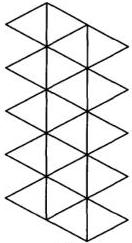
'The simplest regular polygon is the equilateral triangle, and since each apex of an equilateral triangle is an angle of 60°, three such triangles can be combined to form a polyhedral angle. It is seen, then, that a regular polyhedron can be formed, bounded by equilateral triangles and having three at each vertex. This has four faces, and is called a tetrahedron. (See fig. A) Since four angles of 60° are less than four right angles, four equilateral triangles can be combined to form a polyhedral angle and it is seen, then, that a regular polyhedron can be formed, bounded by equilateral triangles, and having four at each vertex. There is such a regular polyhedron. It has eight faces and is called a regular octahedron. (Fig. B) Since five angles of 60° are less than four right angles, five equilateral triangles can be combined to form a polyhedral angle, and it is seen then that a regular polyhedron can be formed, bounded by equilateral triangles and having five each vertex. There is such a regular polyhedron. It has twenty faces and is called the regular icosahedron. (Fig. C) No regular polyhedron bounded by equilateral triangles had having more than five at each vertex is possible, for six or more angles of 60° are equal to or exceed four right angles, and cannot form a polyhedral angle.
The regular polyhedron next in order of simplicity to those formed by the equilateral triangle is the polyhedron formed by the square, each of whose angles is a right angle. Three right angles can be combined to form a polyhedral angle. It is seen then that a regular polyhedron can be formed, bounded by squares, three at each vertex. There is such a polyhedron. It has six faces, and is called a cube or regular hexahedron. (Fig. D) No regular polyhedron bounded by squares and having more than three at each vertex is possible, for four or more right angles cannot form a polyhedral angle.
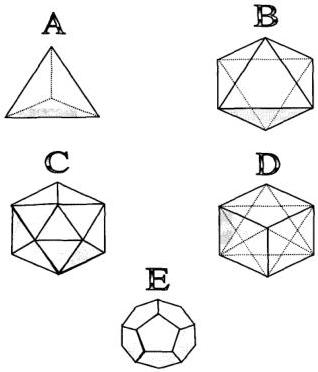
FIGURE 4A - THE POLYHEDRA
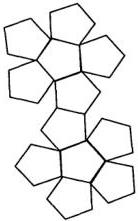
'The next regular polyhedron is that formed by the use of the pentagon, each of whose angles contains $108^{\circ}$. Three angles of $108^{\circ}$ each can be combined to form a polyhedral angle. It is seen then that a regular polyhedron can be formed, bounded by regular pentagons and having three at each vertex. There is such a regular polyhedron. It has twelve faces and is called the dodecahedron. (Fig. E) No regular polyhedron having more than three angles of $108^{\circ}$ at each vertex is possible. These five polyhedra, the tetrahedron, the octahedron, the icosahedron, the hexahedron, and the dodecahedron are the only ones possible.
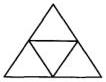
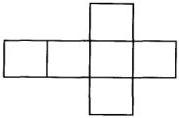
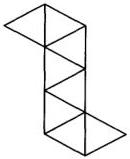
'It would be well for the serious student to construct models of these five figures in order fully to comprehend their meaning. This can be done easily and with perfect accuracy by drawing on cardboard the following outlines, cutting them out and gluing the edges. It may easily be seen by examination that the square, the pentagon, and the hexagon by its equilateral triangle, are all that appear to the eye in regarding them. This trinity of forms is now disclosed to be harmonic with all five of the polyhedra and they are therefore all that are necessary in an analysis of proportional spaces, excepting the Egyptian triangle with the angles of $38^{\circ} 30'$ and $50^{\circ} 30'$ and the ideal angles of $42^{\circ}$ and $48^{\circ}$ which will be considered later.'
The patterns referred to in this quotation will be found on the next page. They should be somewhat enlarged for convenience in construction, and the student who succeeds in making good models of the polyhedra will find himself amply repaid for his trouble.
Assuming that the boundary lines of these patterns are all composed of units of the same length (although they are not so represented in the patterns given below), the pattern of the tetrahedron will
A
D
B
C
E
FIGURE 4B - CONSTRUCTION OF POLYHEDRA
have a perimeter of 6 units, that of the cube 14 units, that of the octahedron 10 units, that of the dodecahedron 38 units, and that of the icosahedron 22 units. Each of these numbers is significant to students of the Ageless Wisdom. We need not elaborate upon the significance of 6, 10, 14 or 22. 38 refers by Gematria to אֵל, moving one thing through another, spinning; כָּלָה, to uncover, to lay a thing open, to reveal; חָל, wall, rampart; לָח, new, unused. These meanings are particularly related to the esoteric meaning of the dodecahedron, and we shall explain them presently.
The sum of the numbers 6, 10, 14, 22 and 38 is 90, and its Gematria is given in Lesson 9A, Page 227.
Pythagoras, and Plato after him, together with the Neo-Platonic and Neo-Pythagorean schools (to which we are indebted for so much of our knowledge of the Ageless Wisdom), ascribed special properties to each of the regular polyhedra. In these schools it was taught that the dodecahedron corresponds to ETHER, the octahedron to AIR, the tetrahedron to FIRE, the icosahedron to WATER and the cube or hexahedron to EARTH.
The order in which they are mentioned in the preceding paragraph is the order of the evolution of the Tattvas, as given in the Science of Breath, the Sanskrit work quoted in Lesson 4A, page 54. Ether, or the Quintessence is the Akasha, Air is Vayu, Fire is Tejas, Water is Apas, and Earth is Prithivi. (See Figure 4A)
We know that Pythagoras studied in India, and it is equally certain that the Neo-Platonists and Neo-Pythagoreans were influenced by Hindu philosophy. Thus it is not surprising to find that when we tabulate the various properties of the regular polyhedra, keeping them in the order of the evolution of the Tattvas, we find some striking symmetries which will, if we take the hints they give, lead to valuable practical conclusions.
Hereafter, for convenience, we shall designate the dodecahedron by the capital letter "D", the octahedron by "O", the tetrahedron by "T", the icosahedron by "I", and the cube by "C".
Now, bearing in mind that the pentagon represents 5, the triangle 3 and the square 4, let us consider one aspect of the meaning of the polyhedra.
D. has 12 pentagonal faces (= 2 \times 5) = 60 O. has 8 triangular faces (= 8 \times 3) = 24 T. has 4 triangular faces (= 4 \times 3) = 12 I. has 20 triangular faces (= 20 \times 3) = 60 C. has 6 square faces (= 6 \times 4) = 24
Observe the symmetry of this arrangement. The tetrahedron is the central point. Above it is a pair of numbers identical with the pair below. This reminds us of the Hermetic axiom, "That which is above is as that which is below." The pair above (D and O) totals 84, and so does the pair below (I and C). Again, the extremes (D and C) also total 84, and so do the opposites (O and I).
The symmetry of the arrangement is striking, but it also points to some very extraordinary conclusions, if we apply the mathematical rule that "things equal to the same thing are equal to each other." For then, since D and I, which represent Akasha and Apas, or the Quintessence and Water, or the Unmanifest and Subconsciousness, are both represented by the number 60, the implication is that Akasha and Apas, Ether and Water, the Unmanifest and Subconsciousness are aspects of the same thing. We may sum this up by saying that the universal, unmanifested reality is identical with the cosmic subconsciousness, and this is a direct echo of Hindu teaching, for we read in Sanskrit works numerous passages like the following:
"She who is pure, eternal Mulaprakriti (root-matter) is Parabrahman itself and the Devata We (the supreme triad of Hinduism, Brahma, Vishnu and Shiva) worship."
Thus it is that we find the unmanifested Reality compared over and over again to a great ocean, implying that its nature is like Water.
In like manner, because both the octahedron and the cube are represented by the number 24, we may look for an identity between Vayu and Prithivi, Air and Earth, superconsciousness and 'matter manifested.' This identity is hinted at by the Western symbols for Air and Earth, which are identical in form, but opposite in position. It is also suggested by this passage from the Sepher Yetzirah:
'He created from the formless and made the non-existent exist; and he formed large columns out of intangible air.' (Chapter 2, paragraph 6).
At first this may seem difficult to grasp, but it is scientifically true. The property of Vayu, say the Hindus, is motion, and that of Prithivi is cohesion. Cohesion is the result of motion, and just as the root-substance of air is electrons, since the atmosphere is made of molecules of gases composed of atoms, so are electrons the basis of all the solider forms that we call earth.
In like manner, that which we experience through the senses as matter is identical with that which we know in superconsciousness. And here we are very close to the knowledge which becomes fully unfolded in the magical consciousness, the knowledge which overcomes the illusions of appearance, and makes it possible for us to perform works of power firmly established upon our knowledge of reality.
The tetrahedron corresponds to the number 12, which is one-seventh of 84. This suggests that a seven-fold expression of the universal FIRE or Fohat or Astral Light, is represented by all the pairs of elements whose combinations, as represented by the polyhedra, give the total of 84. These combinations are: ETHER and AIR (D and O), ETHER and EARTH (D and C), AIR and WATER (O and I), and WATER and EARTH (I and C), four in all. $4 \times 84 = 336$, and $336 = 3 \times 7 \times 16$. The sum of these factors of 336 is $3 + 7 + 16 = 26$, the number of יהוה.
Since ETHER and WATER are both represented by 60, or 5 times the number of FIRE, we may regard ETHER and WATER as being in some sense a fivefold manifestation of FIRE.
Since AIR and EARTH are represented by 24, or $2 \times 12$, we may regard them as corresponding to each other, and as being each a duplication, or twofold manifestation of FIRE.
Another table shows the same correspondences, but based on different facts.
D. (ETHER) has 30 edges O. (AIR) has 12 edges T. (FIRE) has 6 edges I. (WATER) has 30 edges C. (EARTH) has 12 edges
Again, the points of the dodecahedron are the same in number as the faces of the icosahedron. Similarly, the points of the octahedron are the same in number as the faces of the cube. Vice versa, the faces of the dodecahedron are equal to the points of the icosahedron, while the faces of the octahedron are equal in number to the points of the cube.
Here is another table, showing the same correspondences, but enabling us to compare the solids by means of the numbers derived from adding together the numbers of the points, lines and faces of each figure:
| Points | Lines | Faces | Total | ||||
|---|---|---|---|---|---|---|---|
| D. | 20 | + | 30 | + | 12 | = | 62 |
| O. | 6 | + | 12 | + | 8 | = | 26 |
| T. | 4 | + | 6 | + | 4 | = | 14 |
| I. | 12 | + | 30 | + | 20 | = | 62 |
| C. | 8 | + | 12 | + | 6 | = | 26 |
TABLE 4A
Here the solids representing ETHER and AIR, AIR and WATER, WATER and EARTH, and EARTH and ETHER give 88 as the sum of the numbers representing each pair. The number 88 is connected with the Pi-proportion and with the Great Pyramid. It is the number representing the circumference of a circle having a radius of 14, because 14 radius = 28 diameter, and 28 x 3 1/7 = 88, which is the circumference number of the circle of Assiah, as explained in Lesson 2 D. 88 is also the number of units around the base of the Great Pyramid, if the height of that structure be reckoned as 14, the number which corresponds to the tetrahedron, or FIRE in the table above.
Note also that in this table 62 and 26 are not only complementary, as being the component numbers of 88, but they are formed by the same digits, so that one is the reflection, as it were, of the other.
By reducing the numbers shown in the preceding table, we arrive at the following:
$$ D = 62 = 6 + 2 = 8 $$
$$ O = 26 = 2 + 6 = 8 $$
$$ T = 14 = 1 + 4 = 5 $$
$$ I = 62 = 6 + 2 = 8 $$
$$ C = 26 = 2 + 6 = 8 $$
$$ 8 + 8 + 5 + 8 + 8 = 37 $$
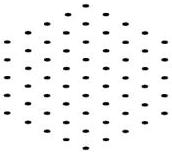
FIGURE 4C - PROJECTION OF CUBE
Thus the number 37 is the sum of the least numbers of the five numbers which represent the geometrical properties of the Pythagorean solids. The digits of 37 are the digits which particularly correspond to the Tree of Life, which has 3 Supernal and 7 Inferior Sephiroth.
Now, if we represent the cube of 4 x 4 x 4, which is built up from 64 small cubes, by a series of points showing the symmetric aspect of that cube in flat projection, the resulting diagram will be what is shown here.
Each point represents one of the 64 constituent cubes in the great cube, and none of these lesser cubes 37 are visible. No more than 37 can be seen at any one time.
The whole 64 stand for Truth, because the Greek word ΑΛΗΘΕΙΑ=64, and thus 37 may be taken to symbolize the revealed or manifested truth.
The reason that this is important is that the Gnosis of the New Testament books indicates, beyond reasonable doubt, that their writers understood the significance of the cube in question. Frederick Bligh Bond, after years of investigation, has made lists of the names, epithets and types of Christ which are multiples of 37. In one of the books written by him in conjunction with T.S. Lea, (their names are given in Lesson 1D) he gives more than a hundred examples. In another book he gives more than 500 Greek words and phrases, used in the New Testament, which correspond by Gematria to 2368, or 37 x 64, which is the number of ΙΗΣΟΥΣ ΧΡΙΣΤΟΣ, Jesus Christ. By the mere operation of the law of averages, something like three percent of all the words or phrases in the New Testament would be multiples of 37, but as Dr. Lea says, 'when a large collection exhibits peculiarities for which the doctrine of Chance cannot wholly account, then other causes must be looked for and will probably be discovered.'
The root-word from which all these New Testament appellations of Jesus Christ are derived is Hebrew, the proper name H B L, Abel, which is derived from a verb spelt with the same letters, meaning, 'to breathe, to wave.' Thus the root-meaning is that of the rhythmic motion of the life-breath.
The same noun is used again and again in Ecclesiastes, being translated 'vanity' in our English Bibles. The real meaning is 'transientness,' or 'transitoriness.' Thus when the Preacher says, 'Vanity of vanities, all is vanity,' he is saying just what Omar puts thus:
'The worldly hope men set their hearts upon Turns ashes--or it prospers; and anon, Like snow upon the desert's dusty face, Lighting a little hour or two--is gone.'
These are not the accents of despair. They are the wise man's recognition of the fact that all external conditions are fluid, that everything as Heracleitus said, 'is becoming, so that a man cannot bathe twice in the same stream.' The idea is ominous and sorrowful for those who have believed in the permanence of things, in the importance of the world's standards of success, in the reality of appearances.
They tell us, indeed, that we shall find no permanent happiness in the world of transient forms, in the phantasmagoria of the appearances of the One Reality. We must find THAT which is behind these appearances if we would have a treasure that nothing can destroy. But there is another aspect of this truth. When it is understood that every condition is impermanent, that the external world is plastic and fluidic, that the law of transition is at work in every detail of our environment, the first step has been taken on the path which leads finally to absolute and magical mastery. It is when the imagination is set free from the belief in the permanence of Name and Form that the ground is made ready for the mustard-seed of conviction which develops into the great tree of confident expectation. So long as you believe in the permanence of mountains, you cannot have faith to move them; but when you see that they are mere temporary waves upon the ocean of ETHER, perhaps your belief that they may be moved will take form as the invention of a new high explosive.
But there is an esoteric meaning to this word HBL, behind the dictionary definition. 'H' or Heh is the Hebrew definite article 'the.' בְּל is a combination of letters which has several meanings. BL is the negative adverb, NOT, equivalent in meaning to LA, which you will remember as the metathesis of AL, strength. It refers to the truth that all things are transitory expressions of the STRENGTH אֵל which is NOT-anything. בְּל, again, is the Aramaic word for 'heart', and originally it meant, 'courage, or strength.' בְּל is also a contraction for BOL, meaning master or Lord. Thus הַבֵּל may be read as the (H) No-thing, the Lord, whose strength is the heart or core of all things בְּל. Again, בְּל is 32, so that הַבֵּל may be read Qabalistically as 'The Thirty-two' referring to the complete manifestation of the 32 paths of the Tree of Life.
Now, the fact that the key-number to all the dimensions of the polyhedra is 37, coupled with the fact that this is the key-number of hundreds of names and epithets of Jesus in the New Testament means that liberation from bondage to conditions is the outcome of the realization that all things are transitory, that whatever exists is the temporary self-expression of the power of THAT which is No-Thing. For we must remember always that the very name 'Jesus' means 'liberation,' that it is synonymous in significance with the Hindu word 'mukti,' and that the whole purport of the teaching of the New Testament is completely misunderstood if we lose sight of the fact that it aims to develop in those who grasp and apply it a truly magical consciousness.
Priestcraft has done its best to conceal the truth. Yet at Christmas-time we read again the story of the visit of the Wise Men, guided by their knowledge of astrology to the birth-place of the Liberator. And not even the effrontery of priestcraft, despite all its false teaching that man is a worm of the dust, has been equal to the suppression of the words which definitely establish the magical quality of the Master's teaching:
'And these signs shall follow them that believe: in my name shall they cast out devils; they shall speak with new tongues; they shall take up serpents, and if they drink any deadly thing, it shall in no wise hurt them; they shall lay hands on the sick, and they shall recover.'
The belief, the conviction, which finally leads to such mighty works has its roots in the knowledge that all the conditions of human environment are expressions of an invisible, impalpable Reality, which can only be designated by negatives. The 'miracles' of this One Thing which is No-Thing are partially interpreted by materialistic science. But our laboratory researchers cannot get at the heart of the phenomena they observe so patiently and accurately. What is missing? They do not see that all these transformations of electro-magnetic energy which they are so busy cataloguing and reducing to formulae are brought about by the mental activity of the One Power whose outward vesture is that same energy. They do not perceive that the whole cosmos is the IDEATION of the Life-Power.
The last few pages may seem to you to have been a long digression from the subject of the Lesson. What has all this to do with the polyhedra? Quite a good deal. For in the symbolism of the Ageless Wisdom one of these figures is a constantly recurring type of the perfection of the cosmic order. The cube furnished the pattern for the Holy of Holies in the Jewish Tabernacle and Temple, is the New Testament symbol of the New Jerusalem, and was the symbol of Hermes among the Greeks. We are now familiar with the fact that this figure represents יהוה by the sum of its points, lines and faces (as does also the Octahedron). In Hebrew tradition, moreover, it is said that Solomon's Temple was built of cubical blocks, measuring nine units every way, just as does the cube which is the basis of construction for the Vault of Brother C. R. in the Rosicrucian allegory which describes that Vault as 'a compendium of the universe.' Thus we know that one of the polyhedra, at least, is widely employed to symbolize the perfection of the manifestation of that cosmic order which, in greater detail, is summed up in the properties of all five regular solids.
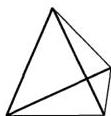
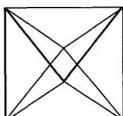
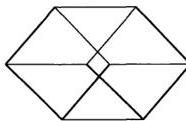
Now, in a work of Rhabanus Maurus 'de laudibus Sanctae Crucis', there is a plate wherein the Nimbus of Jesus has the letters A. M. Ω., signifying the beginning, Middle and End. These letters, written in their primitive forms give us the outlines of the tetrahedron, the octahedron and the cube, thus:
Tetrahedron**
Octahedron**
Cube**
FIGURE 4D – AMΩ (primitive form)
Thus, it is evident that behind the esoteric doctrines of Christianity there is hidden an esoteric doctrine, for when we find New Testament titles of the Liberator repeating over and over again the number which synthesizes the properties of the polyhedra, when we find an old Christian writer using symbols that represent FIRE (tetrahedron) as the ALPHA or Beginning, AIR (Spirit) as the mediating principle (Octahedron), and EARTH (cube) as the End, or manifestation, and when, too, we find the opening words of the Fourth Gospel repeating Platonic and Pythagorean philosophy, we must be blind if we do not see that the real Christianity is inseparable from the stream of the Ageless Wisdom which preceded it. It is a truly magical doctrine, aiming at magical results, and accomplishing them (as was said in the first of these Lessons) by the employment of magical words of power.
See now the agreement between the association of the letter ALPHA with the tetrahedron and FIRE, and the older Qabalistic doctrine you have learned from previous lessons. The Sepher Yetzirah says that FIRE corresponds to the Holy Letter, Shin, which is called 'holy' because its number, 300, is the value of the words רוּחַ אֱלֹהִים, Ruach Elohim, the Life-Breath of the Gods. The Sepher Yetzirah assigns this Ruach also to Aleph, and Aleph is identical with ALPHA. Thus in Hebrew as in Christian symbolism the Beginning of manifestation is associated with FIRE, symbolized by the tetrahedron.
From the Table 4A, it is evident that the number 14 is the key-number of the tetrahedron, and to a Qabalist this immediately suggests the name דוֹד, David, or LOVE, and thus links up the ideas of Beginning and Creative FIRE with that of the attraction between complements which pervades all existence. But this is an aspect we may pass for the time. We shall pass, too, all the interesting deductions which might be drawn from the fact that 14 is the diameter number of the Creative World, as explained in Lesson 2 D. What we wish now to emphasize is that 14 is a numerical representation of the movement of the cosmic Life-Breath.
Traditionally the Elohim אֱלֹהִים are the seven spirits of God. Thus Ruach Elohim may be understood as "Life-Breath of the Seven." (Incidentally, this fact as well as tradition, for the cosmic breath has seven aspects). Therefore, because breathing consists of two movements, inspiration and exhalation (with a pause between them, which is not a movement, but a cessation of motion), the idea of breathing is numerically represented by 2. Hence the motion of the sevenfold Cosmic Breath may be represented as 2 x 7 = 14.
The Cosmic Fire-breath is dual, Outbreathing or manifestation, and Inbreathing or return to the unmanifest. The Outbreathing involves (winds up) the Fire-Breath in the conditions of Name and Form. The Inbreathing involves (unfolds or unwinds) that same Breath from the complexities and limitations of name and form, and brings itself back to the Unmanifest.
All states of ETHER, AIR, WATER and EARTH are states of name and form embodying the FIRE of the Life-Breath. All states of ETHER, AIR, WATER and EARTH are states either of Involution or of Evolution, and at any given period, states of Involution exist simultaneously with states of Evolution. In other words, the Life-Breath is involving itself at one point at the very moment it is evolving itself at another.
The symbol of this is the turning wheel or ROTA, and in previous lessons you have learnt that R.O.T.A. in Hebrew letters adds up to 671, (another 14), which may be represented in our alphabet by A.O.M. (reckoning final M as 600). Of this A.O.M. the Hindu Pranava AUM is a variant, and so is the A.M.O. (mega), that has been studied in this lesson.
It will not escape you, either, that A.M.O. is the spelling of LOVE in Latin², so that the word which makes 671=14 in Hebrew utilizes the letters that spell LOVE in the later tongue of science, but has a numeral value which is the number of LOVE (DVD) in Hebrew, and the number also of the tetrahedron.
The name Elohim also points at the same thing. Its total numeration is 86 = 8 + 6 = 14. This 14 also reduces to 5, the number of the polyhedra, and of the elements and Tattvas. (Note, too, that 14 expresses numerally the idea of the manifestation of ORDER (4) through unity (1)). And each letter
² Ed. note: AMO = "I love", "Love" = AMOR (noun) or AME (imperative).
of ALHIM corresponds to one of the elements, thus:
- A: letter of Ruach, really ETHER (D)
- L: letter of Libra, therefore AIR (O)
- H: letter of Aries, therefore FIRE (T)
- I: letter of Virgo, therefore EARTH (C)
- M: letter of the element of WATER (I)
The order of the elements in this word is the order of the evolution of the Tattvas, except that the last two are reversed. FIRE is central, ETHER and AIR are above, and WATER and EARTH are below. The purport is evident.
Nor should we overlook the significance of the number 86, which is the value of Elohim. It represents the expression of RECIPROCATION, interchange, and the like (6) through the RHYTHM, periodicity, and alternation represented by 8. Thus, from another angle we arrive at the very same idea that the Life-Breath is a rhythmic pulsation of Evolution and Involution.
There is another detail about the polyhedra which we must take into consideration. Three have faces formed from equilateral triangles, one has faces formed from the square, and one has pentagonal faces. The triangle is the number 3, the square the number 4 and the pentagon the number 5, so that in the construction of the polyhedra we find once more the familiar numbers of the old Egyptian triangle of Osiris (3), Isis (4) and Horus (5). The sum of the squares on the three sides of this triangle is $50 (3^2 + 4^2 + 5^2)$ and 50 is the number of the faces of the polyhedra and also the number of their points or vertices. Thus we find the basic numbers of the triangle in the construction of these Platonic solids. Furthermore, the angle formed by the lines of Osiris and Isis is the angle of $90^\circ$, and this angle's numeral value is represented by the total number of edges in the polyhedra, which is also 90.
The polyhedra with triangular faces represent AIR, FIRE and WATER, and they correspond to Osiris, or 3. That which represents EARTH corresponds to ISIS, or 4. That which typifies ETHER corresponds to Horus, or 5. Osiris is a sun-god (Fire), a Nile-god (Water), and, as careful examination of Egyptian myth will show, an atmosphere god also (Air). Isis typifies Mother Earth. Horus, son of Osiris and Isis, represents the Ruach, or ETHER, which is the Quintessence, or fifth essence, of the alchemists.
We hardly expect you to see the force of some of these details at first reading. The reason that this lesson on the polyhedra has been introduced at this point is to show that there is a thread of connection between the mystery symbols of Egypt, India, the Neo-Platonists and Christianity. In these days when the land is filled with the disputes of jarring sects, the fact seems to be forgotten that Christianity is essentially a magical religion, that its aims are precisely the same as those of the older faiths which preceded it.
One of our aims is to revive this fundamental aspect of Christianity. And although all this explanation of numbers and geometry may seem to be very complex (and to many readers, perhaps, more or less far-fetched) we know from experience that the contemplation of these mathematical truths will lead the mind at last to a deeper perception of the hidden symmetries of the cosmic plan. The real meaning of what lies behind all this strange symbolism is simple enough. Everything that exists is an appearance of a single reality. All the appearances are transitory. None has permanence. For the knower of Self, therefore, no obstacle is insuperable, no condition unalterable, no limitation so fixed that it cannot be overcome.
But the mere assertion of this truth is not enough. The Emerald Table advises us to separate the subtle from the gross, the fixed from the volatile with great ingenuity. That is, we must devise as many means as we can to help us in the work of distinguishing the Permanent or Real from the Impermanent or Apparent.
The study of the mathematical properties and correspondences of the polyhedra is one such application of ingenuity. Many others are required in order to overcome the hypnotism of those volatile, ephemeral conditions of Name and Form which seem to us so fixed and unyielding. It is not that these manifold symbols have any magical power of their own. That is not why you are asked to become familiar with their esoteric meaning. The value of this kind of study is that it exercises a power of the mind which is not properly developed by our modern methods of schooling. From the perception of the symbolic correspondences between the letters of the alphabet of nature the mind is led to the realization of the unity which is veiled behind the multiplicity of appearances.
This is the important thing to grasp, and this is the really valuable result of the study of comparative symbology. At first one seems to be lost in a maze of strange signs and emblems, but finally comes the realization which Eckhartshausen expresses in The Cloud Upon the Sanctuary, when he writes:
'As infinity in numbers loses itself in the unit which is their basis, and as the innumerable rays of a circle are united in a single centre, so it is also with the Mysteries; their hieroglyphics and infinitude of emblems have the object of exemplifying but one single truth. He who knows this has found the key to understand everything, and all at once... He who has discovered this way possesses everything therein; all wisdom in one book alone, all strength in one force, every beauty in a single object, all riches in one treasure only, every happiness in one perfect felicity.'
Magical Instruments and Vestments
In ceremonial magic four principle implements are employed: the Wand, the Cup, the Sword and the Pentacle. These implements are represented by the four suits of the Tarot, and what you have already learnt concerning the symbolism of those suits should prepare you to understand the further developments set forth in this lesson.
Eliphas Levi gives the following description of the magic wand, a description full of blinds, but one which contains many clues to the real significance of this implement:
"The magic rod, which must not be confused with the simple divining rod, nor with the fork of the necromancers, nor with the trident of Paracelsus, the true and absolute magic rod, must be a single and perfectly straight beam of the almond or hazel tree, but by a single blow with the magic pruning-knife, or golden sickle, before the sun rises, and at the moment when the tree is about to blossom. It must be longitudinally perforated without splitting or breaking it, and a needle of magnetized iron, occupying its whole length, must be introduced; then a polyhedral prism triangularly out (that is, a tetrahedron), must be fitted to one of its ends, and to the other a similar figure of black resin. In the middle of the rod must be placed two rings, one of red copper, the other of zinc; the rod must be gilt on the side of the resin, and silvered on the side of the prism up to the central rings, and it must be wrapped in silk to the extremities exclusively. On the copper ring must be engraved these characters ירושלים הקדשה = (596 + 414 = 1010), and on the zinc one המלך שלמה (=95 + 375 = 470). The consecration of the rod should last seven days, beginning at the new moon, and should be made by an initiate possessing the great Arcanum, and himself having a consecrated rod. This is the transmission of the magical priesthood, which has never ceased since the misty origin of the transcendent science. The rod and other instruments, but the rod above all, must be carefully hidden, and under no pretext should the magus permit it to be seen or touched by the profane; otherwise it will lose all its virtue. The manner of transmitting the rod is one of the secrets of science which it is never permitted to reveal. The length of the magic rod should not exceed that of the operator's arm; the magician should never use it except when alone, and should not even handle it unnecessarily. Many ancient magi made it only the length of the forearm, and concealed it beneath their long mantles, showing the simple divining rod only in public, or some allegorical scepter made of ivory or ebony, according to the nature of their operations. The magic rod is the Verendum of the magis, he should not so much as refer to it in any clear and precise was; no one should boast of having it, and the secret of its consecration should be transmitted on condition of absolute confidence and discretion alone." The Mysteries of Magic, p. 206 (Parentheses are ours.)
Even a cursory reading of this description ought to be sufficient to show that it is not intended to be taken literally. But the clues to the real meaning are abundant.
In the first place, the material of the wand is to be the wood either of the almond or hazel, and both these trees are symbolic of the power of Kether. The almond about to blossom refers to Kether itself. The hazel is especially attributed to the Moon, and so to the path of the letter Gimel, which proceeds from Kether. The rod must be a single, straight beam. It must be cut with a single blow. Note the emphasis on the idea of singleness or concentration.
In Hebrew the almond is שָׁקַד (=404), and the name refers to the earliness of its flowers and fruit. The derivation is from a verb spelt with the same letters, which means 1) to hasten away; 2) to be zealous, to be eager for or intent upon something; to attend carefully. These ideas, as you can see, are directly connected with Kether, because Kether is the first, or earliest of the Sephiroth, and because it therefore represents the first awakening of the Life-Power into activity at the dawn of the Cosmic Day.
By Gematria, שָׁקַד corresponds to קָדַשׁ, sacred, (which is a transposition of the letters) and to דָּת, a law, edict or commandment. These words represent the outgoing affirmative quality of the primal Will of Kether. The last is particularly interesting because it combines the letters of Venus (D) and Saturn (Tv) and so indicates that the Law is an expression of the creative imagination (D) in activities leading to concrete, specialized results.
The alternative wood, hazel, is named לֵחַ (=43), and this was the name of the place where Jacob is said to have had the dream of angels ascending and descending a ladder. לֵחַ is also a verb whose primitive meaning is "to turn away, to deviate." Later connotations include the idea of forwardness and perversity; and these have a bearing upon later meaning of the path of the letter Gimel. For that path is the path of the Moon, and it is the symbol of the departure of the energy from Kether on its way down to Tiphareth. This departure, descent, or involution is, as we have tried to make clear throughout these lessons, the cause of all limitations and "evils" on which account the feminine principle represented by the moon has always been designated in the books of the wise as the cause of the "Fall".
Corresponding to לֵחַ by Gematria are גָּדוֹל, which means "great" in a wide variety of applications--great in mass or size (weighty, important); great in vehemence (violent); in dignity (authority); in eminence (distinguished). To a Qabalist, therefore, LVZ would suggest intense power and value, so that it is symbolically representative of the potency ascribed to the magic rod. Another word which corresponds to לֵחַ by Gematria is חָלָה, Challah, which is interpreted by Qabalists as representing the Shekinah, or divine agency through which God rules the world. This Shekinah (which Qabalistic Rabbis call the cohabiting glory) is in every respect the same as what the Hindus call Shakti, the feminine power which is the Mulaprakriti and working principle in all things. חָלָה, as corresponding to this power and to לֵחַ, represents the intermediary power between the Primal Will and its manifestations. That power, on the Tree of Life, is represented by the UNITING INTELLIGENCE of the 13th path, and to this path both the almond שָׁקַד and the hazel לֵחַ are attributed. The magic rod, therefore, is to be made of a single beam of this UNITING INTELLIGENCE, that is to say, is to be fashioned from a single ray, or one particular specialized expression of the power which descends from Kether through the 13th path.
Notice, too, that all these words referring to hazel wood are represented by the number 43. They therefore direct our thought to something which combines growth and augmentation (3) with order and regulation (4). And the words which correspond to שָׁקַד, or 404 are designated by a number which shows the essential order (4) of the Limitless Light (0) expressing itself in the regulation of all things (4). These ideas, of course, are directly related to the notion of magic power expressed by the rod.
The prototype of the magical rod is described in the Bible as being of almond wood (Numbers 17). This was the rod of Aaron, the first High Priest of Israel, whose name means "enlightened or lofty".
The needle of magnetized iron represents the Mars-force, or Rajasic energy of desire which must animate the volition of the magus.
The two prisms refer to the fire-power symbolized by the tetrahedron. One is of crystal, representing the transmission of light. The other, of black resin, represents the absorption of light.
The rings in the middle of the rod are of copper and zinc. The red copper ring refers to Venus, and the zinc refers to Jupiter. The gilt at one end of the rod is a symbol of the sun. The silver at the other end is a symbol of the moon.
The Hebrew letters on the copper ring may be translated "Jerusalem the Holy". Note that their numeral value is a double 10. The letters on the ring of zinc may be translated "(The) King Solomon", or "(The) King of Peace". This name has the value of 470, which corresponds by Gematria to DVR DVRIM, a cycle of cycles, or eternity, so that we have here the essence of the idea which Levi expresses elsewhere when he says that a magician should work as if he had all eternity in which to complete his operation. The total value of these Hebrew letters is 1480, and this is the numeration of שָׁבַע שָׁבַתָּהּ, which is literally "Seven Sabbaths". Seven periods of seven days are forty-nine days, and this number 49, which is the square of seven, and so related to the powers of Venus, is one with which we meet constantly in works devoted to practical occultism. Note that its reduct is 13, and its least number 4. The same results come from the reduction of 1480, so that the Qabalistic treatment of the letters on the wand bring us at last to the consideration of Unity and Love (both represented by 13) and finally to the idea of Order, symbolized by 4.
Hence, no sooner has Levi mentioned these letters, than he tells us the consecration of the wand should take seven days. He follows this by a reference to the moon as being important in connection with the consecration, and we have seen that the hazel and almond both refer to the path of the Moon. This, too, is the 13th path, and the reduction of the total value of the Hebrew letters on the wand gives the number 13.
Furthermore, the very word "rod" in Hebrew is מָט =49. Consider, too, what its letters mean. There is M, corresponding to the Hanged Man in the Tarot, and Th, the symbol of Fohat and of its direction, as represented by Strength in the same book of symbolic wisdom.
It is said that "the length of the rod should not exceed that of the operator's arm," to indicate that the extent of the aspiration, or one-pointed purpose which it symbolizes should not be out of his reach. It is called the Verendum, a Latin word synonymous with lingam or phallus, but having special reference to secrecy or privacy, because the immediate source of the power of any magician is actually the nerve-force ordinarily expressed through the organs of reproduction.
We have been at some pains to indicate the clues to the real meaning of Levi's description of the magic wand, because it is an excellent example of the way in which a writer well versed in symbolism can convey occult instruction for the initiated in terms which make apparent sense to the uninitiated.
What he is talking about is the magician's central, dominant purpose--the one particular tendency of the Life Power which he has set himself to realize. And he gives priceless practical instruction when he says that it must be kept carefully hidden, so that the profane may never touch or see it.
For the true rod of miracles in the ONE AIM which you have set yourself to realize in life. Keep it concealed. Do not talk about it. Do not handle it unnecessarily, even when alone, says Levi. This means that the ONE AIM must be kept sacred, that it must not be the subject of too much thought, above all, never of light or doubtful thought. The times when you dwell upon it should be times set apart for the very best that is in you.
This emphasis on secrecy is not to be lightly passed by. None may become a magician who cannot keep his own counsel. Your true, innermost purpose must come to you as an intimation from the highest Self, from that indivisible principle of unity, seated in Kether, which is names IChIDH, Jechidah. That Self is the 'initiate possessing the Great Arcanum,' and that Self already possesses a consecrated rod.
From that self alone may you learn the one high purpose for which you have entered into incarnation, and it is what happens when you receive this inner teaching that Levi means when he says, 'The manner of transmitting the rod is one of the secrets of science which it is never permitted to reveal.'
Now, in ordinary ceremonial, no such elaborate preparations are required. One magician of our acquaintance uses a common black wand with ivory tips, such as may be bought at the shops which deal in supplies for stage conjurors. This form of wand is excellent from the point-of-view of symbolism. The ivory tips are symbols of the elephant-god of India, Ganesha, the god of wisdom. The black body of the wand represents the hidden force of the magical will, and the secrecy which the magician must maintain concerning his one aim. The contrast of colors, black and white, serves the same symbolic purpose as the more elaborate symbolism of the wand described by Levi. For white is the synthesis of all colors, and black is the absorption of every hue. Consequently every aspect of color-vibration is included in this combination of black and white, which, moreover represents the combination of Will (Kether) and Understanding (Binah) since Kether is white and Binah is black. For each magician, the wand must represent all these ideas, plus the special aim or purpose which he has come to realize as a result of listening to the Voice of his innermost Self.
Every time the wand is used in ceremonial, it must be employed to make some gesture or other indication of the power descending through the path of Gimel from Kether. Hence it must invariably remind the magus of the eternal self-direction of the Life-Power toward the production of beautiful results, inasmuch as the path of Gimel ends in Tiphareth. Hence, in making rituals, one must be careful that the wand is used in the right places, and to represent the correct ideas, for otherwise the ceremonial will be more or less confused, and the auto-suggestive value will be lessened.
The prototype of the magic cup is the silver cup used by Joseph for divination. It is primarily a symbol of receptivity, in contrast to the wand, which, as representing the lingam, corresponds to the letter YOD, the archetypal world, and to the powers of Kether and Chokmah. The cup represents the second letter of IHVH, and this letter is assigned to Binah.
It should be made of crystal (which costs too much for ordinary students) or of glass. The preferable material is black glass, but when this cannot be procured, an ordinary glass goblet may be painted black, inside and out, and then varnished with some water-resisting substance. We recommend having this done by somebody who understands all about paints and their application to glass.
The reason the cup should be black is that it is intended to symbolize Binah, the sphere of Saturn. This is one reason, rather. Another is that black is the best color for a magic mirror or divining crystal, and the cup is sometimes used for this purpose.
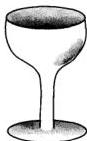
Figure 5A - GOBLET
A goblet of the shape shown here, which is not very unusual, will serve perfectly, after it has been painted black, and the whole cost will be well within the means of the average student.
It is used to contain the water of purification used in ceremonial work, and, as said before, for the kind of divination commonly known as crystal-gazing.
Around its base, in Hebrew letters, should be written the words בינה, אימא and אלהים.
Because the cup corresponds to Binah, it is the particular symbol of intuition, and its use in ceremonials has always to take this into account.
It contains the water of purification, and this water is the symbol of the Astral Fluid, or universal substance. Thus, in a sense, the cup represents the Great Sea of undifferentiated substance whence all forms are generated. And as a cup gives a temporary form to the water which is poured into it (so that if the water be frozen it takes the shape of the cup) this implement of the magician typifies the formative power of Understanding, with which we make our personal contact through intuition.
The cup is a symbol of receptivity, and as such represents the descending current from Kether which traverses the 12th path of the letter Beth. Into the cup of Binah, moreover, are poured the currents of the Life-Force from Chokmah, through the path of Daleth, the 14th path. Hence the water in the cup represents the mingling of the Primal Will with the Life-Force, but that mingling, we must remember, is also a mixture of the qualities of Mercury and Venus. For the 12th path which leads from Kether to Binah is tinged with the quality of Mercury, and is symbolized in the Tarot by the Magician. Thus it represents the volition and attention of the self-consciousness. And the life-force חיה, Chaiah which comes to Binah through the path of Daleth, is tinged with the Venusian quality represented by the Empress, who is subconsciousness as the generatrix of mental images.
Our magical cup then holds the impulses of the Primal Will, expressed as self-conscious attention to the facts of self-experience, and as intelligent classification of those facts, mingled with the life-force proceeding from Universal Wisdom, and expressed as mental imagery proceeding from the principles of that Wisdom.
This combination is what is symbolized by the water in the cup, and all the lustrations and other applications of that water refer to the paths proceeding from Binah. The first of these is the 17th path of Zain, and the other is the 18th path of Cheth. The 17th path is completed in Tiphareth. The 18th is completed in Geburah. The 17th, because it corresponds to Gemini, ruled by Mercury, carries and elaborates an influence which has its origin in the 12th path. The 18th, because it corresponds to the sign Cancer, ruled by the Moon and the exaltation of Jupiter, is a path in which the powers of the subconsciousness, represented by the path of Daleth, predominate. In ceremonial uses of the water in the cup, to produce the most satisfactory results, every emblematic employment of the fluid must express ideas connected with one of other or these two paths.
The magical sword is thus described by Levi:
"The sword is less occult, and must be made in the following manner: - It must be of pure steel with a copper handle made in the form of a cross with three pommels, as it is represented in the Enchiridion of Leo III, or else with two crescents for guard. On the middle knot of the guard, which should be covered with a gold plate, the sign of the Macrocosm must be engraved on one side, and that of the Microcosm on the other. On the Pommel must be inscribed the Hebrew monogram of Michael, as it is seen in Agrippa; the characters באילים יהוה סי במכה (93+26+50+67 = 236) must be engraved on one side, and on the other the monogram of Constantine's labarum with the following words, Vince in hoc, Deo duce, comite ferro. The consecration of the sword must take place on Sunday, in the hours of sunlight, under the invocation of Michael. The sword must be thrust into a fire of laurel and cypress wood; it must then be dried and polished with ashes of the sacred fire, moistened with the blood of the mole or serpent, these words being said: - Sis mihi gladius Michaelis, in virtute Elohim Sabaoth fugiant a te spiritus tenebrarum et reptilia terrae; it must then be perfumed with the perfumes of the Sun, and wrapped up in silk with branches of vervain$^{3}$, which must be burned on the seventh day."
The key to the understanding of this symbolic description is to be found in the fact that the sword is to be consecrated on Sunday, in the hours of sunlight, under the invocation of Michael. For Sunday, sunlight, and the Angel Michael all refer to the sixth Sephira, Tiphareth, to which Qabalists particularly assign the V or IHVH, and of this letter V, in this connection, the sword is the symbol.
Its steel blade represents Mars and the Sephirah Geburah. Its copper handle represents the Sephira which is the complement of Mars, namely, Netzach, sphere of Venus. The middle knot of the guard, with its gold plate, is the sixth Sephira, because gold is the metal corresponding to the sun. The sign of the Macrocosm is the six-pointed star or Hexagram, and the sign of the Microcosm is the five-pointed star, or Pentagram. They are combined in the sword, because this implement represents the personal (microcosmic) expression of universal (macrocosmic) powers. The Hebrew characters (which are printed with many typographical errors, here corrected, in Levi's book) may be freely rendered "In the powers of IHVH how shall there be defeat?" The Latin motto means, "I conquer in this, with God my guide, my sword my companion."
If you will study the diagram of the Tree of Life, you will see that from Kether to Tiphareth inclusive there are six Sephiroth. These are represented by the Hexagram, or seal of the Macrocosm. From Tiphareth to Malkuth inclusive there are five Sephiroth. These are represented by the pentagram, or seal of the Microcosm.
The successive numbers of the Hebrew words are also significant:
באילים = 93 = בני אל, Beni El, the sons of God; לבונה, frankincense, symbol of aspiration; מגן, a shield, used in Hebrew as emblem of God the Protector, and especially connected with the Hexagram, called מגן דוד, Mogun David or Shield of David; נחלה, possession, property, destiny,
$^{3}$ Ed note: also called Verbena.
fate; and TzBA, a host, and army (of which the plural, צבאות, Tzabaoth, is used in the divine names assigned to Netzach and Hod).
יהוה = 26, and the other words given under that number are to be found in the Qabalistic dictionary. It emphasizes the powers of the Self-Existent One.
מי = 50, and this refers to the Gates of Understanding, to the squares of the Pythagorean Triangle, and to the various words having the same number given in the Qabalistic dictionary.
במכה = 67 = a number also given in the dictionary, which is particularly referred to בינה, Understanding and דין, sword, the name of the seventh letter.
236, the sum of all these names, is the number of the Rabbinical word קומץ, which Knorr von Rosenroth translates as Pagillus in his Kabbala Denudata. This word signifies the hand as a weapon, (as may be seen from the English word pugilist, derived from it). Rosenroth says it is YOD (the Hand), or Chokmah (because I of IHVH is assigned thereto), which may be resolved into five fingers, i.e., Binah, since to Binah is referred H (=5) and the fifty Gates. It therefore denotes the powers collected and hidden in the supernals prior to manifestation, whose extension (the opening of the fist) is effected in Binah.
This curious and characteristic bit of Qabalistic symbology is a clue to the Hebrew motto on the sword. The powers of the sword are primarily the powers of Chokmah, of the Father. And, as we have learned that Chokmah is the sphere of the zodiac, here is a hint that all the powers which are symbolized by the magical sword are really the vibrations of the cosmic light manifested through the zodiac. Of like import is the sign of the Hexagram on the pommel. What is meant is that all the activities of personality are really specializations of cosmic forces.
The Latin motto implies the same idea. Vince in hoc signes or 'I conquer in this sign' refers to the cruciform shape of the sword, which designates the letter Tau, the vibration of Saturn, and the crystallizing, specializing power of human activity. This, indeed, is the secret of our magical victories. We win them because in our theurgy, or god-working, we consciously wield and direct, not our own puny personal forces, but the infinite powers of the One Life.
We do so as conscious instruments of the Life-Power, and this is what is meant by Deo duce, 'with God for my guide.' Finally, the magical sword is our companion, our agency, our aid, and this is signified by 'Comite ferro.'
Now, the V in יהוה refers to the Sephiroth from Chesed to Yesod inclusive, and thus symbolizes the powers of the personal consciousness. Chesed is the sphere of MEMORY, Geburah is the fiery Mars-force which we feel as WILL; Tiphareth is IMAGINATION; Netzach is DESIRE; Hod is INTELLECT; Yesod is the AUTOMATIC CONSCIOUSNESS, or the cell-consciousness of the animal organism. These powers, and the connecting activities, represented by the paths joining these Sephiroth, are what is represented by the magical sword. Careful study of the diagrams in Lesson 10 of Section A will help you to understand it better.
Nor should we forget that the magical sword, as corresponding to V of יהוה does, in a measure, represent the particular powers associated with Vau as a letter. To Vau the Sepher Yetzirah assigns the power of HEARING, so that it is the letter which particularly represents the subtle principle of
Sound, or Akasha. To wield the magical sword is to make use of the potencies of sound-vibration – and this is the basic power in all production of forms.
Finally, we come to the Pantacle, represented in the Tarot by the suit of Coins, and so corresponding to the final Heh of IHVH, to the world named Assiah, to the element of Earth, and to Malkuth among the Sephiroth.
Tradition says it is a disk, made of beeswax, and engraved with the sigils and names relating to the particular magical operation to be performed. Thus, if the work be a work of light and wealth, under the patronage of the Sun, the pantacle will have the sigil of Michael, angel of the sun, will bear the magic square of 6 x 6, and the magical names belonging to the Tiphareth. It will be encased in a bag of orange silk, and the names upon it will be filled in with orange paint or with gold. For works of divination and mysteries, under the patronage of the Moon, the names and sigils will be those belonging to Yesod, sphere of the Moon, the magic square will be one of 9 x 9, and the writing will be in silver or blue. So for all the other works. Each is under the presidency of one of the planets, and the pantacle used must bear the magic square, sigils, and names corresponding to the Sephira which is the sphere of that planet, written in the corresponding color; and when not in use will be wrapped in a bag of the same color.
On the reverse side of the pantacle, written in the color which is complementary to that in which the sigils, names, etc. are written, should be a brief statement of the specific result which the operation is intended to accomplish. Thus, if the work be an undertaking which is under the presidency of the Sun, whose names and sigils are written in orange, the statement of the work to be done will be written in blue, the color complementary to orange. These names and sigils are first engraved on the surface of the wax with a stylus, and then filled in with the proper colors.
The material, beeswax, is particularly susceptible to impression by certain of the finer vibrations of the astral light. Its plasticity represents the amenability of the external world to control by mental imagery. As a product of the work of bees, it is of course a symbol of the results of industry, but there is a deeper meaning than this obvious one, which will be easier to grasp if we know the mythological significance of the bee.
Concerning this, the Neo-Platonist, Porphyry, writes:
"The Ancients, moreover, used to call the priestesses of Mother Earth Bees, in that they were initiates of the Terrence Goddess, and the Maid herself Bee-like. They also called the Moon the Bee, as Lady of Generation; and especially because (with the Magians) the Moon in exaltation is the Bull, and Bees are Ox-born--that is, souls coming into birth are Ox-born – and the 'God who steals the Bull' (Mithra) occultly signifies generation."
The Moon, whose sphere is in Yesod, the Foundation or basis, is the subconscious plane of mind, and beeswax, as the product of the Bee or Moon, thus represents the sphere of the elements, Malkuth, which proceeds from the ninth Sephira. In other words, the use of beeswax for the pantacle is a symbolic reminder of the fact that the appearances of the external world are really differentiations or projections of subconsciousness in terms of time, space, name and form. The things which make up our environment are emanations of the subconsciousness. Their very substance is the subconsciousness. And he who is master of his mental imagery is able to make his environment what he will by reason of his power to express patterns upon this universal subconscious plane of being through the channel thereto provided by his personal subconscious mind.
In addition to the four implements, ceremonial work requires incense, fire, and for some rituals, consecrated oil. The incense is of various sorts. Each kind has its particular correspondence to one of the planets.
For works of the Sun, the principle ingredients are clibanum (frankincense) and cinnamon. For works of the Moon, camphor and aloes. For works of Mars, pepper, dragon's blood, and like hot, pungent odors. For works of Mercury, mastic, white sandal, mace and storax. For works of Jupiter, cedar and saffron. For works of Venus, rose, red sandal, and the leaves of myrtle. For works of Saturn myrrh (and in evil magic) assafetida and sulphur.
The base of the oil is pure olive oil (representing the order and measurement of the sphere of Jupiter). With it are combined liquid storax, (for Mercury), camphor (for the Moon) and benzoin (for Venus). Since this course of lessons is concerned principally with the theory of ceremonial, the exact proportions of the elements used in the incense and oil are not here given.
The ashes of the incense are mixed with salt, and are mingled with the water of purification. Rituals of magic include formulae for the consecration of the ash and salt, and for the consecration of the water into which they are cast. The ash represents the material element in aspiration, which is symbolized by the incense. The salt is a symbol of preservation. These are mingled and cast into the water to represent the nucleus of the Tmasic quality around which are crystallized the material results of the magical work.
The magical fire may be a small red lamp, such as is used on altars in the Roman church, containing a large wax candle. It is used for lighting the charcoal on which the incense is cast. From it, also, are lit all the fires or lights which may be required in certain ceremonials; and it serves, too, for the ceremonial purification of the blade of the magic sword, before it is used in making the signs of the Pentagram or Hexagram. This fire represents the cosmic fire, as the ash and salt represent earth, the incense (in process of combustion) air, and the oil one aspect of the watery element.
We have left the description of the magical vestments to the last, not because it is unimportant, but because in this elementary study of the subject, it would be futile to enter into detailed descriptions.
Some writers are of the opinion that the vestments should include an outer robe and an inner robe, a girdle in the form of a serpent, an apron similar to those worn by Free Masons, and a crown. Others substitute a hood or cap for the crown. Others say that the two robes and a silken girdle are sufficient.
The inner robe should be of woolen stuff, and its color black. Thus by color it represents the primal Night which to uninitiated eyes appears to be night but which every seer who has experienced superconsciousness declares to be a radiance surpassing any light we see on earth. It is darkness to our eyes and intellects, but it is also the Primordial Glory, wherein all lesser lights are swallowed up. Thus the black inner robe is often called "The Robe of Glory". It symbolizes AIN SVP AVR, the Limitless Light.
The outer robe may be of a color appropriate to the specific work--orange for works of the Sun, Blue for operations under the dominance of the Moon, Scarlet for works of Mars, Yellow for those of Mercury, Violet for those under the influence of Jupiter, Green for those of Venus, and deep Indigo for the works of Saturn. When these colored outer robes are used, the silken girdle should be of the complementary color. (Color complements are those which are opposite each other in the color-chart.)
But we may simplify matters by using only a white robe, inasmuch as white is the balance or equilibrium of all colors. With this will be worn a girdle of yellow silk, symbolizing the restrictive power of the intellectual selfconsciousness, under the rulership of Mercury.
The black inner robe may be cut like the outer one, or hereafter described, or it may be a cassock such as is worn by priests. Its cut is unimportant, because it is the symbol of the formless Light.
The outer robe, which is called the Robe of Concealment because it is either of a specific color, or else of white linen or silk representing all colors, (we say because on account of the derivation of the word "color," from the Latin celare, to conceal), is cut so as to represent one form of the Tau-cross, as seen on the following page:
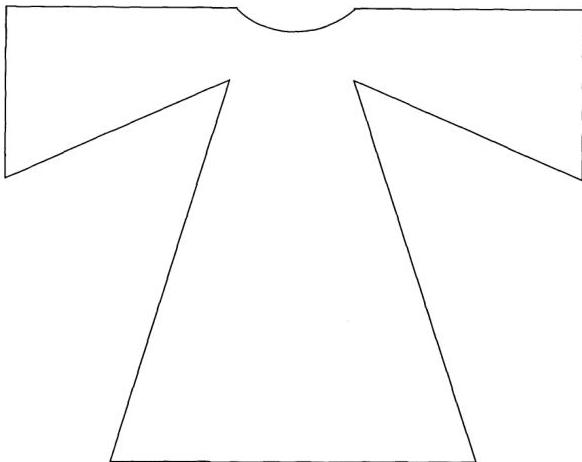
Figure 5B - GARNMENT
The shape of this garment refers to the letter Tau, and to the 32rd path on the Tree of Life. The name of that path, Administrative or Assisting Intelligence, describes the magical consciousness, because a magician is one who by his knowledge of the hidden laws of the Life-Power's self-expression, takes a conscious active part in the administration of those laws. Tau also refers to Saturn, and so represents the force of crystallization which is at work in all practical applications of occult law.
Embroidered upon the breast of the outer robe, or hung by a white cord from his neck, the magician also wears a lamen, or symbolical summary of his understanding of the cosmos. Some use a simple crucifix--which is a perfect symbol if only it be understood, but worse than useless if it be worn without a real knowledge of its meaning. Others wear some variation of the Rose and Cross. Yet others find it best to devise their own lamen, and many enclose it in a vesica piscis. Such a lamen is pictured in a little book on magic which is meat for those who can digest it, entitled, Book Four, Part 2. We prefer the lamens which are the result of the magician's own ingenuity. The simpler they are, as a rule, the better.