The Power of the Mind
The purpose of these lessons on concentration and meditation is really two fold. Primarily they are intended to give you some first-hand knowledge of what happens when one attempts to control mental imagery. This is the object of the exercises at the end of each lesson. Secondarily, they aim to condense into a comparatively small compass the substance of the many books that have been written on the subject, so that at the end of the course you may have in your possession a practical working manual on the practice of this phase of occult training.
By this time your experiences with the exercises already given should have convinced you that those teachers who come periodically to our great cities with the message, 'You can have anything you want if only you will hold the thought,' are telling only part of the secret. What they say is true so far as it goes. The 'catch' is that not one person in ten thousand can even begin to 'hold' a thought. We do not expect that you will have attained any startling degree of skill in this art by the time you have completed these lessons, but we do hope that your experiences with the exercises will have interested you sufficiently to induce you to keep on with the practice for the rest of your life.
You must not suppose that the fifteen minutes practice-period suggested is a maximum. On the contrary, it is the minimum. The more time you can find to devote to this work, the better. The only reason that a period of fifteen minutes is mentioned is that many students of these lessons are busy people who are more or less obsessed by the illusion that they cannot spare time for lengthy practice. We say 'obsessed with the illusion' because a person who really understands the need for concentration will give up almost anything to practice it. Until that understanding comes, however, it seems best to give you a small task, which you can perform, so that you may not be tricked by your brain-cells into neglecting it.
For it is your brain-cells that trick you. Like all other living beings, they hate to change their habits, and you have been letting them do as they please so long that now they will try to wheedle you out of sticking regularly to the practice-period. It is on this account that we ask you to keep a record, and to note the days you do not practice as faithfully as those that you do. In time this will act as an incentive which will help you to overcome the inertia of your lazy brain-cells, if for no other reason that you will be ashamed to send me a report which says repeatedly, 'Did not practice today.' (Of course, shame is the very worst of reasons for being faithful in practice, but it is better than no reason at all.)
What we have just said about the task being primarily one of getting your brain-cells into a habit of industry and obedience goes to the root of the whole matter. It all goes back to the teaching of that master of concentration, the Hindu sage, Patanjali, who begins the Fourth Book of his Yoga Sutras with this declaration:
'Psychic and spiritual powers may be inborn, or they may be gained by the use of drugs, or by incantations, or by fervor, or by meditation.'
So Charles Johnston translates it. In some respects the version given by Swami Vivekananda seems to me to be clearer:
'The Siddhis (powers) are attained by birth, chemical means, power of words, mortification or concentration.'
This is Vivekananda's commentary on this aphorism:
'Sometimes a man is born with the Siddhis, powers, of course from the exercise of powers he had in his previous birth. In this birth he is born, as it were, to enjoy the fruits of them. It is said of Kapila, the great father of the Sankhya Philosophy, that he was a Siddha, which means, literally, a man who has attained to success. The Yogis claim that these powers can be gained by chemical means. All of you know that chemistry originally began as alchemy; men went in search of the philosopher's stone, and elixirs of life, and so forth. In India there was a sect called the Rasayanas. Their idea was that ideality, knowledge, spirituality and religion, were all very right, but that the body was the only instrument by which to attain to all these. If the body broke now and then it would take so much more time to attain to the goal. For instance, a man wants to practice Yoga, or wants to become spiritual. Before he has advanced very far he dies. Then he takes another body and begins again, then dies, and so on, and in this way much time will be lost in dying and being born again. If the body could be made strong and perfect, so that it would get rid of birth and death, we should have so much more time to become spiritual. So these Rasayanas say, first make the body very strong, and they claim that this body can be made immortal. Their idea is that if the mind is manufacturing the body, and if it be true that each mind is only one particular outlet to that infinite energy, and that there is no limit to each particular outlet getting any amount of power from outside, why is it impossible that we should keep our bodies all the time? We shall have to manufacture all the bodies that we shall ever have. As soon as this body dies we shall have to manufacture another. If we can do that why cannot we do it just here and now, without getting out? The theory is perfectly correct. If it is possible that we live after death, and make other bodies, why is it impossible that we should have the power of making bodies here, without dissolving this body, simply changing it continually? They also thought that in mercury and in sulphur was hidden the most wonderful power, and that by certain preparations of these a man could keep the body as long as he liked. Others believed that certain drugs could bring powers, such as flying through the air, etc. Many of the most wonderful medicines of the present day we owe to the Rasayanas, notably the use of metals in medicine. Certain sects of the Yogis claim that many of their principal teachers are still living in their old bodies. Patanjali, the great authority on Yoga, does not deny this. The power of words. There are certain sacred words called Mantrams, which have power, when repeated under proper conditions, to produce these extraordinary powers. We are living in the midst of such a mass of miracles, day and night, that we do not think anything of them. There is no limit to man's power, the power of words and the power of mind. Mortification. You find that in every religion, mortifications and asceticism have been practiced. In these religious conceptions the Hindus always go to the extremes. You will find men standing with their hands up all their lives, until their hands wither and die. Men sleep standing, day and night, until their feet swell, and, if they live, their legs become so stiff in this position that they can no more bend them, but have to stand all their lives. I once saw a man who had raised his hands in this way, and I asked him how it felt when he did it at first. He said it was awful torture. It was such torture that he had to go to a river and put himself in water, and that allayed the pain a little. After a month he did not suffer much. Through such practices powers (Siddhis) can be attained. Concentration. The concentration is Samadhi, and that is Yoga proper; that is the principal theme of this science, and it is the highest means. The preceding ones are only secondary, and we cannot attain to the highest through them. Samadhi is the means through which we can gain anything and everything, mental, moral or spiritual.'
There once lived in our little New York village a woman of sixty who was the most thoroughly disliked person in the community. Of all the 'ingrowing' dispositions that ever one encountered, hers was the worst. Her tongue was like a dagger, and both old and young had suffered from the poison of her envenomed words.
She was a regular attendant at the Baptist Church, but her religion seemed to be limited to occupying a pew twice on Sunday. And her voice! Who could forget its piercing tones as she yelled, 'El-mer-r-r!' to call her nephew into the house -- usually in order to give him a thorough tongue-lashing for some trifling misdeed.
Now it chanced that the poor old lady had to have two teeth extracted, and the dentist gave her laughing-gas. And as she was coming out the anesthetic she has a vision. We don't know just what she saw. She never could be induced to say much about it, and it is probable that she could find no words. But she used to testify that the Lord had come to her to give her a 'look into things.' Whatever it was that she saw, the experience changed her life.
At first, of course, people didn't notice the change; but after a while they began to wonder what had 'come over Mrs. Watson' (We hide her identity under a fictitious name, for good reasons.) One of the things that struck us all was the change in Mrs. Watson's voice. Then Elmer began to tell us boys what a difference he found in her.
Little by little she began to make friends. The young people who used to cross the street to avoid her began to look forward to her appearance. More than that, they began to go to her for advice, for when the Lord gave her 'a look into things'. He also gave her the priceless power of looking with understanding into the hearts of men. For twenty years she was an incarnate blessing to that village – and all because she had two teeth pulled.
For the change in Mrs. Watson was brought about by the laughing-gas. She didn't know it, of course, and neither did anybody else in the village. We found it out years afterward when reading William James's, The Varieties of Religious Experience. In that book James describes the experiments of a little group somewhere here in America, who published some pamphlets concerning what they called 'The Anaesthetic Revelation.' The sum-total of their discovery was that the superconscious experience can be induced by inhaling laughing-gas. In the same way the experiences of people who have experimented with hashish bear internal evidence that they were temporarily raised to the superconscious plane. Let it be definitely understood that I am not even hinting that to take any of these drugs is a good way to develop the superconscious state. On the contrary, it is a very bad way, because it is like breaking an egg-shell to help the chicken get out, or opening the cocoon to release a butterfly. The superconscious powers ought properly to be unfolded from within, and neither the use of drugs, nor the practices of those who 'develop passives' by some variation of hypnotism can be defended by any one who knows the law.
Our reason for dwelling upon this phase of the subject is to make you see that the superconscious state is a brain-state, a body-state, a condition of the blood-chemistry which makes the body able to register the higher, finer, more rapid vibrations of the consciousness beyond thought. The various means enumerated by Patanjali all bring about this change in the physical body, and until that change is made, there is no experience of superconsciousness. For what is called 'the law of parsimony' is at work throughout nature. One principle takes form in manifold effects. In the case now under examination, the established fact that superconsciousness may be induced by taking a drug shows that every example of superconsciousness must involve a change in the body-chemistry similar to that induced by the drug. But the disadvantage of the drug is that it produces other changes, as well as those which temporarily enable certain organs in the brain to register these high vibrations; and it is the reaction from these other chemical activities which has so disastrous a result in the long run.
This danger is obviated when we use the other means that are mentioned by Patanjali – and in spite of the concluding remarks in Vivekananda's comment on the aphorism, also in spite of much that we hear today from people who really ought to know better, it is impossible to succeed in meditation until one has also used the other means. Incantations, or the power of words, must be employed. Mortification is indispensable. Without these there can be no concentration, and we shall now proceed to outline the Builders teaching concerning these two important details.
We make a great deal of use of the power of words. From the very beginning of our work we ask our affiliates to learn the affirmations which state the truth about the Self of man, and these affirmations are what Vivekananda calls mantrams, written in English. There is more to them than the words, as you know by this time. In these ten sentences there is a sound-value and a rhythm-value, and the sound and rhythm play their part in making the affirmations effective. The English language, however, is not so good a medium for making 'words-of-power' as are some other tongues.
Latin, for example, lends itself very well to this kind of thing, and the sentences of the Roman Catholic liturgy have a very strong mantric power. Sanskrit is also well-adapted to making powerful combinations of sound and meaning, and whole books on this subject are to be found in the occult literature of India. It is because of the sound-value in certain words that we find this injunction in The Chaldean Oracles:
'Change not barbarous names in evocation, for they are names divine, having power ineffable in the mysteries.'
One principle, however, that we try to adhere to is that nothing shall be used in practice that is not understood by the person who is doing the work. It is on this account that we prefer the Hebrew words of power. For we know the sound-value and the color-value of every Hebrew letter, so that every technical term in the Secret Wisdom of Israel can be expressed for us as either a sequence of colors or as a sequence of tones. And all our study of the Qabalah is designed to make us familiar with the realities corresponding to these colors and tones.
A member of this class came to us with the objection that it seemed to her that in our concentration work we were only getting reflections of our previous studies -- that after all this work only sets the mind to echoing, as it were, the forms implanted therein by learning the various attributions of the letters, the Tree of Life and its paths, and so on. There is merit in such an objection, and to be able to make it shows the right mental attitude to have toward all occult work. But the student overlooked one important detail. Symbolism is the universal language of the race-consciousness. When you learn the First Year work you are not putting anything into your mind except convenient tags or labels for the ideas your mind already contains. Because the Qabalah is built up scientifically, because the correspondences are true ones, because, at bottom, all these attributions were derived by introspection, this work will ultimately put you in possession of details of the Ageless Wisdom which never can be written in books.
Perhaps the most important thing of all is the fact that this Qabalistic symbolism is a product of the self-examination of men trained in introspection. Concerning the value of introspection we shall write at some length in the next lesson. Just now it need only be said that the Secret Wisdom is the truth which the wise have found by looking within. That truth is always within. It is within you even at this moment -- all of it, and every one of its details. The practice of concentration and meditation simply assists you in bringing it to the surface.
And this brings me to the other part of the student's objection. "It all comes from yourself, doesn't it?" she asked. "Nothing comes from outside." And this seemed to her to indicate that something must be wrong with the work. As a matter of fact it is just what is right with concentration and meditation. We are never so much on the wrong track as when we try to get anything from outside. Even so careful a writer as Vivekananda made a slip in the very quotation given at the beginning of this lesson when he said, "there is no limit to each particular outlet getting any amount of power from outside."
Power is always inside. Whatever the heights you may attain, the power that takes you there will come from within. For the only place where anybody can contact the infinite and eternal energy whence all things proceed is at the very heart of being. Some metaphysicians even go so far as to say that really there isn't any "outside" at all. We are not prepared to argue with them, although at present it seems otherwise to us. But the Builders hold, in agreement with every teaching of the Ageless Wisdom, that the whole process of occult training and development is the externalization of powers already latent within the heart of man.
This, indeed, is one potent reason why the use of drugs is inadvisable. To take a drug to make you superconscious is to fasten the more firmly upon yourself the delusion that you can get power from outside. As a matter of fact the drug only provides a condition, a fulcrum for the lever of your internal power.
To get back to the subject of words-of-power, let us sum up the whole matter by saying that we use the Hebrew names because they are the ones which we can most conveniently explain, because their number is relatively small, and because we can turn every letter into a color and sound. Let us say further that when these names are intoned in the sound-sequences indicated by the letters, an actual vibration is set up which affects everything in correspondence with it.
We need to remember always that our slightest physical activities modify all the matter in space. This is a tremendous fact, determined by the researches of physical scientists. What it means has been well put by Allan Bennett in one of his lectures on The Wisdom of the Aryas:
"I strike my hand on the table, and the action, in that same indivisible instant of time, shifts – by a tiny space, of course, but still shifts – the center of gravity of the earth. Simultaneously, also, the great Sun swerves in his vast march through space, carrying with him his retinue of servient planets. And, you must remember this: that, minute although that alteration in his path may be, it is, if you give it time enough, by no means inappreciable in its results; for, since it involves a change from the path he would otherwise have gone, the distance goes on increasing forever. And not even at our Sun, at our whole family of planets, does the effect of that action – of every action of every living thing – come to an end. Far otherwise, for in the same indivisible moment of time, if the velocity of propagation (of gravitation) be but infinite, great distant Sirius, mightier than a thousand of our own Sun rolled into one huge orb, is likewise set recoiling at a slightly different angle; and yet again, in that same instant, every sun and star that shines; aye, and countless long-dead suns as well, are similarly affected. There is no tiniest speck of cosmic dust but is changed in its direction because of that my action; however remote or tiny; however near or large. All the great universe thrills in answer to every movement of each living thing in each of all these countless islets of its life; until we come to understand how, even in this purely material sense, all Life is One indeed; for force is indestructible, and the effect continues for eternity. Thus, in a sense, we come to see how somehow every atom of matter has a certain part in every other atom; is in a manner present in it; inalienably affecting it each moment of its life.'
Because of this Eliphas Levi wrote, 'There are no solitary actions.' Because of this, too, there is a meaning within a meaning in Jesus' words, 'Of myself I can do nothing.' For he meant not only that the One Life personified in His teaching as the 'Father' is the Eternal Worker in all human activities, but He registered also His knowledge that not even the least of human actions is confined to the personal vehicle through which the One Life performs that action.
For us the time has come when our knowledge of this truth makes it intolerable for us to be unskillful in action. We begin to see the tremendous importance to the Great Work of even our lightest words and thoughts. Either we mar the Work and delay it a little, or else we aid it, and help to speed it to completion. So when we sit in meditation in the seeming solitude of our own rooms, we are really changing even the physical course of worlds, because we are making slight, but nevertheless actual, rearrangements of the atoms in our brains. And when we say a mantram, whether in English, or in some other tongue, the sound and color vibrations which we set up make themselves felt to the outermost reaches of space.
Yet must we remember always that all this is done in and through us by the One Life. It has brought us together to study Its own finer laws. It will ripen us – perhaps by putting obstacles in our way. The illusion of separateness makes it seem to us that we make personal efforts to gain skill and precision, and we cannot say too often that we must act just as if this illusion were true. At the same time we must KNOW THAT IT IS AN ILLUSION, and so escape being deluded by it. Not illusion, the necessary fiction which makes existence possible, but delusion, the forgetting of the truth back of the fiction, is what we all must learn sooner or later to escape from. Complete escape is Moksha, liberation, cosmic consciousness.
Mortification goes to extremes among certain types of religious fanatics, but dare we sit in judgment upon our brothers and sisters because they follow ways which seem to us to be painful and unnecessary? We do not know. We advocate no such extremes as those cited by Vivekananda. At the same time we know that physical control is necessary, and we refuse to be stampeded by the fears of people who do not know that what the Hindus call Hatha Yoga is not regarded, even by its most enthusiastic devotees, as an end in itself. Thus we find the Gheranda Sanhita, one of the Hindu classics on Hatha Yoga, saying: 'I salute that First Lord who taught first the science of Hatha Yoga. This is a ladder for climbing to the higher heights of Raja Yoga.' Even the most rabid of these who denounce Hatha Yoga will recommend the Bhagavad-Gita, and yet the Gita gives precise directions as to posture and breathing, and posture and breathing are part of Hatha Yoga. So is keeping the body clean, inside and out. Vivekananda says, 'A dirty man cannot be a Yogi.' If you want to learn to concentrate, first learn to be scrupulously clean. All this is Hatha Yoga.
We give no rules for hygiene and diet. They are too well known in these days. A freak diet will not help you, unless you happen to be very suggestible, when your belief in the virtues of this or that kind of food may be of some assistance. You will find out from experience what agrees with you and what does not. The main thing is not to eat too much. An old rule is: Eat half what can conveniently be taken.
As to posture, the Hindu teachers differ considerably in their directions, but their meaning is one. The Gheranda Sanhita describes 32 postures (as many as there are paths on the Tree of Life). Some are very difficult, and some seem at first to be comparatively easy. Patanjali says, 'Posture is that which is firm and pleasant.' Sankhya's directions are equally concise, 'Posture is that which is steady and easy.' Be on your guard here. The meaning is not, 'Take any posture which is comfortable.' No posture is comfortable after a few minutes. To be 'firm and pleasant' or 'steady and easy,' a posture must be practiced, and the practice will take you through a door of pain.
Choose a position that keeps the head and back erect and in a straight line. Do not cross the knees. Be careful to sit neither too high nor too low, because in either instance you will put pressure on the nerves behind the knees. When you have decided how you shall sit, be neither relaxed nor tense. The idea is to maintain perfect balance of the flexor and extensor muscles, so that the muscular pull and push shall be equilibrated all over the body. This is very difficult and painful at first. If this part of your practice does not hurt, it is because you are unconsciously easing your muscles by little movements. Watch for these. They are bad 'breaks'. Other distractions will come, too. You will develop itching and tickling sensations in the most unexpected places, yet you must endeavor to keep still in spite of them.
Above all things, do not abandon one posture to try another. Stick to the one you begin with. One day, just as you are ready to believe that steadiness and comfort will never come, you will suddenly find that all sense of body is lost. You won't know you have a body, and from that time on your chosen posture will be the most comfortable attitude you can assume.
Besides posture there is also the matter of breath-control, which the Hindus call Pranayama. If you have had any special training in Pranayama, you need not change your accustomed breath-rhythms. If not, practice rhythmic breathing as follows:
Breathe in through the nostrils slowly, while you count four pulse-beats; hold the breath for sixteen pulse-beats; breathe out through the mouth during eight pulse-beats. In the out-breathing pucker your lips as if your intention was to whistle. Let all this breathing be done slowly and evenly, and use ten of these cycles of breathing before you begin to practice.
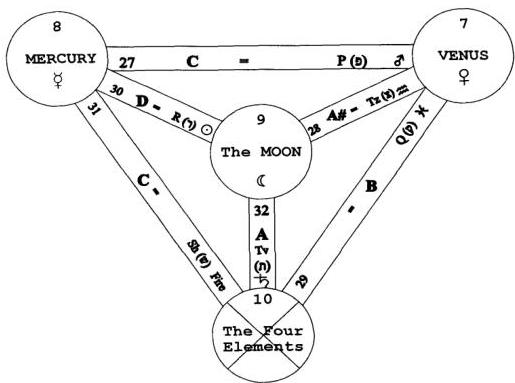
The exercises for this lesson have to do with the 29th, 28th and 27th paths. They complete the lower triangle of the Sephiroth. This has at its center YESOD, the Sephirah which corresponds to the cell-consciousness, or automatic consciousness of the physical organism. (Consider well the various attributions of YESOD as given in the First Year Course.) This Sephirah is the center of the triangle whose points are Malkuth, Hod and Netzach. YESOD, the foundation, is manifested in all three of these other Sephiroth. In Malkuth the power of YESOD takes form as sensation. In Hod the same power is the root of intellectual activities. In Netzach it takes form in emotions and desires. Thus when you have completed this lower triangle of Sephiroth, with Yesod at the center, you have symbolically formulated an equilibration of sensation, intellect and feeling.
Following the same order of attributions as you used in the exercises given in the preceding lesson, practice five minutes (or more) on each path. Project the light from Malkuth to Netzach through the 29th path. Project it from Yesod to Netzach through the 28th path. Draw it across the Tree of Life from Hod to Netzach along the 27th path. Use colors one session, letters another, Tarot cards another, in the same order that you followed in the exercise with the 32nd, 31st and 30th paths. Rest, as before, the seventh day from the day on which you began.
KEEP YOUR RECORD CAREFULLY. If a day comes when you hate the work, say so. These first exercises have deeper meaning than you may now perceive. Don't make the mistake of trying to write a record which you think will please us, the framers of this work. Write exactly what happens. The thing you think not so very important may be the key to your whole problem, and what bulks large in your imagination may not really amount to much. The ways of this world have a tendency to make unconscious liars of all men. Strive to let this account of your work be the undecorated and unvarnished truth.
When you have completed the exercises up to this point you will have passed symbolically through four grades of the Invisible Rosicrucian Order. That is to say, you will have furnished yourself with the pass-words and with certain signs by which members of that Order know each other on the Inner Planes. More than this, you will have attracted by your practice the attention of certain wise ones who are ahead of you on the Path. But do not practice to attract their attention. Practice because you recognize the need for gaining skill, in order that you may be fit to serve.
Among the members of the Invisible Order, or Inner School, when they have attained to a certain degree of conscious perception that such a School really exists, there is regular communication of thought and ideas. You will find a very interesting description of this whole matter in The Cloud Upon the Sanctuary, by Eckhartshausen, especially in Chapter II. As this book is now somewhat difficult to procure, we shall make extracts from it for the use of our affiliates, and these extracts will be issued as a supplement to this course.
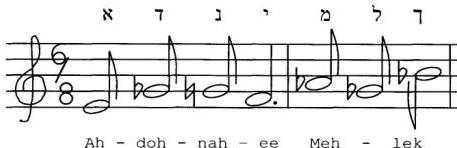
The first grade of the Invisible Order is that of Zelator, and it corresponds to the Sephirah Malkuth. The work of the Zelator has to do with the right classification of the four elements, as shown in the color-cross in Malkuth. His, too, is the work of mastering the senses, of refining them, of purifying them. (Do not forget that to purify is to free from adulteration or mixture. Be on your guard against false interpretations of "purification.")
The Hebrew mantram corresponding to this Sephirah and to the Grade of Zelator is the divine name Adonai Melek, which means "Lord King" or "Divine Royalty." It is pronounced Ah-doh-nah-ee Meh-lek, and the tonal sequence indicated by its letters is as follows:
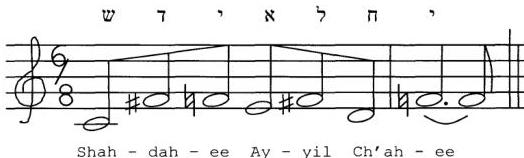
The Sephirah Yesod corresponds to the Grade of Theoricus, which means one versed in the theory of the Great Work. This is an intimation that the whole theory of the Work is somehow connected with the mystery of this 9th Path. So it is, for the basis of the work is the equilibration and sublimation of the power of Yesod. Ponder the attributions of this Sephirah, ask for light from within, and you will begin to realize what it is that you are trying to accomplish.
The mantram for this Grade of Theoricus is the divine name Shaddai El Chai, which means literally 'The Almighty Strength of Life', the tonal sequence with the pronunciation:
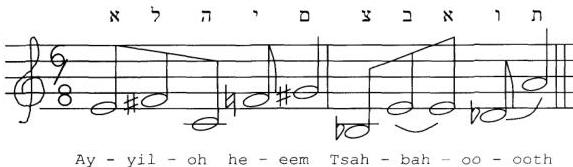
To the Sephirah of Intellectual Activity, the sphere of Reason, corresponds the Grade of Practicus, the grade of those who have passed from study of theory to the experimental work upon which all valid inductive reasoning must be established. The practice of the Builders is founded upon reason. Its method is the scientific method, the method of observation, inference and trial. The mantram of this Grade is Elohim Tzabaoth, 'The Powers of the Hosts,' and it is intoned as follows:
The fourth Grade is the Grade of Philosophus, in which, after experiment, observation and intellectual examination have determined the laws of the Work, the advancing seeker for light begins to grasp somewhat of the meaning behind the laws, something of the philosophy behind the facts. The mantram of this grade is as follows:
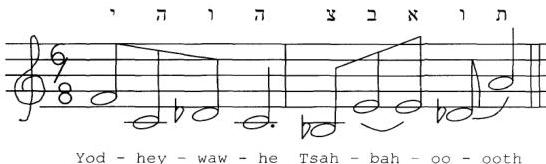
CAUTION: Do not use these mantrams thoughtlessly, or 'just to see what will happen.' They are given at this point for the sake of completeness, and because it is necessary now that you should know what they are. Do not forget that these tone-sequences are color-sequences also. Rightly performed, these names are seen as well as heard.
On the next page you will find a summary of your progress on the Path of Return up to this point. Do not attempt to go beyond this lesson until you have every detail of this portion of the work.
The First Four Steps
ON THE PATH OF RETURN