The Three Principles
The Emerald Tablet of Hermes Trismegistus, so called because tradition says it was inscribed by Hermes upon a plate of emerald with a diamond stylus, opens with these words:
'True, without falsehood, certain and most true; that which is above is as that which is below, and that which is below is as that which is above, for the performance of the miracles of the One Thing; and as all things proceed from one, by the mediation of one, so all have their birth from this One Thing by adaptation.'
In the preceding lesson we identified the One Thing with what modern science calls 'electricity', and satisfied ourselves that the scientific label, with its connotations of materialism, to say nothing of its etymology, is a name not as good as older terms which embody the ancient teaching that the One Thing is the Life-Breath of the cosmos. Whether we use the Sanskrit term Svara, 'The current of the life-wave' (of which Rama Prasad says, 'There is nothing in the manifested universe which has not received existence from the Great Breath, which is the Prana of the universe on the highest plane of life'), or choose some other term, such as the Greek Pneuma, the Latin Spiritus, or the Hebrew Ruach, matters little.
The main thing is to understand that these are not names for different things, but different names for one thing - the Life-Power which beats in our hearts, breathes in our lungs, digests food in our stomachs, and thinks in our brains. In these lessons we shall often use the Hebrew term, Ruach (RVCh), because later on we shall find it a convenient word to sum up many details of knowledge about the Life-Breath. We shall also refer to the same One Thing by the terms 'Life-Power' and L.V.X.
Rama Prasad tells us also that the Svara, or Life-Breath, is what Vedanta philosophers call 'Intelligence' or 'Consciousness'. Here, too, is unity of doctrine among teachers of the Ageless Wisdom. Whatever labels they employ, they always declare that the One Thing (which is really No-Thing, because the Cause of all cannot be any of the things which it causes) is essentially the 'power that knows itself'. Thus, in the teaching of the Qabalah, there is a plain declaration that Ruach is the thinking principle in human life, and the Swami Vivekananda says that Prana is manifest in all activities, from thought down. So also Eliphas Levi, who writes: 'The will of intelligent beings acts directly upon this light, and by means thereof, upon all nature, which is made subject to the modifications of intelligence.'
Emphatically, however, as the wise declare the essential unity of the Life-Power, they are likewise agreed that in its self-expression the One Thing presents itself under three aspects. Thus we find triads, or trinities, in every exoteric religion - veils or personifications of the threefold manifestation of L.V.X. on every plane.
Commenting upon the universality of this trinitarian doctrine, Dr. W. Wynn Westcott writes:
'It is impossible to study any single system of worship throughout the world without being struck by the peculiar persistence of the triple number in regard to divinity; whether as a group of deities, a triformed or 3-headed god, a mysterious Trinity, a deity of 3 powers, or a family relationship of 3 persons, such as the Father, Mother and Son of the Egyptians, Osiris, Isis and Horus.' - Numbers, page 43.
The Egyptian triad has its counterpart in the Christian Trinity and in the Trimurti of Hinduism. Between these last-named personifications of the triple aspect of the Life-Power a closer correspondence exists than is generally known. The Hindu Brahma is a creator, like God the Father; Vishnu is the preserver, even as the Son is the Savior; and Shiva, the transformer, is like the Holy Spirit, under whose influence this world is expected by Christians to be destroyed by fire, that it may be renewed in a timeless eternity, when there shall be a new heaven and a new earth.
Understand, however, that we are proponents of no special exoteric doctrine. We consider the deific trinities as being symbols whereby the race-mind has tried to formulate its intuition that the Life-Power works in a triple manner throughout its self-manifestation. We hold that the Life-Power presents itself to the human mind in three aspects because every expression of human intelligence is really an outpouring of the self-knowledge of the One Living Consciousness. Through the human brain the One Life knows itself.
The examples given thus far are probably more or less familiar. In passing to others not so generally known, let me say again that we do not concern ourselves with different things, but with other names for the same things. The reason for learning these different names is that they will be useful later on, as we proceed with our investigation of symbolism, the second condition which Count Korzybski regards as being so important in the solution of human problems - for in symbolism all thought about the cosmos and its forces finds expression.
One purpose of this Section of the work is to give you an adequate set of symbols which shall be as simple as possible. Many elements of this system are taken from the Qabalah, or Secret Wisdom of Israel. Their total number is small, but the applications are innumerable. In addition to the Qabalistic symbols you will also learn a few from Hindu sources, some which have come down from Egypt, and others pertaining to the closely interrelated sciences of alchemy and astrology.
Does this seem a formidable program? It is far easier than it sounds. Master each lesson thoroughly, so that when you have finished it you may recognize at a glance the symbols it explains and recall their principal meanings. Then your progress will be sure and steady. If you content yourself with a mere cursory perusal of these pages, you will soon find yourself wandering in a maze of incomprehensible terms, but your troubles will be the direct outcome of your own carelessness.
Starting with the idea, accepted everywhere and at all times by the wise, that the One Thing is 'the power which knows', or consciousness, it becomes evident that all these triads and trinities must necessarily refer to three aspects of consciousness.
The task of choosing adequate names for them is not easy, because one may find flaws in every classification. In these lessons the three aspects of the manifestation of the One Consciousness will be termed (1) subconsciousness, (2) self-consciousness, (3) superconsciousness.
SUBCONSCIOUSNESS is that aspect of the power to know which includes every phase of consciousness below self-consciousness. It takes in everything from the rudimentary mental activities of the mineral kingdom, up through the more highly developed aspects of consciousness manifested in plants and animals, to the phases of mental action in man which include control of bodily function, habit, and so on. In the term subconsciousness, then, we include all that is described by Thomson J. Hudson under the name “subjective mind”, by Myers and others as “subliminal consciousness”, by materialistic psychologists as “unconscious cerebration”, by investigators in the field of abnormal psychology as the “co-conscious”, and by Freud and his school as the “unconscious”.
To this last name we take exception, because we have come to understand that no part of the cosmos can be unconscious. When the Life-Power works through the mechanical and chemical activities of the physical plane, it seems to be a blind and fatal force, because we can sense only a fraction of its operation. In truth there are no blind forces. Not one atom is without life and mind. The agelong process of evolution which has produced an instrument - the human brain - through which the Life-Power takes form as thought is a process which expresses a mental tendency eternally subsisting in the Life-Power itself.
Even in the mineral kingdom this tendency appears. The germ of rationality shows itself in the whirling of electrons around the central nucleus of an atom, inasmuch as this terrific interatomic activity is governed by mathematical, and therefore rational, laws. A little higher in the scale, the same laws are exemplified in the geometrical formation of crystals. Even a slight knowledge of chemistry shows mental activity in seemingly inorganic matter. Atoms have their loves and their hates, their affinities, their marriages and their divorces. Metals are subject to fatigue, and may even be poisoned. In short, the forms of matter which are usually thought of as being “lifeless” are now known to possess qualities which make them act precisely as if they had rudimentary sensations and emotions. This knowledge has come to us as the result of laboratory experiments made by hard-headed, materialistic physicists.
R.H. Francé, in Germs of Mind in Plants, gives an interesting account of many forms of mental activity in the plant world. He says that some plants can smell, and describes a vegetable parasite which can “recognize the slightest odor of its victim, and, overcoming all obstacles, will crawl directly to it - something almost incredible had it not been proved over and over again. In the hemp-raising districts there is found every year a strange flesh-colored and also flesh-appearing substance known and feared by the farmer as hemp-death. This growth, which the botanists call Orobanche, lives from the sap of the hemp roots, and with unfailing certainty it turns every one of its subterranean sprouts in the direction of these roots”. In like manner, strawberry plants send their creepers in the direction of moist ground, and many other plants exhibit evidences of sensation and purpose.
In the animal kingdom this mental quality gradually increases its depth and range, and in human life the whole process of mineral, plant and animal evolution is summed up in the functions of subconsciousness.
Subconsciousness has perfect memory, preserving a record of even the most fleeting sense-impressions, moods or thoughts. It is the body-building power which forms the child in the mother's womb, and which governs every function of every organ of the body. As Hudson has shown in his Law of Psychic Phenomena, subconsciousness is always and uncritically amenable to suggestion, and obeys the predominant suggestion. It can also reason deductively from any given premise in so perfect a series of syllogisms that many of its products have ensnared the whole world by their plausibility, simply because the error in the premises has escaped detection.
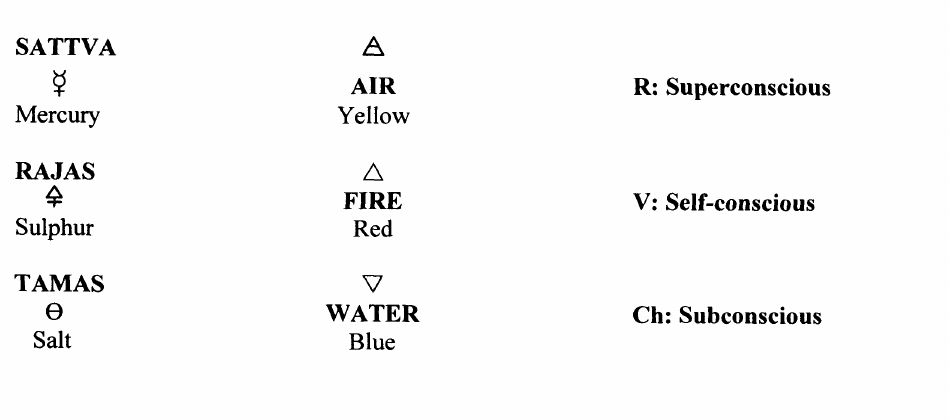
Because of this amenability to suggestion, this influence over bodily function and organization, and this power of perfect memory and deduction, subconsciousness may be either our best friend or our worst foe. Its perfect memory is an inexhaustible treasure-house of images, wherein are stored all the symbols of the race-mind. Subconsciousness is the preservative element in our lives. It enables us to form habits, thus tending to establish conditions of thought and action which are more or less fixed, or what we call 'conservative'. Thus it has in it a static quality which enables us to identify it with what Hindu psychologists name TAMAS, the principle of darkness and inertia. The Western school of occultism designates the same quality by the alchemical term SALT, and uses this symbol for it.
This sign is an oval, bisected horizontally by a line, separating that which is above from that which is below, and suggesting the dual operation of the principle. In some books the alchemical SALT is represented by a circle with a horizontal diameter; but the form given here is older. We prefer it, because it suggests an egg, and also the process of cell-division which attends the body-building functions of subconsciousness. Subconsciousness may be thought of as the egg whence the higher modes of consciousness are hatched in the course of the evolution of the cosmic mental quality.
WATER is another symbol for subconsciousness. Water was the first mirror, and because mirroring is duplication, or reflection, it is akin to remembering, in which an original experience is duplicated or reflected. Memory, indeed, is the root of subconscious activity, hence WATER is a correct symbol of the same. Water, again, is related to Salt, because of the saltiness of sea-water. The alchemical symbol for Water is a blue, inverted, equilateral triangle: ∇
In the noun Ruach (RVCh), the final letter, Ch, corresponds to subconsciousness, because the latter is the field we have to cultivate. Hebrew occultists say that the letter Ch represents speech, and this is another indication that the letter corresponds to the subconscious activities, inasmuch as all the images, metaphors, similes, definitions, and other parts of a language are stored in this 'field'.
Hereafter, then, subconsciousness will be represented for you by the letter Ch of Ruach, by ∇, which represents Water, and by Θ, the alchemical sign for Salt. Remember that this salty, preservative, and therefore conservative, aspect of subconsciousness is the principle of darkness (because all our subconscious operations are in the 'dark' so far as our conscious knowing is concerned), and inertia (because all that holds us back is the weight of subconscious deduction from erroneous premises). Thus it corresponds exactly to what Hindus call TAMAS.
SELF-CONSCIOUSNESS is the distinctly human aspect of consciousness - the consciousness of the waking mind which you are using to read these pages. Self-consciousness finds its highest expression in the process of inductive reasoning. It formulates the premises which subconsciousness accepts as suggestions, elaborates by deduction, and carries out in the direction of physiological function and organization.
Self-consciousness is founded upon the experiences of sensation. The driving power in the greater number of its activities is desire. The Life-Power's expression through it is always a quest into the unknown, for inductive reasoning is ever an attempt to answer questions. In self-consciousness, moreover, the distinctions between past, present and future are sharply drawn. Our memories of the past, our reactions to the present, and our anticipations of the future are all colored and modified by our desires.
Thwarted desires lead to anger. Desire, moreover, has in it something of heat and fire, because all desire is an urge toward self-expansion. Desire, therefore, is the transforming power in consciousness, and its effects upon the physical and finer bodies are disintegrating, form-destroying. To desire anything is to wish that some present condition may cease to exist. Desire tears down continually. Hindus call it RAJAS.
The alchemical name for this flaming heat of the waking consciousness is SULPHUR. Some occultists believe the noun sulphur to be derived from the Latin sol, sun, and the Greek pyr, fire. Hence they define alchemical sulphur as "sun-fire". We question the accuracy of this derivation. It is true, however, that every activity of our waking consciousness is a transformation of solar energy.
The alchemical symbol for SULPHUR is 🜍. The upright triangle symbolizes the cosmic fire. The cross signifies the subdivision of that fire into the four states of matter which the ancients called Fire, Water, Air and Earth. Thus the Sulphur symbol designates the fivefold nature of self-consciousness, fivefold because its modifications are based upon the senses. Of these, one corresponds to the cosmic fire, and the other four are developments of its elementary manifestations. Concerning this you will learn more in the next lesson.
Another alchemical symbol for self-consciousness is FIRE, chosen because of the form-destroying nature of all self-conscious activities. Its emblem is a red upright equilateral triangle: △
Self-consciousness corresponds also to the middle letter of Ruach, the letter V, because it is the connecting link between human beings. Other reasons for this correspondence will be explained in due course.
SUPERCONSCIOUSNESS is indefinable. We find no words to describe it because all the words in the dictionary are symbols of various states of self-consciousness. In some few members of every generation, consciousness evolves beyond the limitations of intellect. In a remarkable work, Cosmic Consciousness, lately reprinted by E.P. Dutton & Co., Doctor Richard Maurice Bucke describes his own experience of this higher consciousness, and gives many examples of its manifestation, or partial manifestation, in the lives of other people.
We do not at all agree with Dr. Bucke's opinion that the cosmic consciousness cannot be experienced after the age of thirty, or before one has reached that age. On the contrary, we know that this experience is one that can be prepared for, and induced, in people who have not attained that age, or who may be many years beyond it. Dr. Bucke's book is, nevertheless, a valuable contribution to the literature of wisdom, and may be read with profit by every student of these lessons. In William James' book, The Varieties of Religious Experience, is also to be found much information about superconsciousness. Of great importance, too, is the teaching given in Swami Vivekananda's Raja Yoga, and in that part of Edward Carpenter's From Adam's Peak to Elephanta which describes his visit to a Gnani. (A Gnani is a Yogi who develops superconsciousness by the method known as "union by means of knowledge". The work given in these lessons, particularly that part which deals with the Qabalah, or Secret Wisdom of Israel, is really a mode of Gnana Yoga.)
William James emphasizes the important fact that superconsciousness is normal to human beings, and is accompanied, like all other states of mind, by specific brain-activities. This, to be sure, is no new knowledge. At least 150 years before the Christian era, a Hindu writer, Patanjali, said: "Psychic and spiritual powers may be inborn, or they may be gained by the use of drugs, or by incantations, or by fervour, or by meditation". Here in America a number of persons have experienced superconsciousness as a result of inhaling laughing-gas. William James has a good deal to say about this "anesthetic revelation". Similarly, throughout the Orient, and by some Western students, hashish has been used to open the gates to the influx of the consciousness beyond thought.
The use of drugs, however, is unwise and unprofitable. It is a forcing process which usually does permanent injury to the delicate mechanism of the brain. Nevertheless, the fact that drugs do enable the brain to act for a time as the vehicle of superconsciousness demonstrates that this state is not a supernatural gift, is not outside the range of natural law, is not to be regarded as essentially different from any other state of consciousness. It is experienced through the brain as a result of the functioning of certain specific groups of cells. The fact that some drugs induce such function is evidence, furthermore, that some subtle change in the blood chemistry contributes its part to the general physiological transformation necessary to the experience.
It is our conviction that all Yoga practices do something to bring about this change in blood chemistry. Thus the word which is translated "fervour" in the foregoing quotation means "mortifications", and refers to various methods of body control, including fasting, abstention from certain kinds of food, and so on, which certainly have a definite bodily reaction. All the methods of physical control grouped by Hindu writers under the general head of "Hatha Yoga" may be regarded as aiming at specific body-changes.
These mortifications of the flesh range all the way from beneficial exercises which result in the perfect coordination of all the bodily functions to practices which Western minds regard as useless and revolting (such as holding the arm in one position until it atrophies). We must remember, however, that such extremes of asceticism are by no means peculiar to the Orient. In the lives of certain Christian mystics we may find the accounts of Oriental self-torture exactly duplicated. And as one writer has justly remarked, "One should not criticize such persons without a thorough knowledge of the subject. Such knowledge has not yet been published". At the same time, we shall do well to avoid imitating these extremes of asceticism.
Incantations are not senseless, superstitious uses of language. They are, when rightly understood, means for utilizing the power of ideas in connection with sound vibration. In that branch of ancient applied psychology which used to be called "magic", this scientific combination of ideas with sounds plays a great part. The affirmations and denials of which so much use is made today are only diluted applications of the same principle. The principle is familiar to every reader of these pages. It is the amenability of the subconsciousness to suggestion. The incantation, or "word of power", makes a mental pattern which the subconsciousness proceeds to build into physical structure and function. By means of it, certain cell groups are modified, so that they can respond to the high rates of vibration which express themselves as superconsciousness.
Meditation, by the same law of suggestion, also effects a change in cell structure. For just as self-consciousness must have its organs - the brain centers which distinguish man from the beasts - so must superconsciousness have its organs. In a rudimentary, or bud state, we have those organs now. By intensive use of practical methods which we have tried, and which have been tested by hundreds of others in past ages, we seek to enable earnest students to complete the organization of the cells whose office it is to translate the cosmic L.V.X. into superconsciousness.
The Sanskrit name for superconsciousness is SATTVA. It means literally, "illumination material". Its alchemical symbol is: ☿
The upper part of this symbol, which designates the alchemical MERCURY, is a crescent, emblem of the Moon. The central part is a circle, representing the sun. The lower part is the cross of the four elements. The sun corresponds to what we have been calling self-consciousness, and the moon is an emblem of the subconscious. Hence the Mercury symbol signifies the raising of the powers of the subconscious above those of self-consciousness. This is what happens when we become channels of superconsciousness. Whether by drugs, or by the power of words, by physical control, or by the practice of concentration and meditation, we modify subconsciousness in accordance with the law of suggestion. Then the subconsciousness changes cell-structure, and enables us to experience superconsciousness. The Mercury symbol is open at the top, and this is exactly descriptive of the state of the man who has entered into the knowing beyond thought. He who does this seems to himself to be opened to an influx of light which enters his body at the top of his head. In this instance the seeming corresponds with fact, because the brain center which is the organ of superconsciousness is located in that position.
Superconsciousness may also be represented by the sign employed by alchemists to designate the “element” of Air. It is a yellow, upright, equilateral triangle with a cross-bar, thus: 🜁
Superconsciousness corresponds also to the letter R in Ruach, because one of the attributions made by Qabalists to this letter is “Collective Intelligence”, inasmuch as superconsciousness sums up, or collects, all the elements of the lower forms of consciousness. For example, past present and future are experienced in this state as an eternal Now, and there is a similar synthesis of space-relations.
Again, Hebrew sages assign the Sun to R, and superconsciousness is sometimes termed “solar consciousness”. Those who use this term say that to be superconscious is to share the consciousness of the great Being whose physical body is the sun. They regard the day-star as a great center of pulsating, vibrating, intelligent energy, which is not only the nucleus of this cosmic atom, our solar system, but is also the great center of all the various activities of consciousness which find expression in that system.
Thus we may sum up our symbolic notation of superconsciousness by ☿, sign of alchemical Mercury, 🜁, symbol of Air, or Spirit, and by the letter R, representing the living light of our particular sun.
Superconsciousness is indescribable, but concerning it some things are definitely known. It is a consciousness of immortality, an experimental certainty that the cessation of the functions of the physical body is not the end of conscious existence. It is also a tremendous mental illumination. We find Dr. Bucke saying, “Among other things, he did not come to believe, he saw and knew that the Cosmos is not dead matter but a living Presence, that the soul of man is immortal, that the universe is so built and ordered that without any peradventure all things work together for the good of each and all, that the foundation principle of the world is what we call love and that the happiness of every one is in the long run absolutely certain...He learned more within a few seconds during which the illumination lasted than in previous months or even years of study, and he learned much that no study could ever have taught”. In exactly the same strain Jacob Boehme wrote, “The gate was opened to me that in one quarter of an hour I saw and knew more than if I had been many years together at a university”.
Dr. Bucke, Boehme, and many other mystics belong to that class of beings of whom Patanjali says that their spiritual powers are inborn. As a result of work done in previous lives (or, if you like, because of a certain inexplicable fineness of organization), they find themselves experiencing cosmic consciousness, usually at about the age of thirty.
Such gifted individuals need no lessons, no training. They ripen almost unconsciously into the experience of superconsciousness. As a rule they do not know just what has happened to them. Fortunately for us who are less gifted, but no less aspiring, the progress of the Ageless Wisdom through the centuries has accumulated a mass of experimental knowledge on this subject. It shows us how to hasten the ripening process, how to open the gate, how to build the Holy of Holies where the limitless Light shines into the temple of human personality.
This is not a work which ends with the personal satisfaction of the man who achieves the final result. Not only does he find a Way Out of this painful world (painful because we may never rightly understand it by intellect alone), not only does he exchange the feeling that he is a being under sentence of death for the absolute certainty that he is immortal, not only does he have a flash of clairvoyance which enables him to read the heart of the cosmic life. These are wonderful attainments, but superconsciousness gives a man something more. It makes him a very dynamo of power, a radiant center of energy whose very presence is a blessing, whose touch heals, whose glance carries with it an electric flash of understanding which illuminates the minds of those who receive it. Even a flash of superconsciousness changes one forever; and when this experience is attained as a result of study and practice, so that it may be repeated several times in a single life, it makes one positively electric.
Such a man will be a great worker. If you hear somebody claiming or hinting that he has experienced the higher consciousness, find out whether or not he is a man of deeds. A true mystic is intensely energetic. Even when he is hampered (as sometimes happens) by a weak body, he usually does more work, in spite of his handicap, than two or three ordinary men. And he does it easily, too.
It does not follow that he will be a man with a mission, although he will understand the mood which made Jesus say, 'I must be about my Father's business'. Certainly he will not try to reform the world by tinkering with the symptoms of the Great Disease. His is a more radical treatment, for he will address himself to the removal of the root-cause of that ailment. He knows that all the evils which afflict us spring from want of love, that the germ of the Great Disease is the sense of separateness, and he will always be at work trying to overcome this fundamental delusion, trying to bring his fellow men together, binding up wounds, and healing differences.
Such a man cannot help lighting the world around him. His love and understanding include all creatures and things. Like St. Francis, he will preach to the birds, and he will see nothing fantastic in mental communication with the trees. Wherever he goes, men and women will feel the power of his presence, and will either be violently attracted by him, or else repelled by the force of the emanation of his personal atmosphere.
This is why many superconscious men and women have suffered martyrdom. They radiate a high-tension current which inspires fear in grosser minds. They are great centers of force, and people who do not understand them mistrust this power they cannot comprehend. But usually the martyrs of the higher consciousness are those into whose lives it has come spontaneously. People who have developed the higher order of knowing by conscious practice have more control over the current of light which flows through them, and are able to be less disturbing to their unripened neighbors.
Want of space forbids a more extended consideration of this topic. Just at present what you have to do is to fix in mind the terms and symbols we shall use to designate the three planes of consciousness.
Study of the symbols of superconsciousness will show you that they all combine the ideas of reception and projection. They are symbols of equilibration, which will serve to remind you that superconsciousness can only be described as a union of subject and object (of the activities of self-consciousness and subconsciousness), and also that sages declare, "Equilibrium is the foundation of the Great Work". The symbols are yellow, most intense of the three primary colors, because all races of men naturally associate this tint with Light, and that Light is the Air or Spirit which we name "Life-Power".
The symbols of self-consciousness are symbols of projection, or ascent, and so of quest, or pioneering. This will help you to remember that self-consciousness always is propounding questions, which it endeavors to answer by inductive reasoning. The symbols are red, color of fire, but less intense than yellow. Self-consciousness is like metal at red heat.
The symbols of subconsciousness are symbols of receptivity. This will help you to remember that the basic activity of subconsciousness is memory, and the law whereby we can control it is that of its constant impressibility, or amenability to suggestion. The symbols of subconsciousness are colored blue, the coldest of the three primary colors, because the rates of subconscious life-vibration are grosser, slower, and therefore colder, than the rates of vibration on the two higher planes.
Commit this table of symbols to memory, so that you can write it without referring to the lesson.