Contemplations of the Adepti
Are you beginning to see the real purpose of these ten lessons? Has a glimmer of their real meaning entered your mind? Do you realize that their object is not so much to develop any 'powers' which you may have as to bring you, by actual experiment, to a point where you know, from having put your own feet upon the stones of the Path, just how rugged is the Way of Return?
It has come to us that some think our Work has too little love in it -- is too intellectual. We hope there's no mawkish sentimentality on any page that we write, for if any has crept in unawares we have failed in the work that has been entrusted to us. But no love in this work? What is love? Is it a tickling sensation somewhere around your fifth rib? Is it an emotional compensation for what you have missed because you have been too selfish to dare to live? No, love is the gift of one's all to the service of life. It is not just a throb in a speaker's voice that brings tears to your eyes, nor a rhythm and cadence in his words that makes your heart beat faster for a moment. Love has its roots in feeling, we grant you, but it is a barren fig-tree unless it bring forth the fruit of action. And action demands skill and training. You cannot feel your way into the Kingdom of God. There is no substitution for the agony of hard work.
Why does a mother love here child so dearly, if not for the pains it cost her? Why does the artist love his work, if it is not for the agony he must pass through in bringing it to completion? Why does a mighty stream of love flow without cessation from the Heart of Life to us? Why else but that the One Life suffers with, and through, and because of us? He who refuses to drink from the cup of pain is unfit for love, does not know what love means, brings a smile of pity to the lips of Those Who Know. For they, the Workers, know how many weary years and lives must be spent in fruitless questing by the soft sentimentalist who refuses to go through the gate of pain.
So we have given you a touch of Their suffering during this last month, in order to arouse you to a realization of the wonder of their love. Every Master of the Wisdom has passed along this very road. Not one of those who have attained the heights of liberation but has first passed through the valley of the shadow of the death of the old, false, deluded notion of the meaning of personality. Not one but has endured the torments of mind and body that attend the early stages of the path of concentration. We all regard the Masters with what we call reverence, but few of us realize that their own declaration that they are adepts of the Patanjali school means nothing else but that they began, in one of their incarnations, the very kind of work that you have been trying to do. Began it, and continued it to the end, to the glorious end of being fit for service, of being conscious of immortality, of having power to renew their bodies moment by moment, so that they might through centuries hold up the light for wayfarers toiling up the Narrow Way. Once they were as we are, deluded by the sense of separateness, filled with petty jealousies and place-seekings, thirsting for the joys of this world and an extra-special crown in the world to come. But a day came when they heard the call, and when they had set their hands to the plough, they turned not back.
Theirs is no easy way. In the old versions of the Tarot we see it represented in the picture of THE MOON, the XVIIIth KEY, and drops of blood are falling from the Moon upon the path. Even so Light on the Path tells us: 'Before the soul can stand in the presence of the Masters its feet must be washed in the blood of the heart.' Notice the correspondence between this saying and the XVIIIth
Key, which represents Pisces, the zodiacal sign that governs the feet. It is only another proof that the wise have one language.
Well, we know that many who begin our Work will not persevere in it until the completion, even, of those first steps upon the Way. Sometimes the burden of that knowledge is not easy to bear. These are tests for us, too, tests of our patience, of our forbearance, of our ability to keep on with the work in spite of misunderstanding, in spite of false reports, in spite of small harvesting from so much scattering of seed.
So, if the path of concentration has cut your feet, remember that every one of those whom you think of as being Masters of the Wisdom has suffered the same pains, in order to be fit to serve the World, in order to be ready to do his part in the great enterprise.
Remember, too, that the Path of Return is what Lao-Tze called TAO, and of which he wrote:
"The path of Tao is backward.
The characteristic of TAO is gentleness.
Everything in the universe comes from existence, and existence from non-existence."
Now, the name of this three-sentence chapter in the Tao-Teh-King is, "Resigning Work," and it may seem strange that we should quote it to you just after saying so much about action. But to resign work is not to attempt to stop working. Look closely at the word "resign." You will get a new thought if you think of it as meaning "to sign again." We have all of us been signing our names to our work, and it not seldom happens that the signature is more prominent than the work itself. We have to rub out this flamboyant personal signature, and learn how to let our work become so perfect an expression of the One Artist that it will sign itself.
For if everything comes from existence, and existence from non-existence, the true Source of all action is the Unmanifested Limitless Light, and if we would be in harmony with the rhythms of the cosmos it's about time we began to stop scribbling our names on the masterpieces of Life, like travelers scrawling their names on the walls of a temple.
This is what is meant by The Book of Tokens (Meditation on Mem, 10 to 12):
-
"Absorb thyself in this Great Sea of the Waters of Life. Dive deep in it until thou hast lost thyself. And having lost thyself, then shalt thou find thyself again, and shalt be one with me, thy Lord and King.
-
Thus shalt thou learn the secret of the restoration of the King unto his throne.
-
And in this path of Stability shall my knowledge of the Roots of Being be united to the glorious Splendor of the Perfect Knowledge which is established in the mirror of the clear waters of HOD. For when the surface of those waters is disturbed by no slightest ripple of thought, then shall the glory of my Self, which is thy true Self, be mirrored unto thee."
This is the secret of the path of the letter MEM, which is the first that you are to traverse mentally in the exercises connected with this lesson. It is the path of re-signing the work that is done through your personality. It is the path of the total loss of the illusive personal self. It is the path of THE HANGED MAN, concerning which I wrote in the preceding lesson.
How men dread to take it! How reluctantly they set foot upon it! For they fear to lose what is really nothing. A delusion like that in the Eastern story makes them think of themselves as being rich in possessions when in truth all that is in the treasure-chest is a handful of dead leaves. One day the truth will flash like lightening before your eyes, and then you will see that all this talk of 'sacrifice' is only meaningless noises. Literally and explicitly, you are called upon to give up nothing, but you hang onto that nonentity as if it were a pearl of great price. Do we say 'you?' Let us include ourselves in the indictment. For we, were the full realization of this path of the letter Mem at work through us, should be able to stand silent before you, and transform your lives with a single glance.
Who is the King that has to be restored to His throne? He is the true Self, standing patiently waiting at the door, and knocking gently for admittance. But the clamor of a multitude of anarchistic cells, shouting madly, 'the voice of the people is the voice of God,' drowns the still, small voice, and the Stranger-King must wait outside. He could command their silence, and even hush them forever, because His is the life-power that they depend upon for everything. But He stands and waits until they remember, until they awaken from their dream of separateness.
The path of the letter Mem leads upward from HOD to GEBURAH. It begins in expectation, in aspiration, in an eager, long look upward toward the Source of Life. This is what is expressed in the affirmation, 'I look forward with confidence to the perfect realization of the Eternal Splendor of the Limitless Light.' Our lips say it now. When our hearts begin to whisper it we shall enter gladly the path of surrender.
We enter it with trepidation now because we still have more or less fear of the undeviating Justice which is at the upper end of this path. We ourselves are just. Most of us are sure of that. But we are a little in doubt about the justice of our neighbor, and one of the main reasons why we find it so hard to give up this illusion of free-will, this sense of separate personality, is that we see that we shall then have no more shadow of excuse for holding another responsible for the seeming evil that is done through him. Yet this was the mind which was in the Master Jesus, as it has been in every other Master of the Wisdom. 'Judge not,' is the admonition of them all, and this implies, 'Do not presume to fix the measure of another's responsibility.' All the world's law, all the world's customs, all the habits of a billion life-time pull against us when we try to stop this judging of our neighbors. That is why the church has to confuse the issues, concealing the humanity of Jesus behind the lie of his special divinity, and making acceptance of that lie the test of salvation. The reason Fundamentalists are so set upon their dogmas is that they feel the utter impossibility of conforming to this world and at the same time trying to live the teachings of Him to whom they cry, 'Lord! Lord!' For He summed up His whole message in this: 'Do the will of the Father. I do nothing of myself. The Father working in me doeth the works. Follow me.' The fundamentalists and formalists of every age know instinctively that he who practices the teachings of the Masters must walk contrary to the world, so they dodge the issue by saying that belief is the one thing needful, and go on judging their fellows and condemning to eternal torment all who do not conform to the standards of their creeds. They are not ready for the Kingdom of Light, and their time for entrance into the Inner School has not arrived.
Jesus, like the Masters K. H., M. and R., and all the others of whom we have heard so much in recent years, came with the message that personality originates nothing, that the Primal Will of the Source of Life is the only real Will, that men, (and this is the most important message that He left us), can become wide-open channels of that Will once they get themselves out of the way. Theologians tell us we shall go to hell if we don't believe that Jesus was the only Son of God. We tell you that you'll pass through hell over and over again until you realize that the theologians are mistaken, that Jesus set an example we can follow, that He was a Son of God, as we are all sons and daughters of the One Divine Life. The Masters have lived to show us what we are able to do. The way they took is open to us, just as soon as we summon courage to brave its terrors.
This we cannot do until we have become at least Lesser Adepts. The path of the Hanged Man is not for beginners on the Way of Return. For it is the path of what the Hindus term Samadhi, the path of perfect concentration, long continued, which brings a man into conscious union with the essence of the Law of Life, and makes him see the exquisite adjustment everywhere that we express in our fifth affirmation.
Such a man, having been a Lesser Adept, faithful in the lighter tasks of the Inner School, now becomes a Greater Adept, who knows himself as a channel for the operation of the unfailing law of the cosmos. He ceases to regard his actions in any personal light. He not only feels the One Law working through him, but also knows just how it is at work in every specific instance. He perceives both the seeds and the fruit of all that is done through him, and he becomes a reader of the hearts of men.
For Samadhi is not just going into a trance. It is a trance, to be sure, but Samadhi is known by its results. As Vivekananda writes:
'Whenever we hear a man say 'I am inspired,' and then talk the most irrational nonsense, simply reject it. Why? Because these three states of the mind -- instinct, reason, and superconsciousness, or the unconscious, conscious and superconscious states -- belong to one and the same mind. There are not three minds in one man, but one develops into the other. Instinct develops into reason, and reason into the transcendental consciousness; therefore one never contradicts the other. So, whenever you meet with wild statements which contradict human reason and common sense, reject them without fear, because the real inspiration will never contradict, but will fulfill. Just as you find the great prophets saying, 'I come not to destroy but to fulfill,' so this inspiration always comes to fulfill reason, and is in direct harmony with reason, and whenever it contradicts reason you must know that it is not inspiration.
Now, just because the superconscious state does not contradict reason is why we say so much about training the intellect, and about the truth that the only reasonable interpretation of the discoveries of modern science is this doctrine of determinism. The world's leading thinkers accept it. Superconsciousness completes it, and shows its meaning by pointing out what is the true nature of the principle of Will at work in man. The lie is that we have a free-will by means of which, somehow, we may be able to circumvent the laws of the cosmos -- a lie invented to give mankind an excuse for thinking ill of the neighbors, and condemning the other fellow to perdition.
Samadhi is a hard path to follow, but it does away with all this delusion. Notice that nobody can go this way who has not passed the trials of the path of DEATH. For this is more than the death of the physical body. It is the extinction of the illusion (while Samadhi lasts) that there are TWO in the sphere of being. It is the extinction of the candle-light in the blaze of noon-day, the vanishing of the stars before the sun. It does not last for long, but it is another man who comes out of Samadhi from him who went in. He has become what Will Comfort calls, "one of those who know and cannot tell." And that one is a Major Adept, for thenceforth he participates consciously in the administration of cosmic laws. Having given up all delusions of personality he has done as Lao-Tze advised: "Having emptied yourself, remain where you are." He is an open channel for the One Life, and because he takes great care not to yield to the illusion of separateness, not to believe in it, although it still surrounds him, when such a man says, "Thy sins be forgiven thee," he voices the knowledge of the One Life that that man's failures to hit the mark shall no more count against him. It is the Greater Adept who seems to perform miracles, but he does them all by getting himself wholly out of the way. And the way to his Grade begins in intellect, in the sphere of Mercury, for until the lesser delusions of faulty logic are overcome a man is not ready for the last great surrender.
From this point on, as the pictures in the Tarot show, the nature of the paths changes. The terrors are past. The last illusion of "me and mine" -- that great barrier to love -- is dissolved in the path of the HANGED MAN, and thereafter the initiate identifies himself, one by one, with the ascending scale of perfections represented by the remaining paths and Keys.
We have just said that the Elder Brothers who have reached the grade of Greater Adepts are those who participate consciously in the administration of cosmic laws. In this our first preliminary survey of that Way of Return, we can only faintly image the meaning of this. Yet we should try the best we can to see what the adept sees fully on the 22nd path, the path of Lamed.
Even the Greater Adepts must traverse this path before they can advance to the next Grade. It is not enough to be conscious of participation in the government of all things. One must know, but one must also be able to instruct. It is not enough to be consciously immortal, so that one may say, "Before Abraham was, I am." One must recognize the truth that he is the incarnate Law, and this is what the Tarot means by the picture of JUSTICE, when we seek the meaning of this picture as a symbol of one state of the Way of Return.
As always, the meaning of the letter-name is one clue. The Greater Adepts prefect themselves by becoming Teachers, or rather, by becoming mouth-pieces of the one Teacher. That is why we call anybody who holds the teaching office a "Prolocutor," which means "One who speaks for."
Now, right here, long before we actually become eligible in the inner grade of Greater Adept, we may prepare ourselves by remembering that each of us stands as an image of the One Teacher. Somebody, somewhere, takes us for an instructor now, even though we may not be aware of it. Be careful lest you be taken as an instructor in what to avoid! Try to be like the Masters by watching yourself moment by moment, to the end that you may be a faithful likeness of the One Life, so far as you see the beauty of that life now. To do this is to teach, and one of the things it will help to teach a great many people is that one may be an occultist without being a freak, without neglecting the niceties of appearance, without compensating for an inferiority complex by doing or saying anything in order to seem unusual.
Some years ago I met a man whom I believe to be one of the Greater Adepts. He made no claim to that effect, and in fact, made no claim at all. But I have good reasons for my belief, for like another
Teacher, this man told me all the things that ever I did. You would not turn to look at him on Fifth Avenue. He could sit unnoticed in the lobby of any New York hotel. His clothes conformed to the ancient Rosicrucian rule, 'Adopt the customs of the country.' And I believe the number of such men is far greater than we have been led to suppose. They conceal themselves in order to teach the better. And they may be known by this: they are faithful to the ideal of Beauty in all things. For this man's dress was beautiful, his voice was beautiful, his choice of words was beautiful, his outlook on life was a perpetual recognition of the beauty that is in everything, and the lesson he taught me -- a lesson I shall never forget -- was a lesson of beauty, too.
To Beauty, moreover, the whole system of the Qabalah is dedicated. That is why it seems so strange to us that any who have heard us say this, as we have said it, over and over again, should think of this as a cold, intellectual teaching, with not enough love in it. We wonder what some people mean by love? No, we don't wonder, we know. Thank life for having brought us through that phase! You'll get clearer instruction through us because of those early ignorances.
The Book of Tokens has some words about this 22nd path which may help you in your meditations. It says:
'Before this have I declared myself to be the Teacher of teachers, and now I say to thee, O Israel, that my instruction is like unto a goad, which guideth thee through the long circuit of existence, until thou returnest to myself.
'I am the root of all action. No work is anywhere performed whereof I am not the doer.
'By action are all things determined, and every action proceedeth from my grasp of every condition of my self-manifestation.
'No man accomplisheth anything of himself. They are deluded who think otherwise.
''Have I not free will'? saith the fool; but the wise knoweth that in all the chains of worlds there is no creature that hath any will apart from my One Will.
'My Will is free indeed, and he who knoweth it as the wellspring of his willing remaineth free from error.
'Let thy meditation bring thee to rest in that Will. Then in the midst of action shalt thou be at peace, and in thy busiest hours shalt find the Eternal Worker doing all things well in thee.
'Lo, I guide thee all the way. Rest thou in me.'
When this perfect rest in the Will of the One Life is a vivid daily experience, the Greater Adept is ready to progress to a still higher stage of the Path, to the Grade corresponding to Chesed or Gedulah, Mercy or Majesty. And the name of this Grade is 'Exempt Adept.' Exempt from what? From the delusion of personal participation in anything, or in any action, perfect freedom from the least tinge of the error that comes from belief in separateness.
He who has reached this Grade is more than an open channel for the Law which cannot be broken, more than a Teacher of that law. He is a channel of the exhaustless Mercy of the Life-Power, and even his outward appearance shows that in Mercy there is a higher majesty even than in Justice. Some readers of these pages may have seen pictures of two of the Masters whose names are connected with the revival of the Eastern Wisdom here in the West. One is of rather stern appearance, the other is of kindlier mien. We have never been given any direct assurance on the matter, but we believe the one is in the Grade of Greater Adept, and the other in the Grade of Exempt Adept. For not only their faces, but the letters from them which are now available, show the characteristic differences in the inner quality of the two Grades. And the kindly Master is, to my mind, a more majestic figure than his fellow.
Whether this surmise of ours be founded in fact or not, there is truly a higher majesty in Mercy than in Justice. And Mercy, strange as it may seem, at first, is more impersonal than Justice. Justice keeps a balance, and so long as there is the idea of balance there is the shadow of separateness. But Mercy gives without sting, even though the Qabalah hints that this beneficence is in accordance with measured rhythms, since it calls Sephirah Chesed the Path of Measuring Intelligence.
It is because of this unifying quality of sympathy in all expressions of Mercy, because of this highest aspect of love, Compassion, that the path to the Grade of Exempt Adept is one which leads upward from Netzach to Chesed, upward from the emotional plane of the desire nature, the sphere of Venus, to the plane of the cosmic self-impartation. The path begins in love (Venus), and ends in compassion (Chesed).
The name of the 21st Path, which leads upward from Netzach to Chesed, is, you will recall, "Intelligence of Desire," and Qabalists say it is the Rewarding Intelligence of those who seek. It is by the sublimation of the desire-nature that we attain to union with the Divine Beneficence, and in that union all sense of separateness is lost. This attainment is the Great Reward, and in it all opposites are reconciled. On this account the 21st Path is also called Intelligence of Conciliation.
This, too, is why it is pictured in the Tarot as a Wheel, for every point in a circle is equidistant from the center, so that there is nowhere the slightest irregularity, and as opposition is suggested by the two extremes of a line, so the circle, and the wheel, because they symbolize an endless line, are emblems of non-separateness.
The Exempt Adept is in the state represented by the Sphinx at the top of the Wheel of Fortune. Mr. Waite tells us in his Pictorial Key to the Tarot that the Sphinx stands for the equilibrium in the perpetual motion of a fluidic universe, for stability in the midst of movement. So the Exempt Adept remains unmoved, for he is as that one of whom we read in the Bhagavad-Gita: "He who knows the divine truth thinketh 'I am doing nothing' if seeing, breathing; even when speaking, letting go or taking, opening or closing his eyes, he saith, 'the senses and organs move by natural impulse to their appropriate objects.'"
This is the meaning of the Grade of Exempt Adept, for he who has really attained to this Grade has lost all sense of "my-ness" in the performance of action. In the 21st Path, which is the first leading to this Grade, this sense of "my-ness" is overcome by constant meditation upon the One Self as being, like the Sphinx, unmoved in the midst of the flux of cosmic activity, and by constant dwelling upon the thought that all the actions of the body, all the actions of the nervous currents, all the actions of the finer bodies, all states of feeling and emotion, are really part of the outflow of the
Cosmic Life, and in no sense limited to personality.
Something of this consciousness you may begin to experience, even now, and one way to this is to identify yourself with the inexhaustible current of Love which flows from the Heart of Life to all the world.
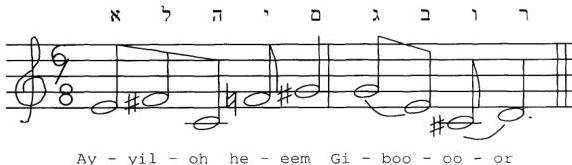
The Divine Name which is the pass-word of the Grade of Greater Adept is allied in root-meaning to the name of the Sephirah to which this Grade corresponds, that of Strength, G B V R H, because it is A L H I M G B V R, literally "The gods of power." The tonal values and pronunciation are:
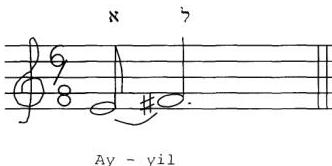
The Divine Name of the Grade of Exempt Adept is A L, "the strong one." Its tonality and pronunciation are:
The first of these names is the number 297, which has for its first reduction 18, the number of the key-word חי, Chai, life, which is the clue to the significance of all other terms corresponding to 18. Thus אלהים גבור, "the gods of power" are Qabalistically shown to be gods of the power of life, and their name, when they are considered as being especially active in Geburah, is מאדים, the plural of מאד, power, strength, might. They represent the force-aspect of life, which is indicated by the fact that Geburah is the sphere of Mars. Note that the final reduction, or least number of 297 is 9, number of the letter Teth, symbol of the serpent-force, FOHAT. Apply these keys to the words אעפיר, Ophir, the place where Solomon got gold; אוצר, a treasure-house, a place for storing gold and silver, treasure; ארמון, a citadel, a fortified house; כורסיא, the Throne, a name of Briah, the creative world; צואר, the neck. In the comparison of these words, and in the attempt to find the thread of meaning which connects them, you will sooner or later discover one secret of the work of transmutation -- a secret which cannot be communicated except by some such obscure terminology as this. Remember, it is a secret of life, ה' and its essence is to be sought in the path which corresponds to the letter Teth. That path you will traverse in the next lesson.
The Divine Name אל is especially important because the reversal of its letters is לא, which means NOT. The Exempt Adept lives this from day to day. 'I am doing nothing,' he declares. And his declaration is even subtler than it seems to be. For he does not for a moment stop action, since he is wise, and as it is written in the Bhagavad-Gita, 'Children only and not the wise speak of renunciation of action and of right performance of action as being different. He who perfectly practices the one receives the fruits of both, and the place which is gained by the renouncer of action is also attained by him who is devoted in action.' The Exempt Adept knows that all his actions are the expressions of that One Reality which is No-Thing, which is 'described as NOT this, NOT that, and so on, by negatives only.' For him 'doing nothing' is synonymous with free and unhampered expression of that power, and because for all men the natural symbol of such expression is the Path of Return, לא 'not' is the Qabalistic equivalent of הודך to go. For all going is but the turning of the Wheel of the self-manifestation of 'that which is NOT.' Furthermore, the Exempt Adept has come to the point where his whole life is a satisfactory answer to every problem, to every question that troubles the minds of those who are yet in the grip of the delusion of separateness. He knows how to act without attachment, how to keep himself perpetually adjusted to the rhythms of the cosmic self-expression. And this the Qabalists hint for us when they point to the numerical identity between AL, LA, HVK, and AIK, for איך means 'How?'
It all comes back to Lao-Tze's teaching, 'Having emptied yourself, remain where you are.' And then what happens? Let the same Master of the Wisdom tell us. In the chapter of the Tao-Teh-King entitled 'Locking Abroad' he says:
'A man may know the world without leaving his own home.
Through his windows he can see the supreme TAO.
The further afield he goes the less likely is he to find it.
Therefore the wise man knows without traveling, names things without seeing them, and accomplishes everything without action.'
In the next chapter, 'The Distress of Knowledge,' he makes clear the folly of the supposition that there is any need for getting knowledge. The reason, of course, is that getting is a quest for something not possessed, for something outside, whereas the way of wisdom is the expression of THAT which is eternally within. He says:
'Bodily and mental distress is increased every day in the effort to get knowledge.
But this distress is daily diminished by the getting of TAO.
Do you continually curtail your effort till there be nothing of it left?
By non-action there is nothing which cannot be effected.
A man might, without the least distress, undertake the government of the world.
But those who distress themselves about governing the world are not fit for it.'