Correlation of Sound and Color
In the order of the Life-Power's self-expression, sound precedes light. This is taught in many versions of the Ageless Wisdom. One statement is a Sanskrit phrase which Swami Vivekananda translates, 'Through sound the world stands.' In Tantrik classics we find mention of Shabda-brahma, the sound-divinity, said to be the root-potentiality of all manifestation. Vivekananda identifies Shabda-brahma with the Logos, concerning which St. John's Gospel says:
'In the beginning was the Logos; and the Logos was with God: and the Logos was God.'
St. John's doctrine echoes Greek philosophy. Plato said the same thing, and so did Pythagoras. These philosophers, each of whom received instruction from Egyptian hierophants, taught their pupils that the world is called forth from chaos by ordered, rhythmic sound. They held that the laws of musical proportion are manifest in everything. When St. John wrote that all things were made through the Logos, he simply repeated the Pythagorean and Platonic doctrine that every form is a thought expressed through sound.
He said also: 'That which hath been made was life in him; and the life was the light of men.' Theologians have almost succeeded in 'spiritualizing' the meaning out of these words. Read them as if you had never seen them before, as if they formulated a brand-new statement, encountered by you for the first time in this lesson. If you clear away preconceptions in this way you will see that the first clause says explicitly that life in the Logos was the original state of everything. This means, if it means anything, that planets and people, houses and hills, tables and trees are expressions of life. Physicists today tell us the same thing, only they call 'life' by another name 'electromagnetic energy'.
Read in the same way, the second clause of the Gospel statement becomes intelligible also. 'The life was the light of men.' The vital principle of the Originating Thought was, and is, the light that we know, the physical light that shines upon the earth from sun and stars. It is not merely the physical light, but it is a radiant vibration which includes the physical light among its manifestations. This is which the Western School of occultists often designates by the term L.V.X. (L.V.X. is Latin for 'light,' but notice that it is written in capitals, with a period after each letter. In a later lesson you will learn why.) Though manifested on many planes, and in an infinite variety of appearances, life and light are one. The root of this living light is the mode of vibration which we call sound.
The Book of Genesis tells the same story. 'And God said, Let there be light.' In Genesis the Life-Power is represented as a personal deity - is made, so to say, in the image of man. Yet the meaning is clear enough. 'God said,' that is, the Life-Power expressed an idea in sound, and the result was light. Even skeptical physicists have come to accept this old, old doctrine.
Their laboratory experiments have taught them that all material objects are forms of the expression of energy, that every expression of energy is a mode of vibration, and that sound is at the beginning of the vibratory scale.
Some time since, in an address before the British Association for the Advancement of Science, Sir William Crookes described a scale of vibrations, beginning with two per second. By repeatedly doubling the number of pulsations per second, his table gives a series of steps or octaves. With the 15th octave sound ends, for human ears, although birds and animals may be able to hear sounds beyond this limit.
After the 15th octave there are several whose vibrations have not been classified by scientists. The octaves from the 20th to the 35th are those of electricity. Crookes octaves 35 to 45 as unknown, but Dr. F. F. Strong has identified them with the nerve-currents of the human body. The 46th, 47th and 48th octaves are heat vibrations. They are followed by several octaves of light. Beyond light is another unknown series. Then come the X-rays, and these may be followed by any number of octaves as yet unclassified.
Crookes' vibratory scale makes clear the point which I seek to emphasize. It shows that when the Life-Power awakens Its mysterious self-activity at the beginning of a cycle of manifestation, sound vibrations come into existence before the more rapid pulsations of electricity and light.
Thus modern science confirms the ancient esoteric teaching that sound is the root of physical existence, a teaching which is of course implied by what you learned about Akasha, or the Quintessence, in Lesson 3 (page 24). For since Akasha is the subtle principle of hearing, it is that mode of vibration which excites the auditory nerves, that is to say, sound. Hence we may paraphrase Rama Prasad's teaching thus: 'It is Out of Sound that every form comes, and it is in Sound that every form lives.'
What is known as the standard pitch of the sound named 'Middle C' in the musical scale is 256 vibrations per second. This is a little slower, or flatter, than the musical pitch now in general use, but the slight variation does not interfere with practical applications of the laws of sound and color. Since 256 is the eighth power of 2, it follows that even 2 beats per second make what we might call an indistinguishable C (two beats, indeed, can be distinguished from three per second as differing in pitch), and this 'tone' will be seven octaves below Middle C.
Any tone is raised an octave by doubling the number of its vibrations per second. Continued far enough, this process of doubling will take us from sound into the unknown then into the plane of electricity, then into the unknown again, and after that into the planes of heat and light.
The 'unknown' vibrations are by no means non-existent. There is vibratory motion in these unclassified octaves as surely as in the planes which are charted. Whatever phenomena they cause, the hidden forces of these octaves between sound and electricity and between electricity and light must, in some respects, be like the forces that we know.
On all planes the law of sympathetic vibration must be operative. This law of sympathy may be illustrated at the piano. Press down a key gently, so as not to sound the note. This will leave the piano-wire free to vibrate. Still holding the key down, strike another note of the same name. (That is, if you are holding C, strike another C.) You will hear the same sound from the wire you have left free, and it will continue for a while, if you continue to hold down the key. It is an unstruck sound, an induced vibration set up by the pulsations of the note that you struck.
The celebrated basse, Lablache, used to apply the same principle for an after-dinner trick. He would pick up a thin wine-glass, determine its pitch by a finger-tap, and then sing one mighty tone of the same pitch directly into the glass. The sound would shiver the tumbler into fragments - a result which amused the guests, but must often have annoyed the hostess, since only thin and expensive glasses are fragile enough for this trick.
We make use of this principle of sympathetic vibration whenever we undertake any specific work in practical occultism. It is a key to control of the Great Magic Agent. Time was when this key was used to unlock secrets of nature which were applied in building operations which are to this day the marvel and despair of engineers. The same principle enables us to tune ourselves to specific rates of cosmic vibration. To use it successfully we need to understand the correlation between sound vibrations and those which affect vision as color.
Before entering upon this part of the lesson, let me emphasize two points:
- The sounds and colors to be correlated are physical. They are heard with physical ears and are seen with physical eyes.
- The relation between them is not symbolic, but actual, and it is not based upon clairvoyance, or any other kind of psychic impression. It is a physical fact.
The simple fact is this: The wavelength of Middle C (at 256 vibrations per second) is 1.344 millimeters. Raised to its 29th power, this is the wavelength of the color-vibration red.
So far as I know, the modern statement of this fact, which was known to the ancients, is due to the work of Edward Maryon, whose conclusions have been tested and approved by such eminent European physicists and mathematicians as Prof Zahn of the Vatican, Prof. Listing of London University, Sir William Crookes, and Antoine Henri Becquerel, discoverer of radioactivity. Mr. Maryon has aroused considerable controversy by his application of this fact to music, but we are not concerned with these matters.
We do not owe their knowledge of the color scale to Mr. Maryon, but they acknowledge the fact that his work confirms what they have received from other sources; and they feel, too, that his discovery (or re-discovery) having been made public makes it possible to give out certain details concerning sound and color which have not been generally known hitherto. It must be said also that the colors utilized in our work are pigments, not direct light-vibrations. This is important to remember, because the mixing of pigments results differently from what happens when colored lights are blended. I speak of this in advance, because of what will be said presently concerning the three primary pigments: Red, Yellow and Blue.
I am careful to indicate the exact nature of this work because the subject of sound and color, as treated in various occult books, has occasioned mental distress to many students.
There is a very Babel of conflicting statements. If you have time and patience to unravel the skein of Madame Blavatsky's teaching you will find that she knew the truth; but for reasons which seemed adequate to her and to Those who helped her write The Secret Doctrine, what is given in that work is full of blinds. So far as I am able to judge there is nowhere any false statement, but the teaching is phrased so adroitly that a reader who merely skims the pages will surely be led astray. This, of course, is a fate richly deserved by superficial students, but when careless readers take to writing occult books of their own, the result is more and more confusion.
This lesson does not pretend to exhaust the subject. It does, however, give you facts established by experimentation, and facts which lead to very striking practical results. For there is a traditional occult attribution of color to the planets and the signs of the zodiac, as well as to the four elements. By means of this we are enabled to determine what color belongs to each letter of the Hebrew alphabet, which we shall study presently, because every letter corresponds either to an element, a planet, or a zodiacal sign. Thus it becomes possible to transform certain Hebrew words or power into tonal sequences, and into color sequences.
The fact that changes have occurred in musical notation, so that what we call "Do" in music is not the same sound that was given that name some centuries since, makes no difference whatever. The traditional colors of the letters give us the clue to their actual sounds, in spite of all such changes in scales, musical nomenclature, etc. This is important to remember.
The color correspondences of the musical scale are as follows:
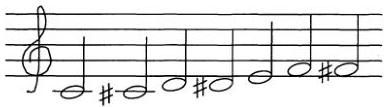
RED (C) RED-ORANGE (C-sharp or D-flat) ORANGE (D) ORANGE-YELLOW (D-sharp or E-flat) YELLOW (E) YELLOW-GREEN (E-sharp or F) GREEN (F-sharp or G-flat)
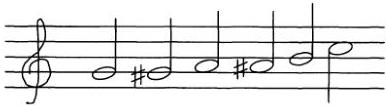
GREEN-BLUE (G) BLUE (G-sharp or A-flat) BLUE-VIOLET (A) VIOLET (A-sharp or B-flat) VIOLET-RED (B) etc...
If you do not read notes, ask some musical friend to explain this scale to you. It is important to remember that any C is red, any E yellow, any C-sharp (or A-flat) blue. A male voice is pitched lower than a woman's, as we all know, but I have had people say to me, "I can't sing that note," because they were trying to sound a tone out of their range. The octave below will produce just the same result.
Now, unless you happen to be color-blind, it will be first of all necessary for you to fix in mind the colors of the foregoing scale, and the best way to do this is to make a color chart like the one given at the end of this lesson. But instead of writing the colors in the twelve spaces of the chart, paint them.
After much experiment, we have found that the most satisfactory pigments for this work are the Show-card Colors made by the Devoe & Reynolds Co., Inc., 34 East 42nd St., New York City They come in glass jars, with a screw top, and are all ready to use. The initial outlay may seem to be rather great but you will find other uses for these paints than the making of the color chart.
The colors required are:
White Black
Light Red Emerald Green
Red Orange Blue (Medium Blue)
Orange Mauve
Yellow Magenta
Use white, hard surfaced drawing paper. It need not be expensive. Avoid soft paper, yellowish paper, paper with a glossy surface, or very thin paper. A small pointed brush for lines, a larger one for filling spaces with color, and one or two white blotters will complete your equipment.
When you paint the scale, be sure to have plenty of clean water, and a cloth to wipe the brushes. Mix the colors on a small white dish, and begin at the red end of the scale. Experiment will show that this saves time and waste. Have a piece of paper to test your colors, because they look different when they are dry.
To make the scale, take a horoscope blank, or draw a circle on a piece of paper and divide it into twelve equal parts. Then follow the directions given in the diagram. A little preliminary study will show you the reason for beginning with red.
Lay on the colors with a rather wet brush, and let each coat dry before applying another. Several washes may be required for some segments. Some people have difficulty with the first three segments of the chart. This may be overcome by painting the red space first, then the yellow, and then filling in the intervening spaces. The colors should then be graduated so that they progress evenly.
By following these directions carefully, you will learn the composition of the colors, and will find it easier to remember what each color represents. Few forget this color scheme, once they have made a scale. Bring your chart to class when it is finished, or mail it to me for correction.
The symbolic use of color has come down to us in three principal schemes, the threefold, the sevenfold, and the twelvefold. In the threefold scheme the colors are the primary pigments. The sevenfold scheme includes the primaries, the secondaries (orange, green and violet), and a dark hue, almost black, made by mixing the three primaries, with blue predominating. The twelvefold scheme adds to the primaries and secondaries six combinations of primary with secondary colors.
Some of the correspondences in the threefold scheme are:
RED: Fire and heat; alchemical sulphur; the Rajas guna; the conscious plane of mentation.
YELLOW: Air and light; alchemical mercury; the Sattva guna; the superconscious plane of mentation.
BLUE: Water and cold; alchemical salt; the Tamas guna; the subconscious plane of mentation.
These attributions are by no means merely analogical. Red vibration is favorable to the special functions of self-consciousness which are mental expressions of the Rajas guna. The yellow ray induces states of mind and body conducive to superconscious activity and Sattvic experience. Blue vibration makes easier the use of subconscious powers. This may be verified by experiment.
I have already told you that the alchemical metals correspond to the 'chakras' of the Yogis, and that in each of these nerve centers we find predominating the influence of one mode of planetary vibration. In the sevenfold color scheme they are indicated as follows:
RED: Mars; alchemical iron; Svadhisthana ('The abode of Self') chakra, second lotus of the Yogis, a nerve center between the base of the spine and the navel.
ORANGE: Sun; alchemical gold; Anahata ('unstruck sound') chakra, or cardiac plexus.
YELLOW: Mercury; alchemical quicksilver; Sahasrara chakra, the pineal gland or conarium.
GREEN: Venus: alchemical copper: the Visuddhi chakra, a nerve center in the throat, the pharyngeal plexus.
BLUE: Moon: alchemical silver: the Ajna chakra, a center in the brain, behind the nose; the hypophysis, or pituitary gland.
VIOLET: Jupiter: alchemical tin; Manipura ("filled with jewels") chakra: the abdominal brain, or solar plexus.
INDIGO: Traditional color of Saturn. The indigo of the spectrum is really blue-violet, combining the colors of Mars and the Moon, but with more of the cold, watery lunar blue than the Martial red. This agrees with the way that Saturn restricts the activity of Mars, without altogether quenching it.
Some clairvoyants, however, report Saturn as green, and many symbolize it as black. Like discrepancies occur in descriptions of Akasha, to which the Saturn ray has close affinities. The truth is that Saturn's color is a mixture of the three primary pigments, with blue predominant. It looks black, but on closer inspection the blue can be detected, and then the red is seen, smothered, as it were, by the blue. In certain cross-lights a certain greenish-yellow sheen also appears.
In different proportions, the three primaries mix to make citrine (orange and green), russet (orange and violet), or slate (green and violet). These also symbolize certain aspects of Saturn's influence.
The important point to remember is that the Saturnine "indigo," which looks black to some people, and green or blue-violet to others, is really a combination of the three primaries.
The corresponding alchemical metal is lead; the chakra, the Muladhara, the basic lows of the Yogis, identified with the sacral plexus.
Here the fiery power of Kundalini, the serpent-force, is said to be coiled or latent, and that latency is an example of the limiting influence of Saturn. That influence is at work in the physical functions governed by the sacral plexus. For us these are functions of excretion including the excretory functions which play a part in the transmission of life from one generation to another.
As shown in the diagram, the twelvefold scheme assigns a color to each sign of the zodiac. Independent investigation of the therapeutic effects of color shows that the colors of the signs overcome the diseases which astrologers mention as resulting from "afflictions" to those signs from malefic planets or aspects. Some of these therapeutic uses of color will be in the following paragraphs:
RED: Aries, the Ram. The color is that of Mars, ruler of the sign. Red stimulates and energizes, warms the blood, and overcomes muscular fatigue. Rooms decorated in soft red tones are better for brain-workers than rooms furnished in cold, bluish colors. Red vibration stimulates a brain sluggish from poor circulation.
RED-ORANGE: Taurus, the Bull. In red-orange, the red is the complement of the green of Venus, ruler of Taurus. The orange complements the Moon's blue, and in Taurus the Moon is exalted. Red-orange is a gentler stimulant than red, useful in throat affections, such as tonsillitis, croup, diphtheria and goitre. By arousing the complementary vibrations of green and blue, mixed in green-blue, this color also relieves constipation, irregular menstruation, diseases involving congestion of the genito-urinary organs.
ORANGE: Gemini, the Twins. Orange stimulates the nerves, is useful in pulmonary diseases, pneumonia, pleurisy, bronchitis and asthma, and gives quick recuperation from fatigue induced by mental work. It is also beneficial for rheumatism and neuralgia. Note that the color of the sign Gemini is the Sun's hue, although Gemini is ruled by Mercury. When you come to study the Tree of Life, you will find that the sphere of Mercury on the Tree is orange also. There is a secret of practical occultism to which this seeming contradiction affords a clue, but this is not the place to explain it.
ORANGE-YELLOW: Cancer, the Crab. The orange is the complement of blue, color of the Moon, ruler of the sign. The yellow is the complement of violet, which is the color of the Jupiter vibration, and Jupiter is the planet exalted in Cancer. Orange-yellow relieves indigestion, gas on the stomach, hiccoughs and diopsy. Its cheering influence helps to overcome "blues," hypochondria and hysteria.
YELLOW: Leo, the Lion. Leo is ruled by the Sun, whose color is orange. Here is a seeming contradiction like that between the color of Gemini and its ruler, Mercury. On the Tree of Life, too, the sphere of the Sun is yellow. The thing suggested is an interchange between the Mercurial and Solar potencies, and this reminds us that Mercury is the "metal" with which alchemists work to produce the "Stone" which changes Saturn (lead) into gold (Sol, the sun). You will find out more about this as you proceed with your studies.
Yellow, midway in the scale between the warm red and the cold blue, has an equilibrating influence. It relieves congestion, overcomes extremes of temperature, quiets pain in the heart, palpitation, and helps to soothe the sharp pain of angina pectoris. This color also helps to establish emotional balance. Thus it is not impossible that Buddhists wear yellow robes (whatever the traditional reason) because the color helps them in their endeavor to follow the "Middle Way," the way of equilibrium between the "pairs of opposites." Yellow is also the color of Hermes (Mercury), and equilibrium is the basis of the alchemical process, or Hermetic Work.
YELLOW-GREEN: Virgo, the Virgin. Virgo's ruler is Mercury, whose color predominates in yellow-green. This vibration overcomes diseases of the abdominal region, including affections of the large and small intestines, the liver, the pancreas and the spleen. It is beneficial for jaundice, liver intoxication, peritonitis, malnutrition, typhoid fever and influenza.
GREEN: Libra, the Balance. This sign's color is that of Venus, its ruler. The green ray affects the kidneys, vaso-motor system, lumbar region of the spine, and skin. It corrects inflammation in these parts, and is indicated for lumbago, and for skin diseases like eczema.
It has also a beneficial effect upon brain-workers, and this is one of the reasons why it is the predominant note in the color scheme at our office.
GREEN-BLUE: Scorpio, the Scorpion. The predominance of green in the color of this sign is complementary to the color of the ruler of the sign, Mars. Green-blue corrects bladder inflammation and diseases of the external genito-urinary organs. It is also beneficial for nasal catarrh, adenoids and polypi.
BLUE: Sagittarius, the Archer. The Moon, which is also blue, is related to this sign through the Moon's connection with Artemis, or Diana the huntress. There is a close correspondence between the Moon and Jupiter, the ruler of Sagittarius, because Jupiter is exalted in Cancer, the Moon's own sign, and also because the subconscious influence corresponding to the Moon is, as you have learned, strong in the Jupiter vibration. In the Qabalistic Tree of Life you will find that the sphere of Jupiter is also blue, the Moon's color, while the sphere of the Moon is violet, Jupiter's color. This interchange of colors is like that between the spheres of the Sun and Mercury.
Blue cools the blood, soothes the nerves, is antiseptic and sedative. It relieves locomotor ataxia, rheumatism and hip disease, and cures headache, toothache, neuralgia and insomnia.
BLUE-VIOLET: Capricorn, the Goat. The sign's color is that of its ruler, Saturn, as seen by most clairvoyants; but the blue-violet of Capricorn is the true indigo, with no mixture of yellow. It is cooling and antiseptic. Relieves indigestion, skin eruptions, and pain in the knees. Aids in the healing of wounds.
VIOLET: Aquarius, the Water-Bearer, Violet is indicated for irregular heart-action, varicose veins, and dropsical swellings of the lower leg or ankles. It reduces spinal inflammation, and corrects kidney disturbances.
In making the color scale, you may find that the MAUVE, which is used for violet, is a little dark. It can be made lighter by adding a little white.
VIOLET-RED: Pisces, the Fishes. This color overcomes cold in the feet, and helps to counteract the desire for drink or drugs. Diseases helped by yellow-green also yield to the violet-red ray.
In painting the color scale, MAGENTA is used for violet-red.
At this point in your studies be careful not to rush into experiments with color healing. Digest the information before you try to apply it. As used by us, the application of these color vibrations to the treatment of disease is wholly along mental lines, and before you can hope to do this sort of work you will need preliminary practice in mind-control and willed imagination.
After painting your color scale, you may begin to practice the correlation of color and sound in consciousness. Begin with the color red, and when you have filled your whole mind with the red vibration, hum a tone. At first you may be considerably 'off pitch,' so that the note you hum is by no means that which corresponds to the color. Daily practice with a single color, however, should gradually establish the correlation, so that the visual image of red will automatically call up the tone C, and so on.
To test your progress, use a chromatic pitch-pipe, or the piano. (If you use the piano, be sure that it is in tune, with A at between 430 and 440. Your piano-tuner will understand what this means, if you don't.) ALWAYS VISUALIZE THE COLOR BEFORE SOUNDING THE NOTE, and then test the result with the pitch-pipe or the piano. Because of the difference between laboratory pitch and musical pitch, it is probable that your impulse will be to hum the tone just a shade 'flat.'
In the beginning you will have to look at the color in order to set up the visual vibration. After awhile you can call up the color with your eyes closed. Use one color only during each practice period. And it is better to stick to a single color until you have succeeded in getting the right tone from it every time.
Practice at least five minutes daily, never more than fifteen. If the use of a color produces any unpleasant physical effect, correct this at once by using the complementary. The complements are those which are in opposite segments of the color chart.
Long before you have accomplished perfect automatic correlation, you may make use of color to help yourself. If you cannot get the right tone without the pitch-pipe or the piano, never mind. But always try to get it. Never sound the note before you have imagined the color and attempted to hum the tone. Use the pitch-pipe only to correct your errors.
Employ only the three primaries for the present. If you feel tired or depressed, imagine a glowing, flame-red triangle (the symbol of the Tejas Tattva), and hum the note C.
To overcome anger, excitement, or other excesses of the Rajas quality, to induce sleep, or to intensify the activity of the subconscious, imagine a blue salt-symbol, or a blue crescent Moon, and hum G-sharp. To establish mental or physical balance, and as a preliminary to study or meditation, imagine a yellow Mercury symbol, and hum the note E.
Do not fall into the error of thinking that this is 'all imagination.' When you use these correlations of color and sound you set in motion powerful cosmic activities. By the operation of the law of sympathy you set up vibrations in many octaves of unseen forces. Therefore do not trifle. I am not giving you something with which to amuse yourself in an idle hour. It may seem a matter of small importance to imagine a color and hum a sound. Don't be deceived. These simple practices have far-reaching consequences. They are your first steps in learning to master the Astral Light. Remember that Eliphas Levi says the man who is perfect in this mastery becomes the depositary of the power of God, and take care to recognize the responsibility this entails.
Learn the various details of this lesson thoroughly. This will save you time and trouble later on. It is by no means sufficient to have the lesson to refer to. You must have it in your brain cells. This work gives you the seeds of the Ageless Wisdom. You must plant them and do the gardening yourself. Learn the details of each lesson as you go along, and practice whatever exercises may be given. By the time the course is ended you will have begun to think in the symbolic language used by the Masters of the Wisdom. And when you can think in Their language you can receive the thought-vibrations which they are continually broadcasting to all the world.